It is pointed out that telecommunications carriers can obtain fairly accurate location information about where users were and when.
Smartphones have location-finding mechanisms that are available to carriers, and in the worst case scenario, could be exploited by foreign carriers, argues computer science expert Andy Wong.
Mobile carriers can get your GPS location
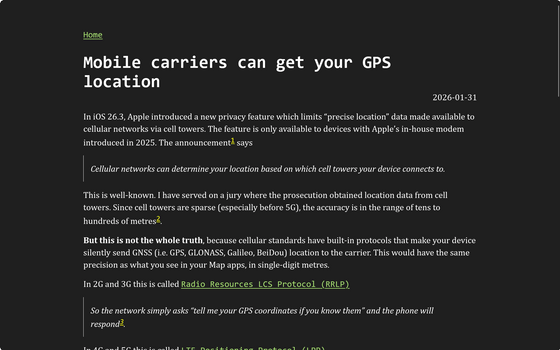
Smartphones can measure location information using carrier networks. Wong added, 'Devices have built-in protocols that allow them to automatically send location information obtained from GPS and other sources to carriers. For 2G and 3G, this is called the Radio Resource Location Protocol (
While smartphones aren't designed to transmit precise location data outside of the device, Wong points out that this information can be collected by law enforcement agencies under court orders or used by governments for contact tracing. 'The ability to extract precise location data raises questions about the security of the information,' he said.
Apple introduced a new security feature in iOS 26.3 to protect this information, restricting the 'precise location' data provided to cellular networks via cell towers. Wong explained, 'By enabling full control over modem silicon and firmware, we've taken a good step toward limiting at least one method of mass surveillance. Going forward, we'll require users to disable location reporting to carriers and notify them when such an attempt is made against their device.'
Related Posts:



in Smartphone, Security, Posted by log1p_kr