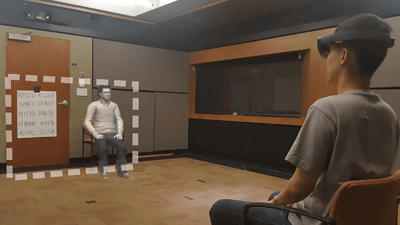
OriRing, a wearable device inspired by origami, is being developed that can return tactile sensations from the virtual world to your fingertips.
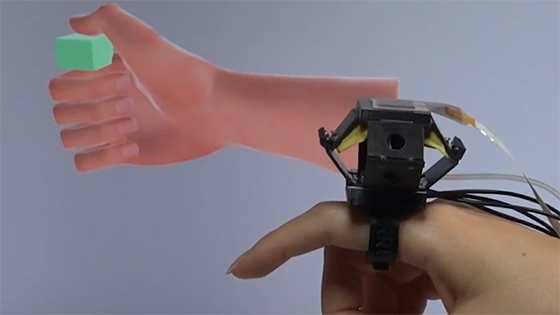
Virtual reality (VR) and augmented reality (AR) not only enhance the sense of immersion in games and videos, but are also being used in training and work support. However, the focus of VR and AR experiences tends to be on sight and hearing. Meanwhile, a joint research team from multiple universities announced in the scientific journal Nature Electronics that they have developed a wearable device that can deliver tactile sensations to the fingertips of a virtual world.
An 18-g haptic feedback ring with a three-axis force-sensing skin | Nature Electronics
Origami-inspired ring lets users 'feel' virtual worlds
https://techxplore.com/news/2026-01-origami-users-virtual-worlds.html
A joint research team from Sungkyunkwan University, the Swiss Federal Institute of Technology in Lausanne (EPFL), and Istanbul Technical University has developed 'OriRing,' a wearable ring-shaped device that allows users to experience tactile sensations in real life that are in line with their virtual world experiences. 'OriRing' can detect not only the direction of pressure (up and down) but also the force exerted when sliding the fingertip (left and right), and can return a counterforce to the finger according to the direction.
The research team points out in their paper that 'the development of wearable tactile devices with kinesthetic feedback is still limited because the size and weight of the devices limit portability and comfort.' However, the OriRing is designed to be lightweight, weighing just 18 grams.
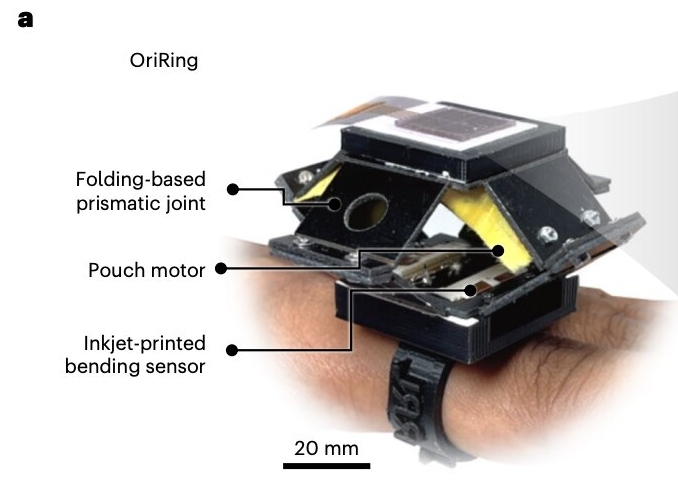
The base of the 'OriRing' has a folding structure inspired by origami, and the research team says that this folding structure makes it compact yet efficient at transmitting force.
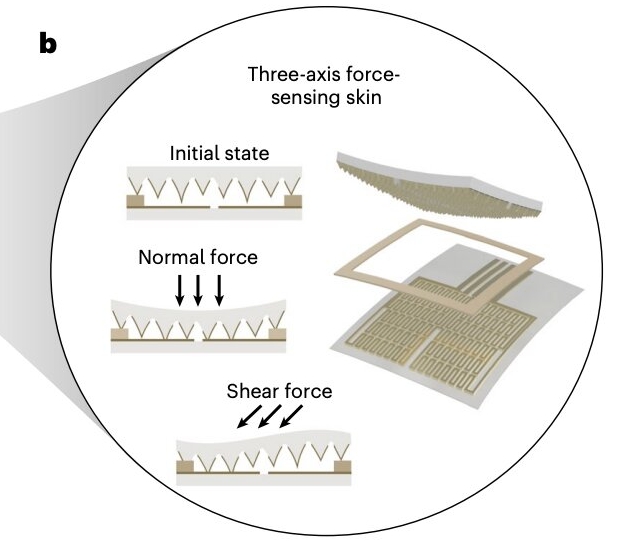
The part of the OriRing that touches the fingertip is designed as 'force-sensing skin' that can simultaneously detect pressure, rubbing, and sliding forces. According to the research team, the force-sensing skin is composed of a layer with laser-processed pyramidal micro-irregularities and a layer with four small measurement zones whose resistance changes when pressed. This ensures linear sensitivity and fast response, the research team says.
The OriRing ring contains four sensors whose electrical resistance changes when pressed or bent, and also includes a flexible actuator that expands with air pressure to provide a force response to the fingertip. The research team explains that the ring also uses an inkjet-printed sensor to measure the degree of finger bending.
The research team reports that initial testing of the OriRing confirmed that it could apply force not only up and down but also left and right. It also reportedly provided haptic feedback of up to 6.5 Newtons. The research team believes that this could potentially provide haptic feedback that is in line with the object being touched in VR and AR environments.
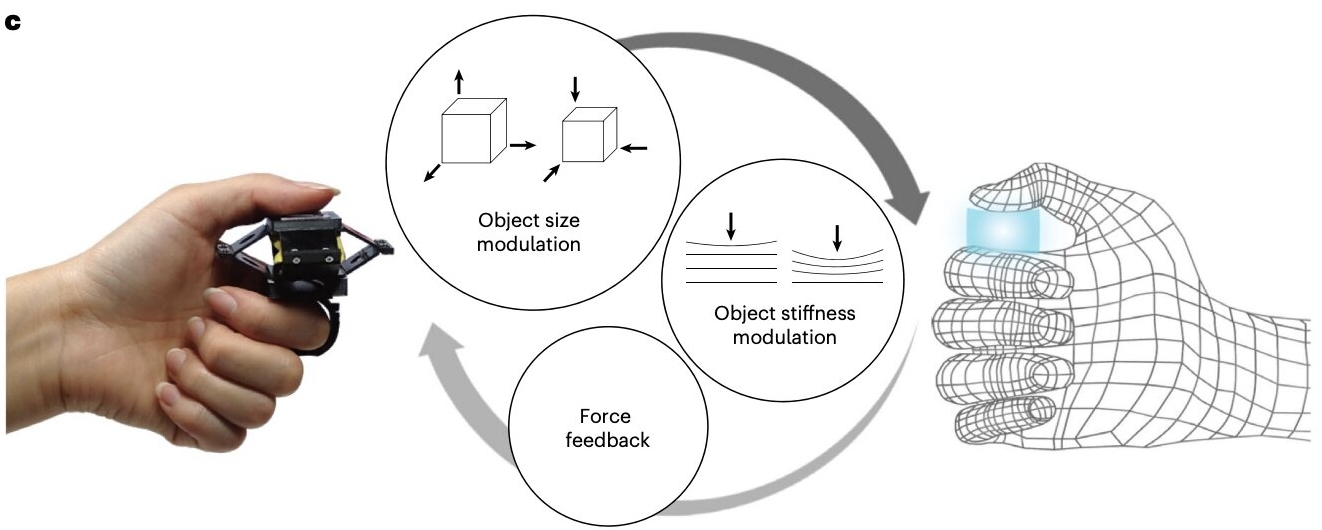
The research team also envisions future applications beyond enhancing gaming experiences, including in specialized training and medical rehabilitation, where tactile operation and learning are important. As the number of small, easy-to-wear tactile wearable devices increases, it is expected that the experience of virtual space will expand beyond just seeing and hearing to also include touching and verifying.
Related Posts: