Nearly one-third of social media studies do not disclose industry ties

There have been several studies investigating the impact of social media on society, such as
[2601.11507] Industry Influence in High-Profile Social Media Research
https://arxiv.org/abs/2601.11507
Nearly a third of social media research has undisclosed ties to industry, preprint claims | Science | AAAS
https://www.science.org/content/article/nearly-third-social-media-research-has-undisclosed-ties-industry-preprint-claims
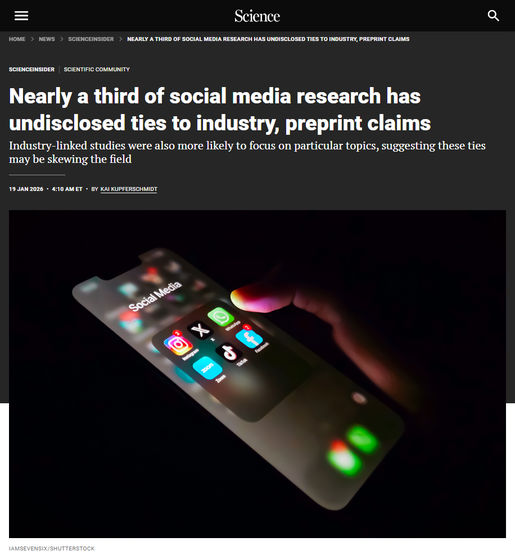
A recent paper published on the preprint server arXiv reveals that roughly one-third of social media studies published in leading academic journals have authors with industry ties that should be disclosed but are not. The paper's lead author is Joseph Buck-Coleman, a postdoctoral researcher at the University of Washington.
The authors of the studies with industry ties include researchers who received funding and co-authored with industry insiders. These connections could skew the findings, Buck-Coleman and his team noted. Industry-linked studies tend to focus on topics like why individuals share misinformation, rather than the role of platforms and their algorithms.
Sander van der Linden, a psychologist at the University of Cambridge who was not involved in Buck-Coleman's study, said the revelations about widespread undisclosed relationships were 'really shocking and totally unacceptable, but perhaps not necessarily malicious.'
Linden pointed out that social sciences have less established conflict of interest norms than other fields, such as medicine, and said, 'Scientists involved in social media research may need to be better educated about the importance of transparency and conflict of interest.'
'This paper is important because it may spark a broader discussion about this issue,' said Naomi Oreskes, a historian of science at Harvard University. 'The potential for conflicts of interest is huge because big tech companies invest heavily in social media research.'
To determine how many papers had undisclosed industry ties, Buck-Coleman and his team scrutinized social media-related research papers published since 2010 in academic journals like
The study included 295 papers with a total of 50,000 citations and over 15,000 news articles, and 20% of these papers had authors who explicitly stated industry ties, such as having received funding from or worked with social media companies, at some point in the paper.
The researchers then examined information from OpenAlex, an open-access catalog of scientific papers, and industry publications to identify connections between authors and social media companies during the period when journals were required to disclose such information. They found that roughly half of the papers had some kind of connection to social media companies, and that in 30% of all studies, authors had not declared potential conflicts of interest.
The researchers also investigated whether the authors of a subset of papers whose editors and reviewers were known also had conflicts of interest. When those with conflicts of interest were included in the analysis, the proportion of papers with some industry ties rose to 66%. By extrapolating, they estimated that if reviewers were anonymous, the chances of a paper remaining completely independent of industry throughout the publication process would fall to just one in five.

Buck-Coleman and her team said they weren't trying to blame any particular researchers for highlighting a systemic problem. 'In individual cases, if you say, 'Here's why I didn't disclose,' it doesn't sound all that unreasonable,' said study co-author Kaelin O'Connor, a philosopher of science at the University of California, Irvine. 'But when you take it all together, something unreasonable is happening.'
Buck-Coleman argues that academic journals should audit all social media studies they publish and correct the scientific record if they determine that undisclosed conflicts of interest violate standards.
However, Linden notes that the criteria for determining industry ties are very strict. For example, 'even co-authoring a paper with a Meta employee would be considered a potential conflict of interest.'
A Science spokesperson explained, 'We do not require researchers to disclose such collaborations in new papers.'
The research team also questioned whether papers linked to social media companies might focus on specific topics. For example, the food and tobacco industries have long been accused of funding research that distracts from the potential harms of their products, and 'Coca-Cola has been funding research on exercise and obesity for many years,' O'Connor noted. 'This is real research, and it often has important or interesting findings,' she said.
Additionally, while research on how people share misinformation is common in social media industry research, research on platform dynamics (e.g., how algorithms affect polarization) is rare. 'While we cannot definitively prove that industry funding in this area shifts consumer attention away from products, our findings suggest the possibility,' the researchers wrote.
'The problem is that certain types of experiments can only be done in collaboration with social media companies because they control the data,' Linden said.
'While some purists believe all academic research on social media should be completely separate from industry, these connections can be beneficial for knowledge creation,' said Shelby Grossman, a political scientist at Arizona State University.
Related Posts:







in Science, Posted by logu_ii