A star 730 light years away that cannot be explained by existing physics has been observed
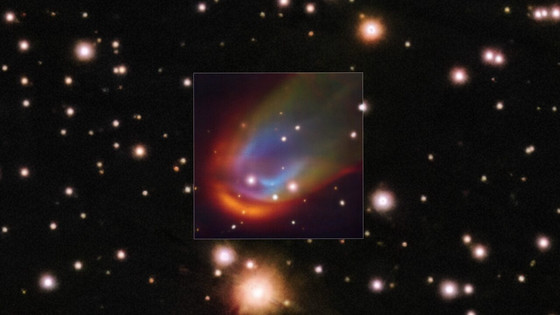
by ESO/K. Iłkiewicz and S. Scaringi et al.
The European Southern Observatory (ESO) has reported the detection of a mysterious shock wave around
Astronomers surprised by mysterious shock wave around dead star | ESO
https://www.eso.org/public/news/eso2601/
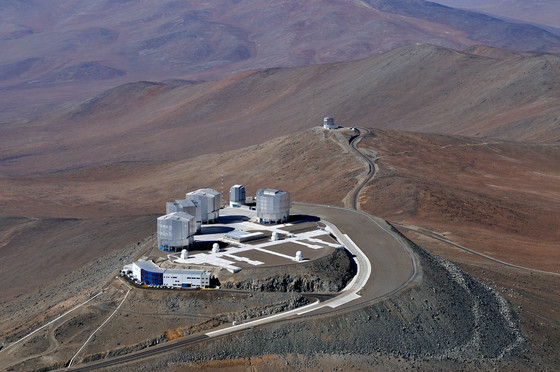
The observations reported this time were made with the Multi Unit Spectroscopic Explorer (MUSE), an extremely powerful visible-light spectrometer on board the Very Large Telescope (VLT) in the Atacama Desert in northern Chile.
by JL Dauvergne & G. Hüdepohl (atacamaphoto.com)/ESO
RXJ0528+2838 is a binary star system consisting of
As stars move through the galaxy, they can interact with the gas in interstellar space, creating a shock wave structure known as a 'bow shock.' The bow shock, typically seen in this type of binary star system, is thought to be created when gas blowing out from the central star's disk pushes the interstellar gas aside.
However, the results of this study revealed that the magnetic field of the white dwarf in RXJ0528+2838 is extremely strong, at 42-45 megagauss (MG), and that this strong magnetic field is insufficient to form an accretion disk, making it impossible to explain the mechanism by which a huge bow shock forms using existing astrophysics.
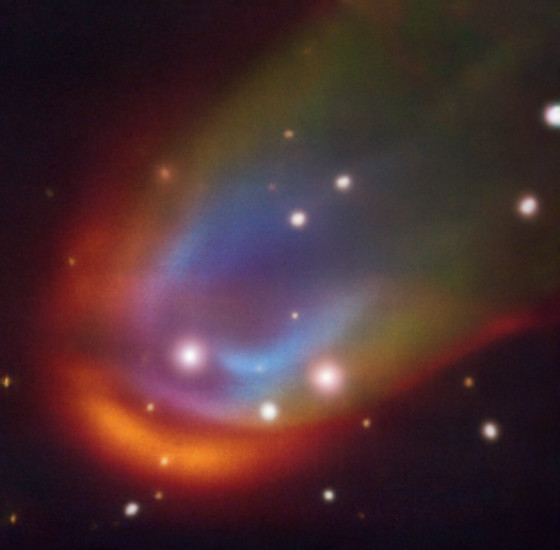
by SO/K. Iłkiewicz and S. Scaringi et al.
Furthermore, it was found that the energy required to maintain the bow shock was approximately 3.4 times the total energy that could be produced by the infall of all the material in RXJ0528+2838. Furthermore, it is estimated that energy has been continuously injected into the bow shock of RXJ0528+2838 for at least 1,000 years, which cannot be explained by a transient nova explosion. In other words, it is unclear how enough energy is generated to maintain the observed bow shock for more than 1,000 years.
The research team, because it cannot be explained by existing physics, suggests that there may be a powerful and overlooked energy loss mechanism related to the magnetic activity of the white dwarf as the power source of this mystery, and states that it may be a mechanism linked to magnetic activity, but that this remains merely a hypothesis. The research team argued that if similar disks can be systematically studied in the future and the conditions under which long-lived outflows are generated can be elucidated, a new energy escape route may be discovered that could affect the evolution of binary stars themselves.
Related Posts:



in Science, Posted by log1i_yk