It turns out that the 'mammoth bones' stored in a museum for 70 years were actually bones of a completely different animal
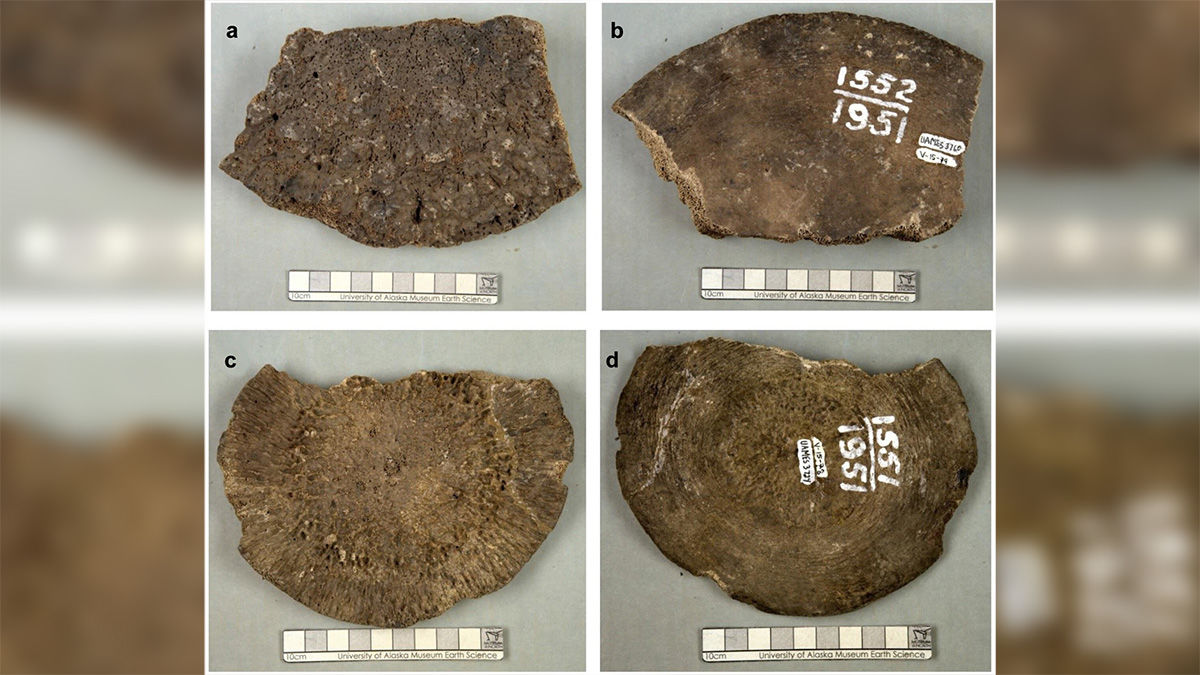
Adopted “mammoths” from Alaska turn out to be a whale's tale - Wooller - Journal of Quaternary Science - Wiley Online Library
https://onlinelibrary.wiley.com/doi/10.1002/jqs.70040
'Mammoth' Bones Kept in a Museum For 70 Years Turn Out to Be An Entirely Different Animal : ScienceAlert
https://www.sciencealert.com/mammoth-bones-kept-in-a-museum-for-70-years-turn-out-to-be-an-entirely-different-animal
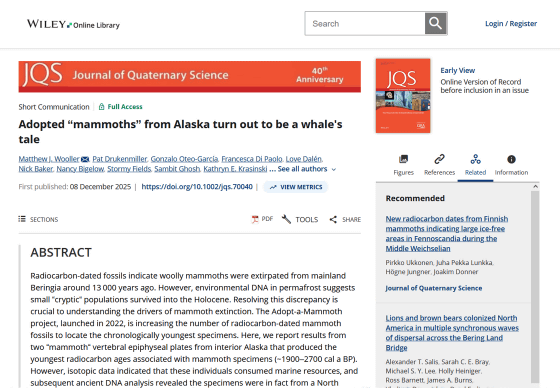
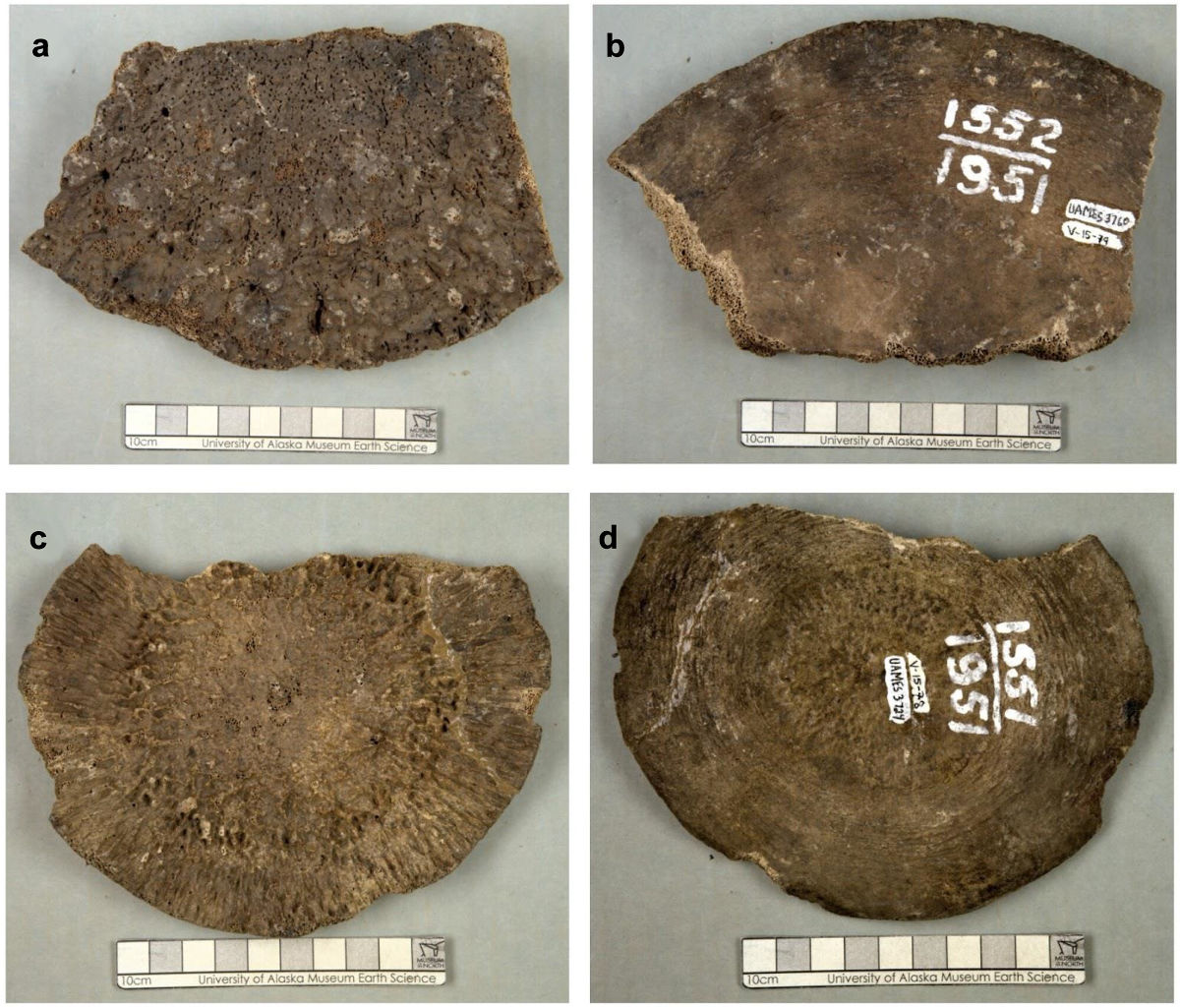
In 1951, German archaeologist and explorer Otto Geist discovered two mammalian vertebrae while mining for gold near Fairbanks , in the interior of Alaska, USA.
Based on the bones' appearance and location, they were presumed to be mammoth bones. Geist's conclusion that the bones belonged to a mammoth was also supported by the large number of large mammal bones excavated in the area from the Late Pleistocene, which dates back to 11,700 years ago. The size of the spine also supported Geist's conclusion that the bones belonged to a mammoth.
The bones below are the actual mammal bones discovered by Geist. These bones were brought to the University of Alaska Museum of the North and stored as 'mammoth bones' for over 70 years.
The Adopt-a-Mammoth Project, which systematically conducts
In many areas, mammoths are believed to have become extinct between 14,000 and 10,000 years ago, and even on Wrangel Island in the Arctic Ocean, where mammoths are believed to have survived until the end, they are thought to have become extinct around 4,000 years ago. Therefore, if the discovery that mammoths lived in Alaska between 1,900 and 2,700 years ago is true, it would be a major discovery that would rewrite history.
However, a research team at the University of Alaska conducted further investigations, questioning whether the bones were actually those of a mammoth. The team analyzed radiocarbon data and associated stable isotope data to infer the diet of the bone's owner.
The researchers found that the two bones contained amounts of nitrogen-15 and carbon-13 far exceeding those typically found in herbivorous land animals like mammoths.
These isotopes are sometimes found in land animals, but are more abundant in the ocean, so they tend to accumulate in large amounts in marine animals. Since mammoths living in the Alaskan interior are unlikely to accumulate large amounts of these isotopes, the bones discovered by Geist, along with their size, are more likely to be from a whale.
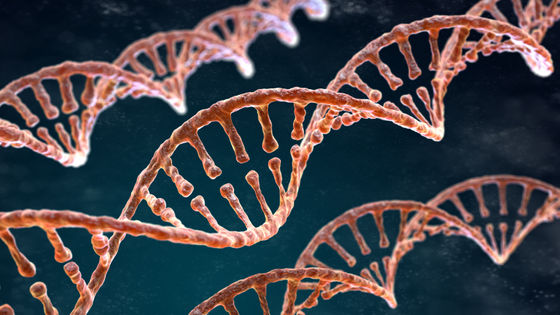
The team consulted with experts on mammoths and whales, but decided that it would be difficult to distinguish between mammoths and whales based on morphology alone, given the specimen's condition. They decided to extract and analyze the DNA. While the DNA contained in the cell nuclei could not be extracted due to severe degradation, they were able to extract mitochondrial DNA, which they then used to compare with whale mitochondrial DNA.

Analysis revealed that the mitochondrial DNA extracted from the two bones came from right whales and minke whales .
This raises a new question: Why was a whale bone from over 1,000 years ago discovered inland in Alaska, 400 km from the nearest coastline? The research team offers four possible explanations for this question:
First, whales may have migrated inland through ancient estuaries and rivers, but this is unlikely due to the small size of the waters in Alaska's interior and the scarcity of food.
2. Animals such as bears transported whale carcasses. While bears do eat whale carcasses, there are few examples of them transporting carcasses long distances.
3. Ancient peoples transported whale carcasses and bones inland for trade or other purposes. While there is no archaeological evidence of whale bones being used in inland Alaska, there are examples of whale bones being transported inland in other areas.
4. The mix-up occurred when Geist donated the fossils to the museum. Geist actively collected fossils throughout Alaska between 1951 and 1953, including coastal collections.
'Ultimately, this issue may never be fully resolved. However, for the Adopt-a-Mammoth project, we have successfully eliminated these specimens from the list of potential last mammoths,' the research team said.
Related Posts:
in Free Member, Science, Creature, Posted by log1h_ik