A part of the mechanism by which millions of 'mother's cells' continue to exist in a child's body has been revealed

The phenomenon of cells moving in both directions between the mother and fetus during pregnancy, with some of these remaining in the body after birth and creating a long-term coexistence, is called '
Tolerance to non-inherited maternal antigen is sustained by LysM+ CD11c+ maternal microchimeric cells: Immunity
https://www.cell.com/immunity/fulltext/S1074-7613(25)00368-1
Millions of Your Mother's Cells Persist Inside You, And Now We Know How : ScienceAlert
https://www.sciencealert.com/millions-of-your-mothers-cells-persist-inside-you-and-now-we-know-how

The research team led by Yangyang Peng of the Cincinnati Children's Hospital Medical Center in the United States worked to solve this mystery. The research team focused on the possibility that immune tolerance to 'antigens derived from the mother that the child does not inherit' may be maintained by maternal cells.
The research team states, 'Maternally derived cells have been found not only in immune cells but also in various tissues and cell types, including those of the nervous system, liver, and skin.' The problem the research team identified is that simply finding maternal cells does not determine whether they are good or bad for the body, or whether they are a cause or a consequence. While microchimerism has sometimes been linked to autoimmune diseases, cancer, cardiovascular disease, and neurological disorders including dementia, the proportion of maternal cells is very low—'less than one in 100,000 to one million cells'—and the types of maternal cells found vary widely, making it difficult to demonstrate a definitive causal relationship, the research team states.
'Even if the percentage is small, the number could be significant in the whole body,' said Science Alert, noting that maternal cells could potentially number in the millions. Furthermore, because the immune system is essentially a system that eliminates 'non-self,' the persistence of maternal cells for so long raises questions.
Therefore, the research team created an experimental framework in mice to 'specify and reduce maternal cell types.' The team designed the framework so that only targeted cell types among maternal cells were eliminated by diphtheria toxin, and examined how the immune status changed when maternal cells were gradually reduced.
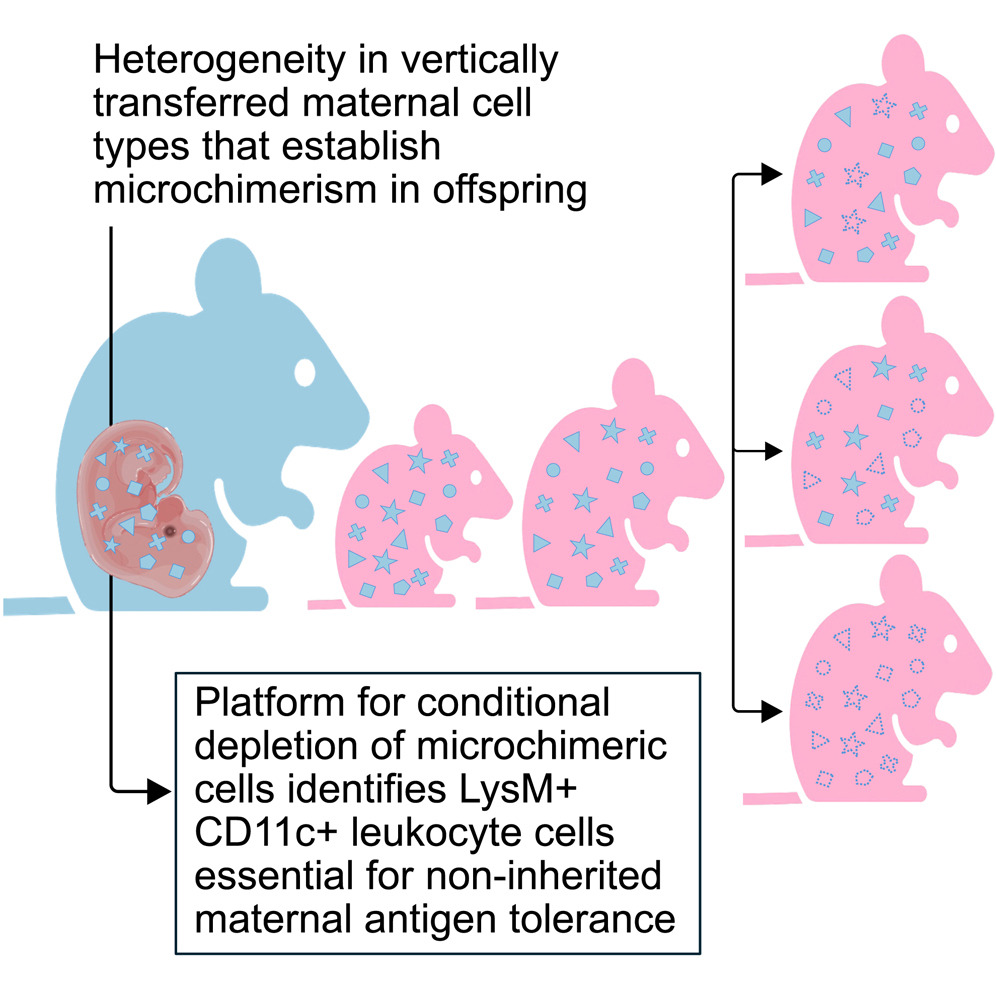
The research team investigated the phenomenon in which a child's immune system becomes less likely to attack maternal antigens (immune markers). The research team defines these antigens as 'antigens that the mother has but that the child has not inherited genetically.' In other words, the research examined the phenomenon in which the immune system is inclined to not aggressively eliminate antigens that the child does not have. To gauge whether this phenomenon is occurring, the research team used 'an increase in regulatory T cells,' which put a brake on the immune response, and 'a tendency for the daughter to be less likely to lose a fetus when she becomes pregnant as an adult,' as characteristics associated with this immune state.
The research team reported that in mouse experiments, the total removal of maternal cells disrupted the immune system's 'hard-to-attack' state, prevented the proliferation of regulatory T cells, and eliminated the 'predisposition to fetal loss' seen in subsequent pregnancies. The research team considered these results to be 'evidence that maternal cells support the immune system.'
Next, the research team gradually narrowed down which maternal cells were responsible for this role. As a result, they found that while removing immune cells derived from white blood cells from the mother's body disrupts the immune system, removing cells that make up the surface of skin (epithelial system) and cells that make up the inside of blood vessels (endothelial system) maintains the immune system. This indicates that the white blood cell system is central to supporting the immune system.
The research team further subdivided the white blood cell system and continued their experiments. They found that removing maternal lymphocytes did not compromise the immune system, but removing maternal myeloid immune cells and maternal dendritic cells did, resulting in a compromised immune system and a loss of the 'predisposition to fetal loss' during pregnancy.
In conclusion, the research team states that the child's immunity to maternal antigens is maintained by a small proportion of maternal white blood cells that have both myeloid and dendritic cell characteristics.
The research team also found that even when the immune system was disrupted by conditionally removing cells that support the immune system, the total number of maternal cells remaining in the body did not decrease significantly. They concluded that 'while a small number of maternal cells play a role in maintaining the immune system, the remaining maternal cells may continue to remain through a different mechanism.'
Related Posts:






in Science, Posted by log1b_ok