Research shows that people who are positive about AI tend to spend more time on social media

While social media is often convenient and fun, there are concerns that it can be highly addictive and lead to addictive behavior. While personality traits, difficulty regulating emotions, and a history of mental illness are known to be factors that make people more susceptible to problematic social media use, new research suggests that a 'positive attitude toward AI' may also be a contributing factor.
The darker side of positive AI attitudes: Investigating associations with (problematic) social media use - ScienceDirect
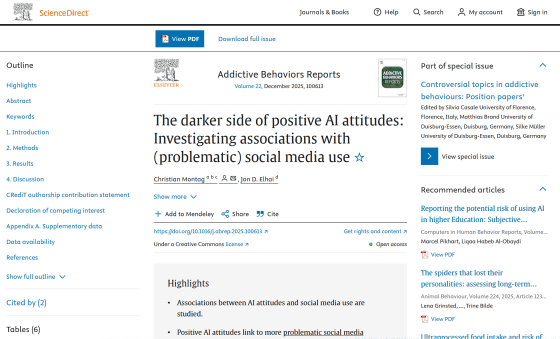
Positive attitudes toward AI linked to problematic social media use
https://www.psypost.org/positive-attitudes-toward-ai-linked-to-more-prone-to-problematic-social-media-use/
Nearly all major social media platforms are equipped with AI algorithms that learn from users' behavior and preferences to recommend content they are likely to like and maximize engagement. While this encourages users to spend more time on the platform, which benefits advertisers and businesses, it also comes at the risk of users becoming addicted to the platform.
So, Christian Montague, a professor of cognitive and neuroscience at the University of Macau, wondered whether attitudes toward AI might be related to social media addiction: People who trust AI might be more likely to embrace, and even overuse, AI-powered platforms like social media.

To test this idea, Montag and his colleagues conducted a survey of German adults across a wide range of ages and education levels. To gauge their attitudes toward AI, participants were asked to rate their agreement with statements such as 'I trust AI,' 'AI will benefit humanity,' 'I fear AI,' and 'AI will destroy humanity.'
To assess their social media use, participants were asked whether they use platforms such as Facebook, Instagram, TikTok, YouTube, and WhatsApp, and how much time they spend on them each day for personal and professional purposes. Those who reported using social media also completed a Social Networking Site Addiction Test to measure their attachment to or dependency on social media.
After excluding incomplete responses and outliers, a total of 956 participants reported using social media. The researchers found that people with more positive attitudes toward AI tended to spend more time on social media and exhibit more problematic usage patterns. This relationship was observed for both men and women, but was stronger among men.
In contrast, negative attitudes toward AI were weakly associated with social media use, suggesting that enthusiastic support for AI, rather than fear or skepticism, is more closely associated with excessive social media use.
It should be noted that this study only showed correlations, not a causal relationship between positive attitudes toward AI and problematic social media use. It is possible that people who already use social media frequently are more likely to have positive attitudes toward AI, or that other factors, such as interest in technology, may be involved.
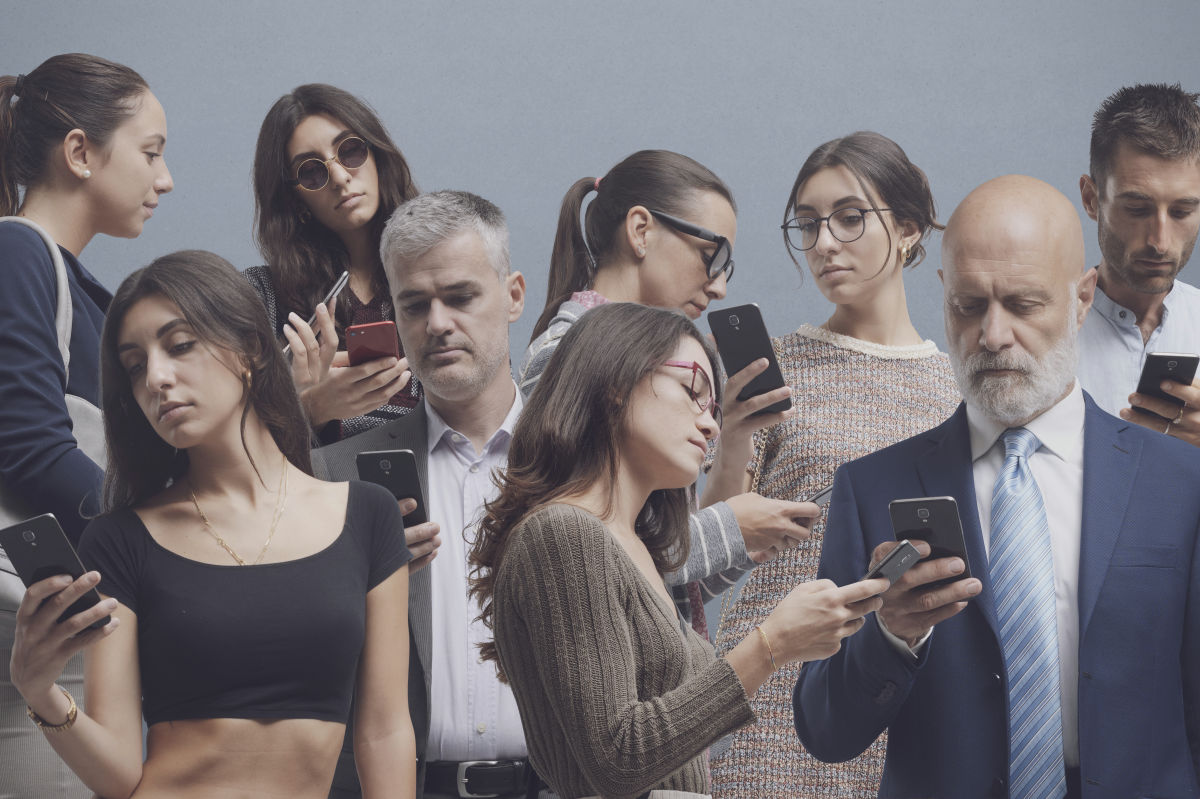
'Personally, I believe it's important to have a certain degree of positive attitude toward benevolent AI technologies. AI will profoundly change our personal and professional lives, so we should be better prepared to embrace this technology,' Montague said. 'However, our research suggests that a positive attitude toward AI, which is an important predictor of AI technology adoption, may come with a cost. This could manifest in over-reliance on these technologies, or, as in our case, over-use of social media, where AI plays a key role in content personalization.'
Related Posts: