What is the 'doorman fallacy' that explains why the careless introduction of AI backfires?

AI is now widespread in various fields of work, with
The 'doorman fallacy': why careless adoption of AI backfires so easily
https://theconversation.com/the-doorman-fallacy-why-careless-adoption-of-ai-backfires-so-easily-268380
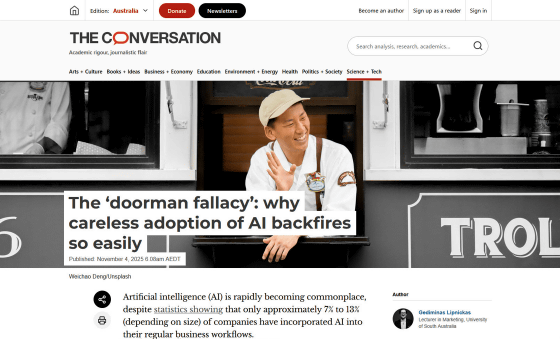
The adoption of AI by companies is fueled by the expectation that it will enable them to reduce labor costs by significantly improving operational efficiency. As a result, as AI becomes more widespread, layoffs are expected to increase, and it is possible that AI will replace millions of jobs within the next decade.
However, Lipnickas points out that while expectations for AI are high, many companies have yet to realize its benefits. Data on productivity improvements from the introduction of AI is often ambiguous , and many companies are facing increased costs due to failed AI implementations. In fact, there have been reported cases where fintech companies that had been actively implementing AI customer service resumed hiring humans after experiencing a decline in service quality.
Fintech company that aggressively introduced AI customer service and stopped hiring resumes human recruitment due to 'deteriorating service quality' - GIGAZINE
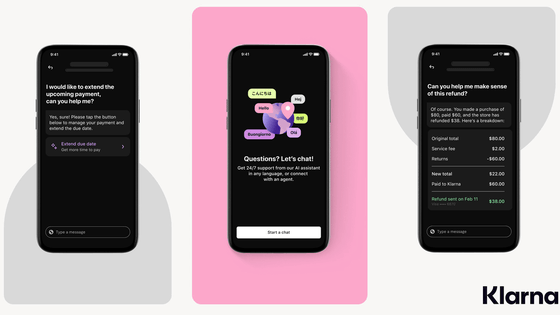
Lipnickas points out that the reason why companies' AI adoption fails is because organizations fall into the 'doorman fallacy.' The doorman fallacy refers to the various disadvantages that result from overlooking the nuances and adaptability of human employees and reducing complex tasks to a single task.
The term 'doorman fallacy' was coined by British advertising executive Rory Sutherland . In his book ' Alchemy: The Dark Art and Curious Science of Creating Magic in Brands, Business, and Life,' Sutherland uses the example of a hotel doorman to explain how companies can misjudge the value of employees like doormen.
To business consultants aiming to reduce costs and improve productivity, a hotel doorman may appear to be someone who simply stands at the entrance, opens the door, and occasionally chats with guests. If that were all there was to their job, simply introducing a technology-based entry system would make it possible to fire the doorman and reduce costs.
However, in reality, the role of a doorman is multifaceted, and they not only open the door but also perform other tasks such as 'warmly welcoming guests,' 'arranging taxis,' 'enhancing security,' 'preventing nuisance behavior,' 'providing attentive service to regular customers,' and 'their very presence elevates the hotel and raises the quality of service perceived by guests.'
If we ignore all these advantages, it's true that doormen can be automated. However, when you simplify the tasks of a multi-faceted employee like a doorman and replace them with technology, the hidden service and nuance that humans bring to the table disappear, and various drawbacks become apparent. This is what is meant by the term 'doorman fallacy.'

As AI becomes more prevalent, many companies are beginning to evaluate their employees the way a business consultant evaluates a doorman, often highlighting the most visible tasks an employee performs and deciding that they can be replaced by AI, while overlooking the broader value the employee brings.
In July 2025, Australia's Commonwealth Bank announced that it had replaced its customer service representatives with 'AI chatbots' and laid off 45 employees, resulting in reduced call charges. However, in reality, on-site call charges increased, and the remaining employees worked overtime to resolve the situation. In the end, the Commonwealth Bank acknowledged that the dismissal of the employees was a mistake and offered the dismissed employees the option of continuing in their previous positions.
Additionally, American fast food chain Taco Bell has been using voice AI in its drive-thrus since 2024. However, there have been numerous posts on social media complaining about glitches and slow responses in Taco Bell's voice AI ordering system, leading Taco Bell to reconsider its use of AI.
A major fast food chain that introduced a voice AI ordering system to its drive-thru is reconsidering how to use AI - GIGAZINE

The examples of Commonwealth Bank and Taco Bell are not uncommon. According to a report published by software platform Orgvue, 55% of companies that have replaced employees with AI admit that they 'adopted too early.'
To avoid the doorman fallacy when implementing AI, organizations must recognize that human employees not only perform tasks that are listed in their job descriptions, but also contribute to the workplace in ways that leaders often don't realize. They must also emphasize the customer experience and long-term outcomes of human intervention, rather than simply focusing on 'efficiency.'
'Before companies look to automate any role and offload tasks to AI, they need to deeply understand that role,' Lipnickas said. 'The evidence is clear: the best way to leverage AI is to combine it with human judgment. This approach preserves the parts of the job where context, personal engagement, and trust are important.'
Related Posts:






in AI, Posted by log1h_ik