It's been 14 years since it was said that IPv4 addresses had run out. What will happen to IPv4 in 2025?

IP addresses are essential as the foundation of the Internet, and around 2011, when IPv4 addresses were allotted to each Regional Internet Registry, people began saying that 'IPv4 addresses have run out.' Looking back to 2025,
The IPv4 address swamp: The new normal | APNIC Blog
https://blog.apnic.net/2025/12/23/the-ipv4-address-swamp-the-new-normal/
IPv4 exhaustion, meaning that ICANN allocated all IPv4 addresses to each RIR, occurred in 2011, and from that point on, it became impossible to obtain new unallocated addresses. When we hear the word 'exhaustion,' we tend to get the impression that IPv4 will one day become unusable, but what happened first was a thorough reallocation of IPv4, which had become a scarce resource.
For example, large address blocks have been transferred, and mechanisms such as waiting lists and address leasing have become part of operations, with the means of acquiring addresses shifting toward markets and institutions. Furthermore, major cloud providers have increasingly secured address blocks and allocated them to data centers around the world. Network address translation (NAT) continues to be widely used on the user side, and at the same time, the adoption of IPv6 continues to grow year by year. In other words, APNIC states that the events surrounding IPv4 in 2025 will not mean that 'IPv4 has disappeared,' but rather that 'the mechanisms for managing IPv4 have become normalized.'
Next, as IPv4 addresses became scarce, it became common to distribute them in smaller chunks rather than using one large chunk as is. As a result, Internet routing information became a collection of many small routes rather than a few large routes.

In '192/8,' from 192.0.0.0 to 192.255.255.255, a large number of small address blocks close to the minimum unit size are circulated, and it is known that route information tends to swell. APNIC speculates that this trend is not limited to a few special areas, but has spread to the entire IPv4 network. In fact, the number of route information items referenced by network devices has increased to approximately 1 million, and routes close to the minimum unit size account for more than half, and recently this figure has remained close to 60%.
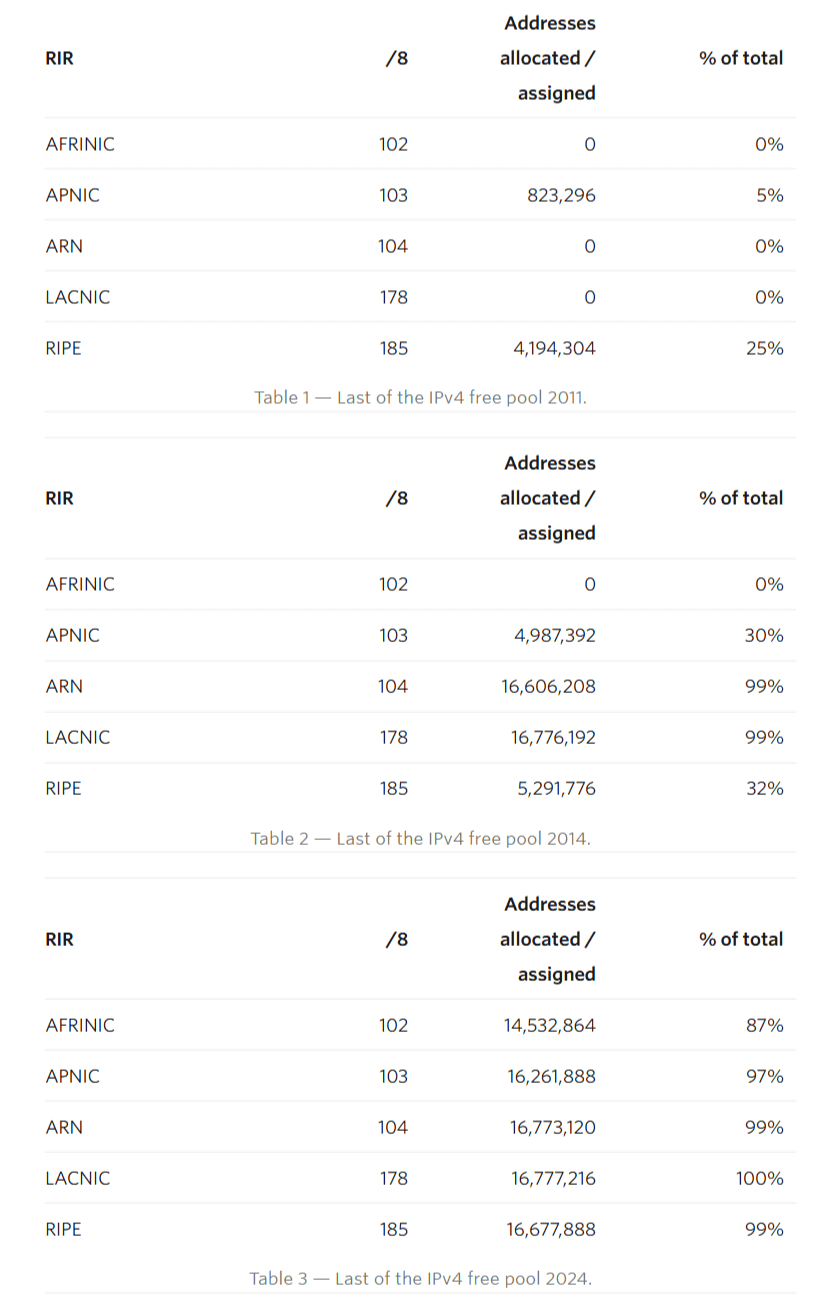
It seems that the IPv4 addresses allocated in 2011 had not yet been allocated at the end of that year, but in 2014 they were rapidly consumed in some regions, and as of 2024, virtually all of them have been allocated in each RIR. Rather than large unused chunks remaining for over a decade after exhaustion, addresses have been used up gradually over time in line with the system and demand.

However, the 'assigned' status in the registration does not match the 'reachable' status from the Internet. As of 2024, 192/8 will have 14,526 routes, but only 62% of addresses are covered, meaning that nearly 40% are not reachable directly from the Internet. On the other hand, the last group of /8s allocated show higher coverage rates; for example, APNIC's 103/8 has 42,660 routes and 72% coverage, while LACNIC 's 179/8 has 5,973 routes and 99% coverage. In short, APNIC argues that even for the same /8, the numbers reflect the difference in how finely it is divided and how many routes it accumulates.
APNIC said that while IPv4 has almost been distributed, the number of small addresses has increased, resulting in an expansion of routing information. Furthermore, addresses have become more susceptible to change ownership and usage, making it difficult to rely on the reputation of IP addresses to combat spam communications. They concluded by saying, 'IPv6 is gradually becoming more widespread, but for the time being, we need to continue to consider operations and security based on the current situation with IPv4.'
Related Posts:







in Web Service, Posted by log1i_yk