Research shows that in societies with low freedom of speech, many people believe in conspiracy theories
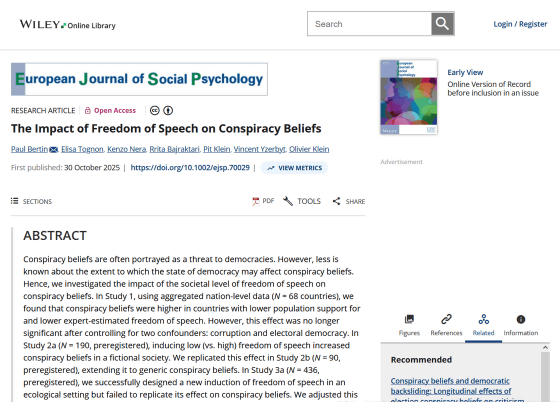
The Impact of Freedom of Speech on Conspiracy Beliefs - Bertin - European Journal of Social Psychology - Wiley Online Library
https://onlinelibrary.wiley.com/doi/10.1002/ejsp.70029
Conspiracy beliefs are higher in societies with lower freedom of speech, study finds
https://www.psypost.org/conspiracy-beliefs-are-higher-in-societies-with-lower-freedom-of-speech-study-finds/
Conspiracy theories, which claim that there is a group manipulating various events behind the scenes, tend to arise when people feel uncertain, lose control of their lives, or distrust official sources of information. Conspiracy theories simplify complex realities by claiming there is a 'clear villain' behind events and presenting a story that seems logical at first glance.
Conspiracy theories have been cited as a threat to democracy because they appeal to emotions rather than evidence, tend to spread rapidly, give believers a strong sense of identity and belonging, and can undermine trust in social institutions, science, and democratic processes.
So, a research team led by Paul Bertin, a psychologist at the University of Lausanne in Switzerland, conducted a country-level analysis and multiple experiments on the relationship between freedom of speech, which is important in democracy, and belief in conspiracy theories.
First, the research team analyzed several measures of freedom of speech collected in 26 to 68 countries, as well as conspiracy beliefs about COVID-19, support for freedom of speech, perceptions of political corruption, and perceptions of society's democratic nature measured in 69 countries in 2020.
The results showed that in countries with low levels of freedom of speech and low support for freedom of speech, citizens tend to believe in conspiracy theories. It was also reported that people in countries perceived as less democratic and more corrupt also tended to believe in conspiracy theories. When political corruption and perceptions of democracy were taken into account in the analysis, the relationship between freedom of speech and conspiracy theories became insignificant.
The researchers then conducted several experiments to examine the relationship between free speech and conspiracy theories. In the first experiment, 190 American and 90 Belgian students participated, and were divided into two groups, each assuming the role of a citizen of a fictional country.
One group read an article describing low freedom of speech in their assigned fictional country, including statements like 'online opinion filters are implemented,' 'persecution of journalists,' and 'surveillance of citizens.' The other group read an article describing high freedom of speech, including statements like 'citizens are free to share their opinions,' 'independent media exists,' and 'peaceful protests are permitted.'
The subjects then read a fictitious article about the death of the leader of an opposition party, a leading candidate for the upcoming election, in a traffic accident. The article also included conspiracy theories, including that a party member suspected government involvement, despite the government's official announcement that the death was an accident.
After reading a series of articles, participants were asked to rate their belief in claims that the government was involved in the death of an opposition leader. The results showed that the lower participants' perception of freedom of speech in the fictional country, the more likely they were to believe the conspiracy claims.

The next experiment involved over 400 French speakers. They were shown an infographic depicting the level of freedom of speech in France and divided into three groups: those who believed France had high freedom of speech, those who believed France had medium freedom of speech, and those who believed France had low freedom of speech.
The subjects then read a fictional article from the previous experiment, which described the death of a leading opposition leader in the upcoming election in a traffic accident. The article was modified to fit a realistic French situation. The subjects' conspiracy beliefs were measured based on the extent to which they believed the conspiracy claims in the article.
We also conducted a similar experiment with over 400 French speakers, presenting the data on freedom of speech as a '2030 prediction,' hoping that asking participants to imagine France in the future rather than present-day France might change their conspiracy beliefs.
The results of the experiment showed that in the version depicting present-day France, there was no correlation between the infographic about freedom of speech and endorsement of conspiracy theory beliefs. This may be because the subjects did not accept the information about the level of freedom of speech in France as reliable. On the other hand, in the version depicting future France, subjects who were shown an infographic predicting a decline in freedom of speech in France in the future showed increased levels of conspiracy theory beliefs.

The research team found that 'expert estimates and countries with weaker support for freedom of speech showed higher conspiratorial beliefs about COVID-19. However, the significance of these effects diminished when two confounding factors, corruption and electoral democracy, were considered. Switching to an experimental design, we observed that freedom of speech causally affects conspiratorial beliefs in two experiments conducted in fictional contexts.' They concluded.
PsyPost, a psychology publication, noted that the initial analysis had low statistical power due to the small number of countries used. It also pointed out that in the experiment, in which participants assumed they were citizens of a fictitious country, they may have simply rationally believed that a government that persecutes free speech might kill dissidents. 'Because such events actually occur in the real world,' it said. 'Their assessments may not reflect the impact of free speech itself on conspiracy beliefs, but rather may have been rational judgments about the safety of public figures under a totalitarian regime.'
Related Posts:





in Free Member, Science, Posted by log1h_ik