US government halts five large-scale offshore wind projects, citing 'national security risks'
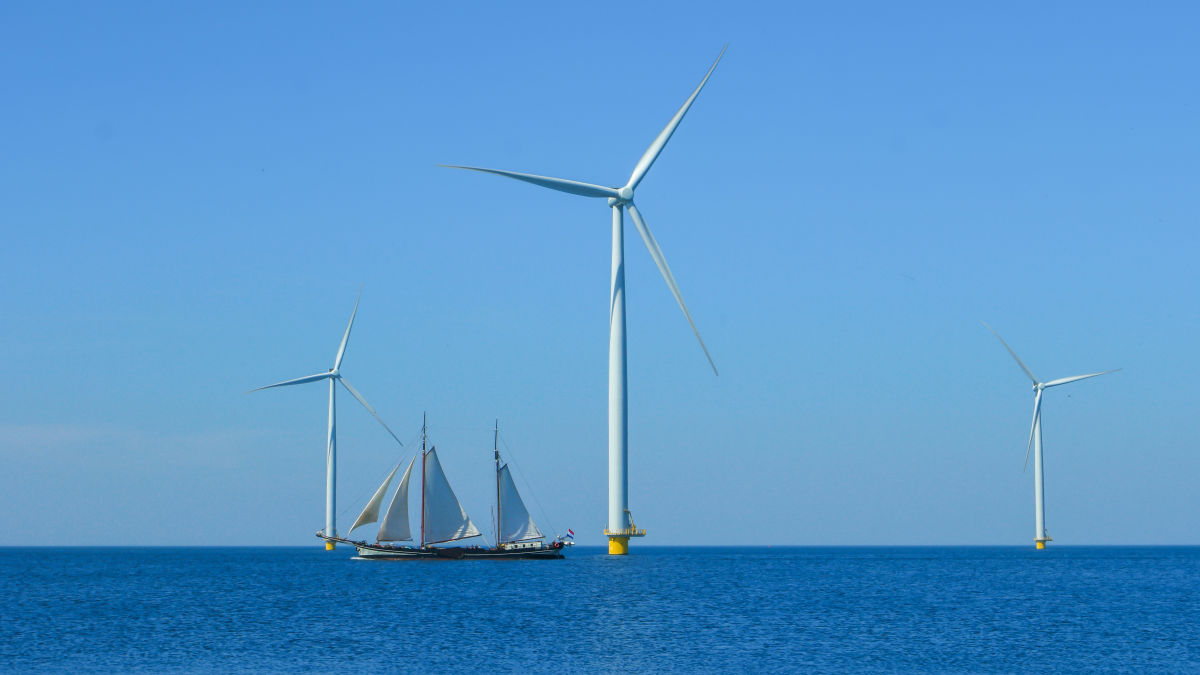
On December 22, 2025, the U.S. Department of the Interior announced that it would immediately suspend lease agreements for large-scale offshore wind power projects under construction in the U.S. The Department of the Interior cited national security risks identified in a classified report by
The Trump Administration Protects US National Security by Pausing Offshore Wind Leases | US Department of the Interior
https://www.doi.gov/pressreleases/trump-administration-protects-us-national-security-pausing-offshore-wind-leases
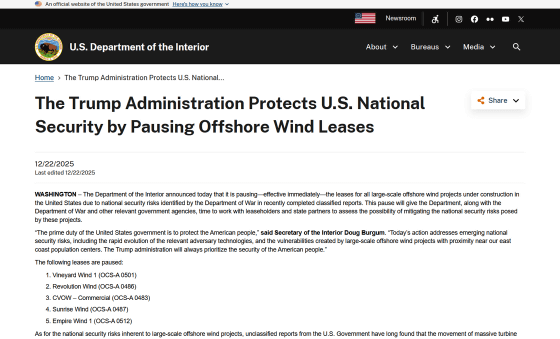
US blocks all offshore wind construction, says reason is classified - Ars Technica
https://arstechnica.com/science/2025/12/us-government-finds-new-excuse-to-stop-construction-of-offshore-wind/
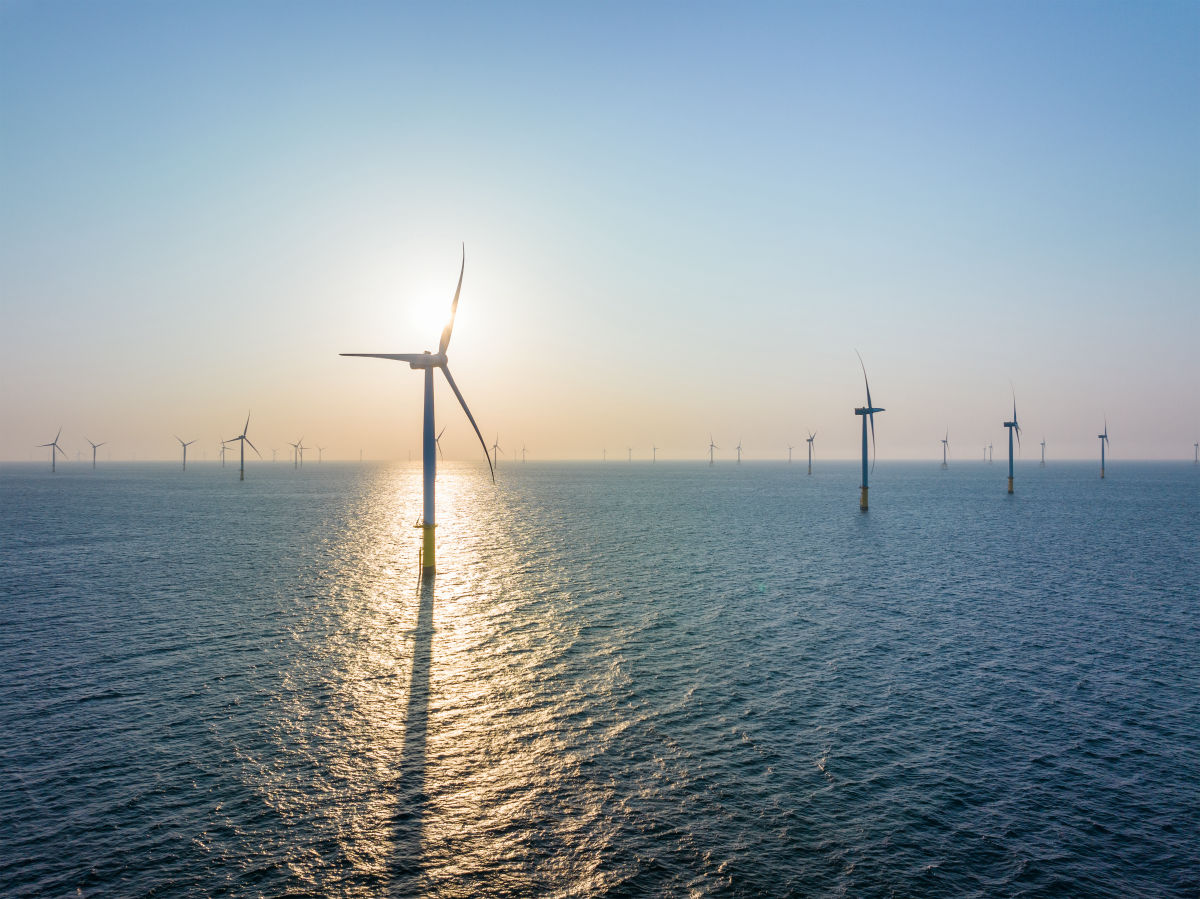
Offshore wind power generation is a facility that uses wind turbines built far from land to generate electricity using sea breezes. The winds at sea are much stronger than those on land, and offshore wind power generation has the potential to generate three times as much electricity as wind power generation on land.
During the 2025 presidential election campaign, US President Donald Trump expressed his negative views on offshore wind power generation, and on his first day in office he issued an executive order calling for a temporary suspension of permit issuance for offshore wind power generation projects. This executive order was sued by groups representing state governments and wind power companies, and was revoked in early December on the grounds that it lacked justification.
The Trump administration has also intermittently attempted to block offshore wind projects that were approved before the executive order was issued. Construction halts have been issued for offshore wind projects such as Empire Wind , currently under construction off the coast of New York, and Revolution Wind (Orsted project) off the coast of southern New England , but both have been lifted through lobbying and litigation.
On December 22, the Department of the Interior announced that it would immediately suspend lease agreements for five large-scale offshore wind projects. The suspended offshore wind projects include the Empire Wind and Orsted projects, as well as Coastal Virginia Offshore Wind, which is currently under construction off the coast of Virginia, Sunrise Wind, which will be constructed off the coast of Long Island in New York, and Vineyard Wind 1, which will be constructed off the coast of Massachusetts.
The Interior Department said, 'This is due to national security risks identified in a recently completed classified report by the Department of Defense. This pause will allow the Interior Department, along with the Department of Defense and other relevant government agencies, time to work with leaseholders and state partners to assess the potential for mitigating the national security risks posed by these projects.'
The Department of the Interior did not disclose the specific national security risks it identified. The Department of the Interior statement said, 'Unclassified U.S. government reports have long documented that large turbine blade movements and highly reflective towers create radar interference known as 'clutter.'' This is not a new problem.
In making the announcement, Interior Secretary Doug Burgum mentioned the rapid evolution of adversarial technology, but did not elaborate further. Technology media outlet Ars Technica noted, 'The announcement noted that the Pentagon's analysis is classified, meaning no one knows what the reasons, if any, are. This classification also makes it much more difficult to challenge the decision in court.'
Many of the states affected by the Interior Department's decision have high hopes for the electricity that offshore wind will provide, and companies have already spent almost all of the funds needed to build them. Therefore, it is highly likely that states and companies will oppose the decision in some way.
Related Posts:





in Note, Posted by log1h_ik