Japanese researchers discover that frog gut bacteria exert powerful anti-cancer effects, eradicating tumors

by
As researchers around the world search for ways to treat cancer, the relationship between intestinal bacteria and cancer is attracting attention. A research team at the Japan Advanced Institute of Science and Technology in Japan has recently discovered that the intestinal bacteria of reptiles and amphibians have powerful anti-cancer effects.
Full article: Discovery and characterization of antitumor gut microbiota from amphibians and reptiles: Ewingella americana as a novel therapeutic agent with dual cytotoxic and immunomodulatory properties
https://www.tandfonline.com/doi/full/10.1080/19490976.2025.2599562
Groundbreaking cancer treatment bacteria discovered in the intestinal bacteria of amphibians and reptiles! | JAIST Japan Advanced Institute of Science and Technology
https://www.jaist.ac.jp/whatsnew/press/2025/12/15-1.html
In recent years, attempts to apply gut bacteria to cancer treatment have been attracting attention. In 2021, research results were reported showing that administering appropriate gut bacteria to patients for whom cancer immunotherapy was ineffective improved the patient's immune response, resulting in stabilization of the patient's condition and tumor shrinkage. In addition, in 2025, a collaborative research group including the National Cancer Center reported the discovery of a new gut bacteria that enhances the therapeutic effects of cancer immunotherapy.
'Transplanting someone else's feces' may be useful for treating cancer patients who are resistant to immunotherapy - GIGAZINE

Therefore, a research team led by Professor Eijiro Miyako of the Frontier Research Area of Materials Chemistry at the Japan Advanced Institute of Science and Technology isolated 45 strains of intestinal bacteria from reptiles and amphibians such as the Japanese tree frog , the Japanese red-bellied newt , and the Japanese grass lizard.
Systematic screening of these bacterial strains revealed that nine strains exhibited antitumor effects. When these bacteria were administered to mice that reproduced the main characteristics of human colon cancer and their therapeutic effects were evaluated, one strain showed no detectable antitumor activity, while five strains showed significant tumor growth inhibition, and three strains were confirmed to have both tumor growth inhibition and tumor regression effects.
In particular, a bacterium called Ewingella americana , isolated from the intestines of Japanese tree frogs, has been reported to completely eliminate tumors in mice after just one administration, making them undetectable by laboratory tests. This therapeutic effect far exceeds that of immune checkpoint inhibitors and chemotherapy, which were currently the standard of care.
Ewingella americana accumulated in hypoxic cancer tissue and demonstrated both a 'direct killing effect' that directly destroyed the cancer tissue, and an 'immunostimulatory effect' that strongly stimulated the immune system and attracted immune cells such as T cells, B cells, and neutrophils to the cancer cells.
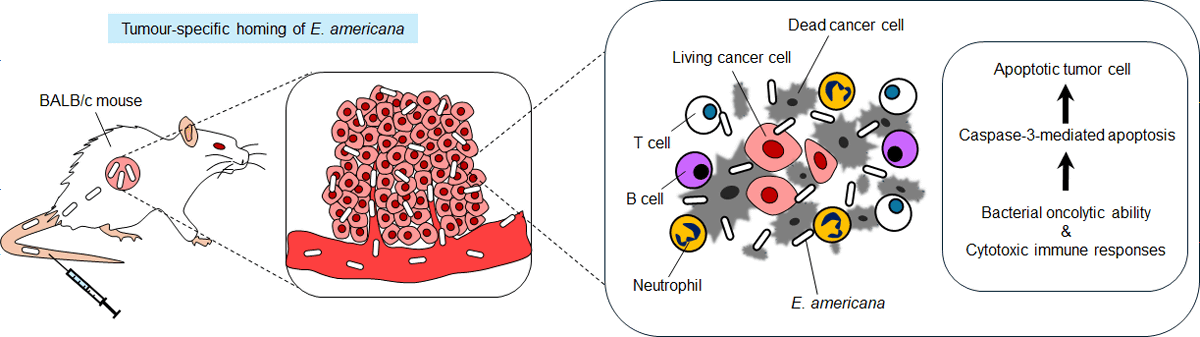
Ewingella americana has a tumor-specific accumulation mechanism that allows it to selectively accumulate in cancer tissue while not colonizing normal tissue. This is thought to be due to a combination of various mechanisms, including the hypoxic environment specific to cancer tissue, the immunosuppressive environment caused by proteins expressed by cancer cells, the high blood vessels in cancer tissue that make it easy for bacteria to invade, and cancer-specific metabolic products that support the selective growth of bacteria.
Furthermore, Ewingella americana was completely eliminated from the bloodstream within 24 hours, did not colonize normal organs such as the liver, spleen, lungs, kidneys, or heart, and the mild inflammatory response it induced was transient and normalized within 72 hours, demonstrating an excellent safety profile. Even in a 60-day long-term observation, no chronic toxicity was observed in mice.
The research team stated, 'This study demonstrates the potential for a new cancer treatment using natural bacteria,' and plans to expand the application of this method to other types of cancer, optimize administration methods, and develop combination therapies.
Related Posts: