If AI replaces workers, should it also pay taxes?
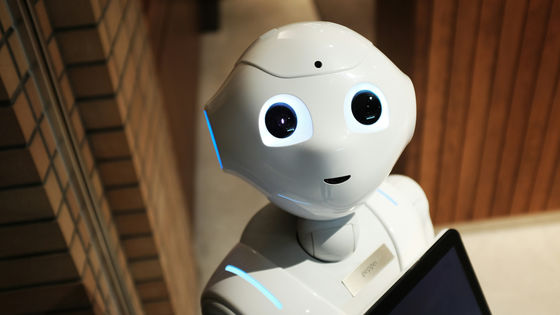
Major companies are investing heavily in AI and are also introducing it to improve business efficiency. This has led to large-scale workforce reductions, sparking a heated debate in some circles about whether AI should also pay taxes if it is replacing workers.
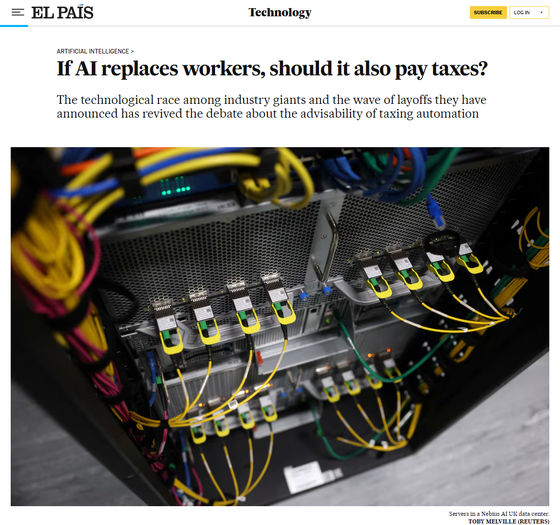
If AI replaces workers, should it also pay taxes? | Technology | EL PAÍS English
Amazon is working to improve operational efficiency through generative AI and AI agents, and as a result, it has announced plans to lay off 30,000 employees by October 2025. As such, many companies are simultaneously adopting AI and reducing their workforce. This is not limited to Amazon; companies like Meta and UPS are also simultaneously adopting AI and reducing their workforce.
Amazon CEO Andy Jassy says AI will drive operational efficiency and lead to job cuts in the next few years - GIGAZINE

Fewer workers means fewer taxpayers, which raises the question: if machines and algorithms are replacing human jobs, should they be required to pay the taxes that humans no longer pay?
Sanjay Patnaik, director of the Center on Regulation and Markets at the Brookings Institution , noted, 'Trends in automation and AI could lead to a decline in tax revenue. For example, in the United States, approximately 85% of tax revenue comes from labor income.' However, Patnaik recommended addressing the 'risks posed by AI' by increasing capital gains taxes rather than introducing a special tax system for AI (an AI tax). He also noted that a tax system like an AI tax would be difficult to design and could potentially lead to distortions.
Goldman Sachs predicts that AI will boost global GDP by 7% over the next decade, while the International Monetary Fund predicts that AI could contribute up to 0.8% annual growth between 2025 and 2030. Meanwhile, the International Labour Organization estimates that one in four workers worldwide, concentrated in high-income countries, will be employed in some form of AI-related job, but predicts that most jobs will not disappear, but will simply be transformed.
Professor Daniel Wardenstrom of the Stockholm Institute for Industrial Economics also opposes AI-specific tax proposals, partly because he believes that even in the United States, a country that is a leader in AI, the unemployment rate will not rise significantly even as AI adoption progresses.
Professor Wadenstrom also emphasized the difficulty of precisely defining AI, saying, 'What are automation, robots, and AI? Is it a chip? Is it a humanoid machine? Is it an application? Is it a computer program? We will never be able to define it precisely. We should continue to tax what we already have: labor income, consumption income, and capital gains.'

Economists at the International Monetary Fund have stated that they do not recommend taxing AI, citing the potential for it to hinder productivity and distort markets. Instead, the IMF recommended reviewing existing tax systems.
Carl Frey, an economist at the University of Oxford who specializes in AI and labor, also doesn't support an AI tax, but acknowledges that tax systems are becoming imbalanced. He points out that in many
Suzanne Bieler, Secretary General of the International Federation of Robotics, argues that automation and robots 'will create new jobs by increasing productivity,' and that the introduction of an AI tax is 'a mistake based on a problem that doesn't exist.' Bieler warned that taxing production tools (AI) rather than corporate profits would have a 'harmful impact' on competitiveness and employment. Bieler also said, 'Companies need incentives to utilize technologies like robots and digitalization to remain globally competitive.' 'The world faces a labor shortage of approximately 40 million people per year, and while robots cannot replace all jobs, they can perform certain tasks.'

Related Posts:







in AI, Posted by logu_ii