RSL 1.0, the industry standard that defines content usage rules for the AI era, is released as an official specification

Really Simple Licensing (RSL) 1.0 , which has been attracting attention as a mechanism that allows publishers to clearly state the terms of use for each use of web content by AI companies, has been released as an official standard specification. Internet infrastructure companies such as Cloudflare and Akamai, as well as many media companies, have already expressed their support for the implementation of RSL.
New RSL Web Standard and Collective Rights Organization Automate Content Licensing for the AI-First Internet and enable Fair Compensation for Millions of Publishers and Creators | RSL: Really Simple Licensing
https://rslstandard.org/press/rsl-1-specification-2025
RSL 1.0 has arrived, allowing publishers to ask AI companies pay to scrape content | The Verge
https://www.theverge.com/news/841222/rsl-licensing-ai-spec-launch
The RSL itself was released in September 2025, and the version 1.0 standard specification was established in November 2025.
'RSL' is a system under development that notifies users of terms and fees for scraping for AI learning purposes, and is already being adopted by Yahoo, Reddit, O'Reilly, and others - GIGAZINE
The RSL 1.0 specification has now been officially released as an industry standard, and it has been announced that major internet infrastructure companies and major publishers have fully adopted it. This positioning of RSL as more than just a proposed specification means that it is now positioned as an 'operable mechanism' that will be implemented by infrastructure services such as Cloudflare and Akamai, creating a practical framework for controlling AI search and traditional search separately for each purpose.
RSL extends the existing robots.txt and is unique in that it not only allows access but also allows users to specify conditions for each use, such as training AI models, searches, and generating answers. RSL 1.0 adds items such as 'ai-all,' 'ai-input,' and 'ai-index,' allowing for detailed settings such as allowing search engines to index data while denying its use for AI search functions. This will enable publishers to selectively control only AI uses while maintaining traditional search traffic.
Furthermore, in collaboration with Creative Commons, RSL 1.0 introduces a 'contribution' option to protect non-profit knowledge-sharing communities. This is a mechanism that requires AI companies to make financial or infrastructure contributions in a manner that differs from commercial licenses. Creators can now demand fair compensation and support when their work is used in AI systems, without blocking access or compromising open collaboration.

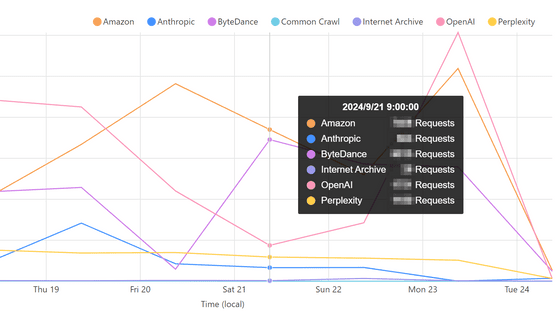
The widespread adoption of RSLs has been largely supported by internet infrastructure companies. The content used for AI training and inference is collected by web scraping bots, but these bots have been known to ignore website robot.txt files while crawling, raising concerns. For example, internet infrastructure company Cloudflare has indicated it will crack down on these AI bots.
Cloudflare releases a feature to block AI bots that collect training data in bulk - GIGAZINE

Cloudflare stated that 'RSL 1.0 is beneficial because it allows license information to be embedded in HTTP 402 responses.' Akamai, another internet infrastructure company, also expressed its support for RSL, indicating its support for clarifying publisher terms of use. Support from internet infrastructure companies will enable measures such as blocking unlicensed AI scrapers.

In addition, over 1,500 other media outlets and companies, including the Associated Press, the Guardian, USA Today, BuzzFeed, Slate, and Stack Overflow, have expressed their support for RSL. The RSL Collective has declared that with the adoption of RSL as a standard by internet infrastructure companies and major media outlets, RSL will be recognized and published as an official industry specification.
The RSL Collective stated that it plans to continue expanding and promoting the specification, and hopes that RSL will become a system that creates a transparent and responsible usage environment between AI companies, publishers, and creators.
Related Posts: