When ants get sick, they release a scent that will make others kill them.
When a group member becomes ill, they risk being excluded or attacked by the group. For this reason, group animals often hide their illnesses. However, when ant pupae become infected with a pathogen and reach a terminal stage, they exhibit altruistic behavior by emitting chemical signals indicating their terminal condition and allowing themselves to be killed by other members.
Altruistic disease signaling in ant colonies | Nature Communications
https://www.nature.com/articles/s41467-025-66175-z
ISTA | Ants Signal Deadly Infection
https://ista.ac.at/en/news/ants-signal-deadly-infection/
The research results were reported by a research team from the Institute of Science and Technology Australia (ISTA). The research team infected pupae of the ant genus Lasius neglectus with the entomopathogenic fungus Metarhizium brunneum and observed the behavior of colonies after infection.
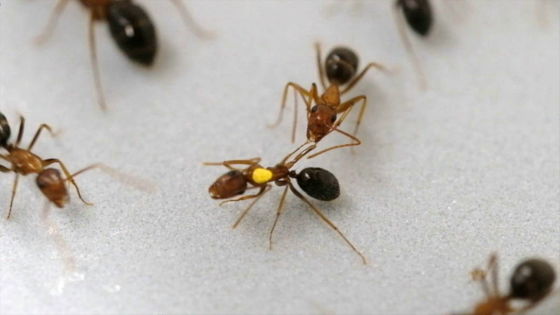
The experiment revealed that pupae in the final stages of pathogen infection emit a specific odor-like chemical signal. When worker ants detect this chemical signal, they gather around the pupae, break open the cocoon, remove the individual inside, pierce the individual's body, and apply formic acid. Formic acid acts as a disinfectant, preventing the pathogen from spreading throughout the nest, but the treated pupae die.
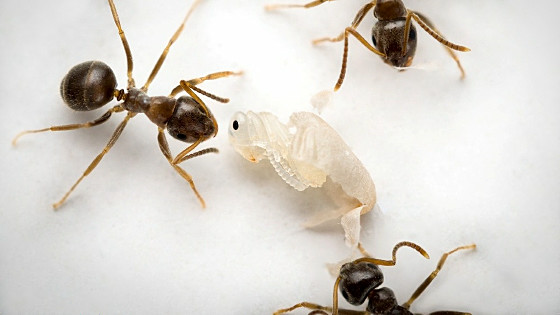
Although there are many pupae in an ant nest, worker ants can pinpoint the exact pupae that emitted the signal because the signal is composed of non-volatile compounds that remain on the surface of the ant's body, rather than volatile compounds that spread in the air. Specifically, two types of compounds that make up the overall scent of the pupa are amplified.
The research team extracted chemical signals emitted by 'pathogen-infected pupae' and applied them to healthy pupae. As a result, it was confirmed that worker ants applied formic acid to healthy pupae. Based on these results, the research team speculates that the change in the odor (chemical signal) of the pathogen-infected pupae is what triggers the worker ants' behavior.
On the other hand, queen ant pupae did not emit chemical signals even when infected with pathogens, which is thought to be because queen ant pupae have a stronger immune system than worker ant pupae and are therefore able to fight off pathogens on their own.
Based on the results of this experiment, the research team concluded, 'Ants use altruistic signaling to prevent the spread of pathogens. This demonstrates a balanced interplay between individual and social immunity that efficiently achieves the health of the entire colony.'
Related Posts:

in Free Member, Science, Creature, Posted by log1o_hf