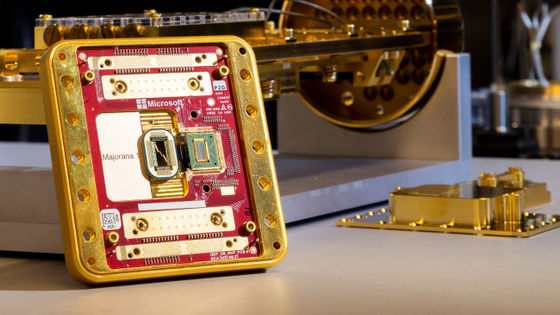
A research team at California Institute of Technology succeeds in building the largest quantum computer array with 6,100 qubits, paving the way for large-scale 'fault tolerance' using neutral atoms
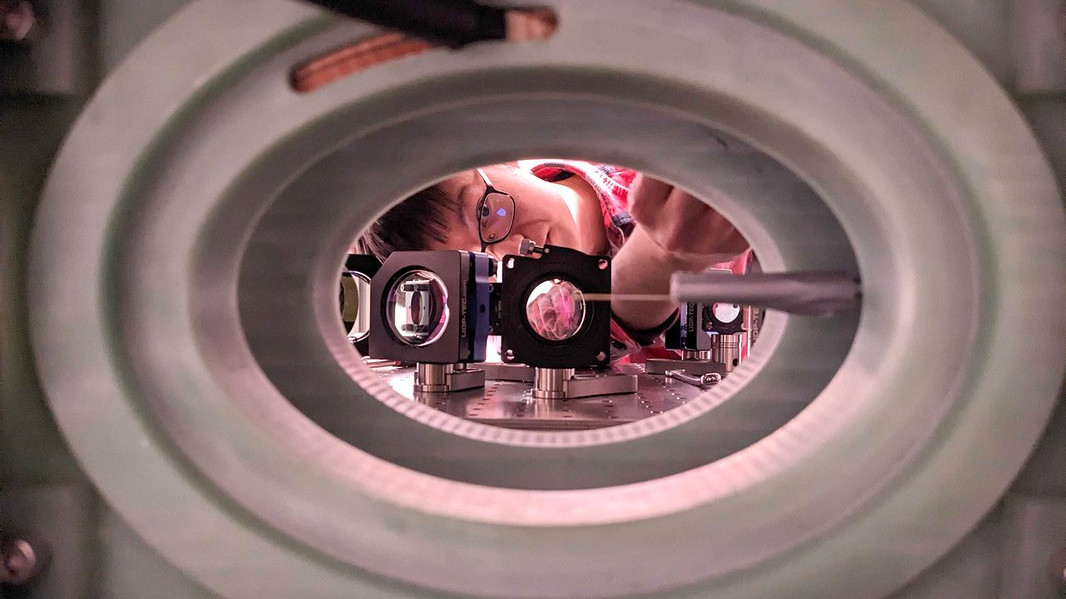
by Caltech/Gyohei Nomura
To realize a practical quantum computer, it is thought that a million qubits are needed for 'error tolerance.' Until now, qubit arrays have only been built at the hundreds level, but a research team at the California Institute of Technology has revealed that they have succeeded in building an array of 6,100 qubits.
Caltech Team Sets Record with 6,100-Qubit Array - www.caltech.edu
Device with 6100 qubits is a step towards largest quantum computer yet | New Scientist
https://www.newscientist.com/article/2497439-device-with-6100-qubits-is-a-step-towards-largest-quantum-computer-yet/
While bits handled by conventional (classical) computers are either '0' or '1,' quantum computers' qubits can exist in two states simultaneously: '0' and '1' through 'superposition.'
This 'superposition' gives quantum computers the potential to perform complex calculations that are difficult for classical computers to perform, but it has been pointed out that 'superposition' is a very delicate state, and that it can fall into ' decoherence ' due to the influence of noise, etc. For this reason, how to reduce errors is a major challenge, and it is thought that a system with hundreds of thousands to a million qubits would be necessary to achieve practical 'error tolerance.'
As a first step towards this vision, a research team at the California Institute of Technology has succeeded in building a quantum bit array consisting of 6,100 quantum bits made of neutral atoms trapped in a lattice by lasers.
According to Professor Yoshiro Takahashi of the Graduate School of Science at Kyoto University, who specializes in quantum optics and atomic physics, quantum computers can be broadly divided into 'quantum annealing' and 'quantum gate' systems. In terms of the physical systems that make up quantum bits, five systems are being actively developed: 'superconducting,' 'quantum dot,' 'optical,' 'neutral atom,' and 'ion trap.' Professor Takahashi is also researching the neutral atom system, and one of its features is that it confines atoms inside a vacuum chamber using laser light, eliminating the need for wiring like the superconducting system, making it advantageous for large-scale implementation.
[The Future of Quantum Computers] Professor Yoshiro Takahashi (Graduate School of Science) - YouTube
A research team at California Institute of Technology (Caltech) has now used a highly focused laser beam called optical tweezers to trap thousands of cesium atoms in a lattice pattern. To create the atomic arrangement, the laser beam was split into 12,000 tweezers, and the team successfully held 6,100 atoms in a vacuum chamber.
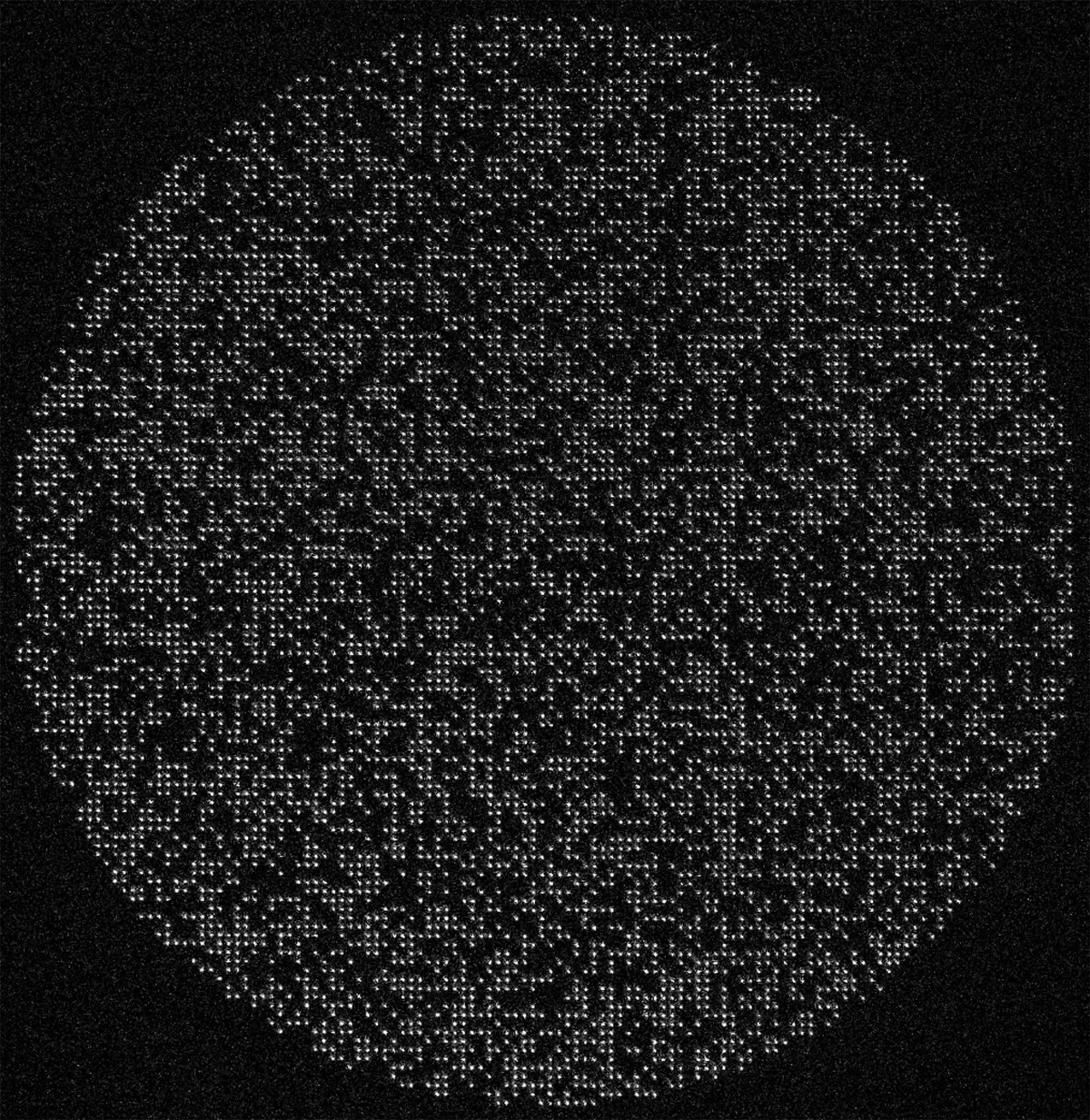
by Caltech/Endres Lab
One major achievement is that scaling up didn't sacrifice quality: In this case, the researchers managed to keep 6,100 qubits in a 'superposition' state for roughly 13 seconds, roughly 10 times longer than previous similar arrays.
They also succeeded in manipulating individual qubits with 99.98% accuracy.
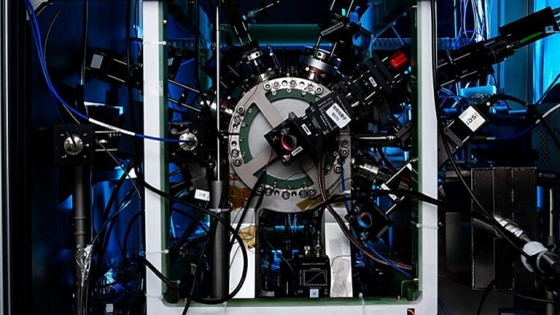
Below is a video in which Hannah Manesh, one of the researchers involved in the research, introduces the laboratory and equipment used in the study.
Inside the Endres Lab with a 6,100-Qubit Array - YouTube
Gyohei Nomura, who worked on the research with Manesh and Elie Bataille, said, 'It is often thought that increasing the number of atoms in a large-scale system sacrifices precision, but our results show that it is possible to achieve both precision and scale. Quantum bits are meaningless without quality. Now we have both quantity and quality.'
'This is a groundbreaking moment for neutral atom-based quantum computing,' said lead researcher Manuel Endres, professor of physics at the California Institute of Technology. 'We are on the path to large-scale 'fault-tolerant' quantum computers. The building blocks are in place.'
Related Posts: