It turns out that YouTube has been using AI to change the appearance of videos without permission, and YouTube explains that it 'uses machine learning, not generative AI, to reduce blur and noise.'
It has come to light that YouTube's short videos have been subject to AI processing without the uploader's permission, resulting in changes to their appearance. YouTube has acknowledged the processing of short videos and explained the details of the processing.
YouTube Shorts are almost certainly being AI upscaled : r/youtube
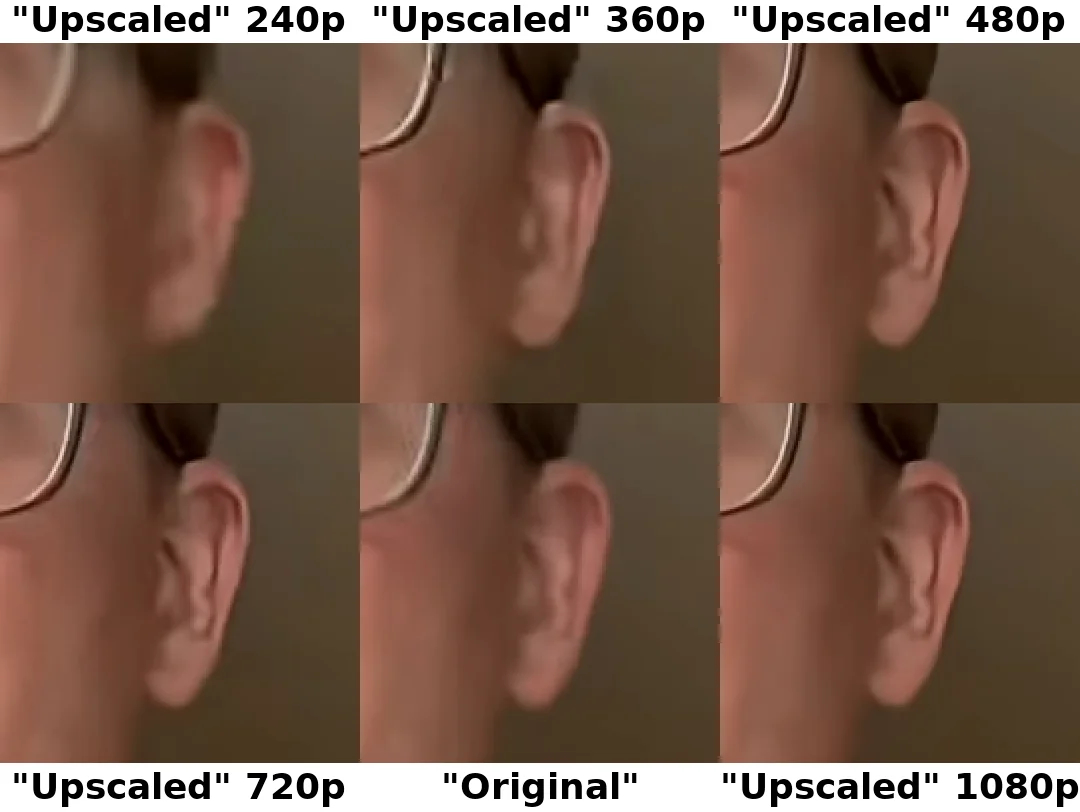
In the image below, the left side is a regular short video, and the right side is a short video with AI processing. Comparing the left and right sides, you can see that the outline of the glasses, the contours of the ears, the patterns of the clothes, etc. are more clearly depicted. You can click on the image to see a larger version.

When you line up 'AI-processed 240p video,' 'AI-processed 360p video,' 'AI-processed 480p video,' 'AI-processed 720p video,' 'original video,' and 'AI-processed 1080p video,' you get something like this. In the original video, the ears look blurry, but in AI-processed videos of 480p or higher, the ears are clear. In other words, the AI-processed video does not restore the original, but rather automatically calculates and compensates for information not present in the original video.
The AI-processed videos have also been criticized for their flattened skin texture and overly sharp contours, making them look like they were made with video-generating AI. The following user, X, slammed YouTube, saying, 'YouTube is editing short videos to make them look like they were made with AI. This is intentional and malicious. Once the AI processing feature is officially released, viewers will have a harder time distinguishing between low-quality AI content (Al-slop) and good content, and will begin to perceive AI content as good.'
youtube is applying post-processing to all shorts so they look more like Al. this is intentional & malicious.
— pretend 𓅂 mirrors ♫ (@earthklaans) August 19, 2025
when their generative Al shorts feature launches users will be less likely to discern what's Al-slop and what's not, and the audience will think Al video is just as good pic.twitter.com/5KkzlUScdS
In response to the above post, YouTube employee Rene Ritchie explained, 'We don't use generative AI or upscaling. We use machine learning techniques on some YouTube Shorts videos to reduce blur, noise, and improve clarity, similar to the video capture feature on modern smartphones.'
No GenAI, no upscaling. We're running an experiment on select YouTube Shorts that uses traditional machine learning technology to unblur, denoise, and improve clarity in videos during processing (similar to what a modern smartphone does when you record a video)
— YouTube Liaison (@YouTubeInsider) August 20, 2025
YouTube is always… https://t.co/vrojrRGwNw
'As a tech geek, I try to use accurate terminology,' Richie said. 'Generative AI refers to relatively new technologies like Transformers and large-scale language models. Upscaling refers to the process of taking low-resolution content (such as 480p) and scaling it up to high-resolution content (such as 1080p). YouTube Shorts doesn't use generative AI or upscaling; it uses machine learning technology similar to what you'd find in a smartphone camera.' He emphasized that YouTube Shorts only uses traditional machine learning-based video sharpening technology, and doesn't use generative AI editing.
Hi! I'm a tech nerd and I try to be precise about the terminology I use
— YouTube Liaison (@YouTubeInsider) August 20, 2025
GenAI typically refers to technologies like transformers and large language models, which are relatively new
Upscaling typically refers to taking one resolution (like SD/480p) and making it look good at a…
However, Richie's post has received replies such as, 'It's still AI (even if it's machine learning),' and 'I don't want machine learning technology to be used on my content for YouTube's financial gain. Please tell me how to opt out.'
It's still AI.
— DeanoSauruz (@DeanoSauruz) August 20, 2025
It walks and sounds like a duck and i was told that the difference is that THIS is a Goose.
The analogy confirms that regardless of its outside description its still AI, the same way a Duck and Goose belong to the Antidae family, is the same way machine learning…
AI processing for short videos is currently being tested on some videos, and the official release date is unknown.
Related Posts:




in Web Service, Posted by log1o_hf