What are the problems with the methods of assessing academic ability in university entrance exams, and what are the newly devised methods of assessing ability?
By
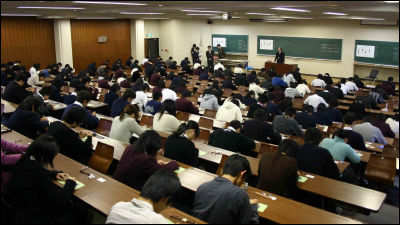
In Japan, the National Center Test for University Admissions has been in place for 20 years, but it is becoming increasingly difficult to achieve its original purpose of measuring basic academic proficiency. The introduction of a new 'Achievement Test' (tentative name) is being considered within the next few years. The trend of assessing students' 'ability to learn' rather than just their academic ability seems to be prevalent in the United States as well, and various methods are being tried at all levels.
Colleges Want Students with Character, But Can't Measure It - Issue 12: Feedback - Nautilus
http://nautil.us/issue/12/feedback/colleges-want-students-with-character-but-cant-measure-it
◆Current entrance examination system 'SAT'
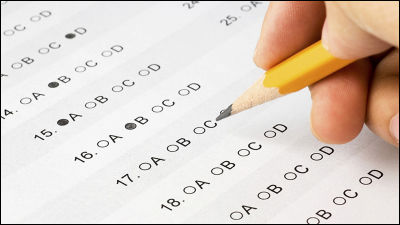
Two of the most commonly used tests in the American university entrance examination system are the SAT (Scholastic Assessment Test) and the ACT (American College Testing program), and applicants to universities in the United States are required to submit the results of either test. The most widely used of these is the SAT, which was introduced in 1901 as a 'standardized test' to unify the academic evaluation standards that differed between high schools across the United States. The SAT is incorporated into the entrance examination system as one of the criteria for determining whether a student has the academic ability to study at the university of their choice and whether they are accepted or rejected.
However, there are voices pointing out that the SAT does not accurately assess students. John Bokenstedt, director of admissions at DePaul University in Chicago, Illinois, says, 'The current SAT places too much emphasis on the college admissions process itself.' Some of the problems include the system being disadvantageous to economically disadvantaged and minority students, the tendency to lock students into fixed courses after enrollment, and the fact that SAT results only predict performance in the first one to two years of college . Already, 800 four-year universities in the United States, or 20% of the total , no longer require students to submit the SAT at the time of admission. Bokenstedt's DePaul University is one such university, saying, 'The SAT does not reflect a student's true ability.'
While the SAT measures a student's academic ability based on their cognitive abilities , universities that don't require the SAT also value factors such as optimism, curiosity, resilience, and grit, which play an important role in a student's long-term growth.

By
Problems with the SAT
However, unlike academic tests like the SAT, which can be easily evaluated by converting scores, some argue that mental strength is difficult to quantify. Even staff at Bokenstedt's university say, 'You can't measure the mental aspect.'
As a standardized test, the SAT should ideally be evaluated equally for everyone, but in its current state, it appears to fall short of ideal. The College Board, which oversees the SAT, has recognized this issue and implemented revisions such as making the essay section multiple choice, but it remains undeniable that socioeconomic disparities affect SAT scores. While the perfect score for the SAT is 2,400 points across three subjects, a study by an economist revealed that economically disadvantaged students tend to achieve an average score 784 points lower than other students.
Not only the College Board but also universities are questioning whether what they should be looking for in students is merely 'brain power,' i.e., memory. Angela Duckworth, a psychologist at the University of Pennsylvania and a recipient of the MacArthur Foundation 's Genius Award, which is awarded annually to outstanding individuals in various fields, attributes her success to 'grit.' Duckworth defines grit as 'the ability to sustain interest and effort in long-term goals,' describing it as 'a more reliable predictor of success than numerical values like traditional standardized tests.'
◆ New ability assessment method
While both the College Board and universities recognize the problems with the current SAT format, the methodology for assessing a student's aptitude has yet to be established. Traditional methods rely on personal essays, interviews, records of extracurricular activities, and letters of recommendation to build a picture of an individual's character. Patrick Kylonen, a senior executive at ETS , the organization that administers the SAT, commented on the difficulty of this assessment method, saying, 'It's incredibly complex, like the Rorschach test , a type of personality test.'

By
In 2010, the College Board classified 12 factors that 100 universities identified as important for success into three categories: cognitive/ intellectual (knowledge and mastery of general principles), interpersonal (curiosity and appreciation of diversity), and intrapersonal (adaptability and perseverance).
The College Board conducted a validation experiment based on this theory. Students were asked to answer questions about their personal backgrounds and experiences , and how they would behave in hypothetical situations, such as 'I've been assigned to work on a project. The project members are all sitting in a room, but they're all silent.' The results revealed that levels of curiosity , understanding of diversity , and adaptability , which are not cognitive abilities, are significantly correlated with college grades. Furthermore, the results showed little variation across social groups and races, suggesting the potential for this method to be used in assessing students' personalities during admissions.
Based on these results, ETS has launched an online assessment program called the Personal Potential Index ( PPI ), which scores student leaders on a 5-point scale across six areas: communication skills, morality and integrity, knowledge and creativity, planning and organization, resilience, and teamwork. Students can also add comments to their scores if they choose.

By Morgan
Meanwhile, DePaul University, where Bokenstedt works, has implemented a unique essay-based exam program. For the 2012 intake, 10% of students will be taking a test measuring leadership ability and the ability to achieve long-term goals, rather than the traditional SAT or ACT. The university is currently in the process of verifying the validity of the new program. The university compared the percentage of students admitted under the old and new programs who continued to their second year without repeating a year. The results showed that the percentage of students who took the new program was nearly identical : 84% for students who took the traditional exam, and 85% for students who took the new program. In other words, students admitted using the new exam method performed at a similar rate to other students, demonstrating the validity of the new program's selection method .
However, this method also poses the problem of allowing students to falsify their answers. Andrew Flegel, head of admissions at Brandeis University in Massachusetts, cited this as one of the reasons the university does not use the method for its admissions, saying, ' It's clear that attempts to falsify the results will be made , especially in cases where important outcomes are at stake.' Meanwhile, Brandeis continues to explore alternative assessment methods to the traditional SAT and ACT, and has introduced a program for the September 2014 admissions exam that allows students to take the exam with their transcripts and letters of recommendation.
As such, the debate over how to measure student abilities continues. Nicholas Leman , author of numerous books on education, argues that traditional cognitive ability tests are valid, saying they 'can represent the actual capabilities of the brain.' Meanwhile, Bokenstedt, encouraged by the aforementioned research results, says there's 'no end' to the pursuit of new, elusive methods.
Related Posts: