A Stanford University professor emeritus has proposed 'Homa,' a communication protocol to replace TCP, arguing that even a 1-millisecond delay will cause GPUs to wait in the age of AI.
Professor Emeritus John Osterhout of Stanford University argues that TCP, the communication protocol that underpins the web and cloud, is unsuitable for communication in AI data centers and advocates for a shift to the transport protocol Homa. Homa has a mechanism to reduce communication delays by prioritizing the processing of short messages and can be implemented in parallel with the existing TCP.
The Homa network protocol [LWN.net]
Homa: The End of TCP for AI Clusters — John Ousterhout, Stanford - YouTube
A Linux Kernel Implementation of the Homa Transport Protocol
(PDF file) https://www.usenix.org/system/files/atc21-ousterhout.pdf
Stanford prof is beating the drum for a new protocol to replace TCP
https://www.theregister.com/networks/2026/10/01/stanford-prof-is-beating-the-drum-for-a-new-protocol-to-replace-tcp/5300629
TCP is a communication mechanism that confirms that the data sent has reached the recipient, and it is used in a wide range of applications, including the web. While it ensures highly reliable communication, it has the characteristic of managing the state for each connection and treating data as a 'byte stream' arranged in the order it is sent.
TCP has been used for many years in general internet communication, but in data centers, where a large number of computers in close proximity exchange a large volume of small requests, the processing involved in connection management and guaranteeing transmission order accounts for a large proportion of communication time.
Furthermore, in large-scale clusters for AI, large-scale data transfers such as model weights and gradients, as well as shorter communications such as KV cache searches and metadata adjustments, flow over the same network. It is crucial to manage these large and small data communications separately to minimize latency. Osterhout points out that 'latency is important,' stating that even a delay of just 1 millisecond can result in expensive GPUs waiting to process the data.

In TCP, the sender adjusts the transmission rate based on an estimate of network congestion, but because it slows down the transmission based on responses received from the receiver, it is difficult for individual senders to grasp how much traffic is concentrated on the receiver, including other senders, and responses to congestion tend to be slow. Also, because TCP treats data as a continuous stream, it does not have a mechanism to distinguish between short and long messages and deliver the shorter ones first.
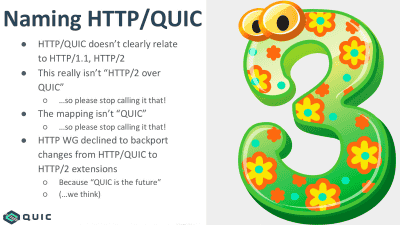
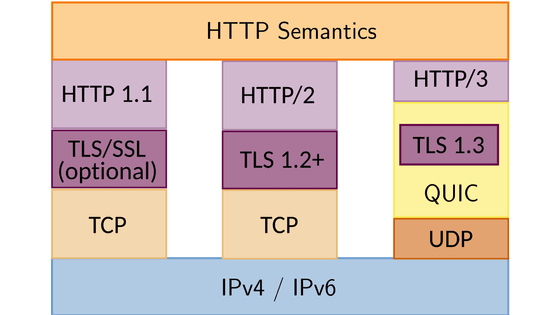
Similar problems have been pointed out on the web for some time, and in HTTP/2, which runs on TCP, 'Head-of-Line Blocking' occurs when packets are lost, causing subsequent data to be delayed. For the web, HTTP/3 has emerged, which uses QUIC instead of TCP, and GIGAZINE has explained it in detail in the following article in the past.

Homa aims to solve the problems of TCP by redesigning data center communication itself. Research on Homa dates back to a paper published in 2018 , in which Benham Montazeri and Osterhout proposed Homa as a protocol that can achieve both 'low latency for short messages' and 'high network utilization.'
A key feature of Homa is that it communicates using a 'message-based' architecture rather than a stream-based architecture like TCP. Homa is designed to use RPC (Remote Procedure Call), a mechanism for calling processes on other computers, so the length of the message being sent is known from the start. The receiving end can see the remaining amount of data and prioritize processing messages that can be received in a short amount of time.
Furthermore, Homa gives the receiving side the initiative in congestion control. The receiving side checks the volume of messages expected to arrive and specifies, using a notification called 'GRANT,' how much data each sender is allowed to send. This makes it easier for the receiving side to adjust the arrival order even if a large volume of traffic overwhelms a single server.
To prevent short messages from getting stuck in traffic, Homa also utilizes the priority queues of network devices. In Homa, which the research team released in 2018, a system is used that prioritizes communications with less data remaining until reception is complete. The aim is to reduce the waiting time that small requests have to wait behind large data transfers.
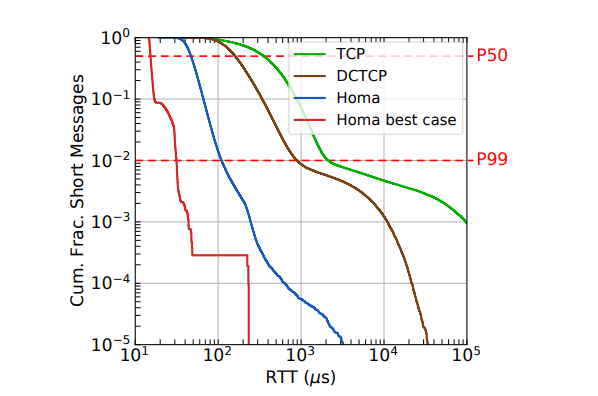
In a comparison presented by Osterhout to The Register under conditions of 100Gbps and 80% network utilization, the 99th percentile delay for short messages was 1.2 milliseconds for TCP, compared to 92 microseconds for Homa, which was about 1/13th of that for TCP. Osterhout also claims that Homa performed about twice as well as TCP for long messages.
A paper published in 2021 on the Homa implementation for the Linux kernel also reported that in tests using 40 machines, Homa recorded lower latency than TCP and DCTCP for all message sizes, with the 99th percentile latency for short messages being 1/19 to 1/72 of TCP and 1/7 to 1/83 of DCTCP.
The transition to Homa can be done gradually, and it is not necessary to discontinue existing TCP communication all at once. By installing the publicly available Linux kernel module on both the client and server, Homa and TCP can be used in parallel, allowing applications to be migrated to Homa sequentially. Osterhout is also working on performance improvements when using Homa and TCP simultaneously, and in January 2026, 'homa_qdisc,' which improves communication control when the two coexist, was added to GitHub.
Homa is not just a research project; standardization and integration into Linux are also progressing. IANA (Internet Assigned Numbers Authority) has already assigned Homa IP protocol number '146,' and Osterhout is continuously submitting patches to integrate Homa into the Linux core.
Development continues on the GitHub implementation, with a backport to Red Hat Enterprise Linux 8 and 9.5 in March 2026, and changes to the data transmission permission mechanism in September of the same year.
GitHub - PlatformLab/HomaModule: A Linux kernel module that implements the Homa transport protocol. · GitHub
https://github.com/PlatformLab/HomaModule
While QUIC became popular in the web world to circumvent TCP issues, Homa is targeting RPC within data centers. Osterhout is working on creating documentation for standardization at the IETF and integrating it into Linux, while also working on prototypes using Homa with major financial services companies. Rather than immediately replacing TCP, which has been the main player in networks for nearly half a century, he has indicated that he plans to first expand Homa in places with strict latency requirements, such as AI clusters.
Additionally, other low-latency communication technologies such as RDMA are also used for data centers.
Meta announces new communication protocol 'MetaRoCE' designed for 1 million GPUs, enabling high-speed connection of AI clusters over Ethernet, assuming packet loss - GIGAZINE

Related Posts:


in Note, Posted by log1d_ts