A Microsoft executive described AI-powered data scraping as 'the greatest labor theft in human history.'

In December 2023, The New York Times, the third-largest newspaper in the United States by circulation,
Microsoft exec called AI scraping 'the largest theft of labor in human history,' new unredacted filings reveal | TechCrunch
https://techcrunch.com/2026/09/17/microsoft-exec-called-ai-scraping-the-largest-theft-of-labor-in-human-history-new-unredacted-filings-reveal/
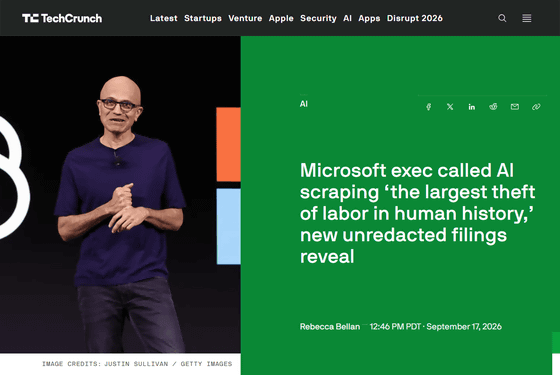
Newly released litigation documents reveal that Microsoft executives referred to OpenAI and Microsoft's AI training methods as 'theft' in private. OpenAI's management also stated that their AI models posed an 'existential threat' to publishers and journalists who created the content used for training.
Furthermore, the documents released reveal that OpenAI and Microsoft bypassed the paywall in a way that went undetected, built training datasets through large-scale scraping, and intentionally removed copyright notices from the training datasets.
However, TechCrunch noted that much of the information released this time is based on a brief submitted by The New York Times, and therefore not all of the supporting evidence itself has been made public, and much of it lacks context.
The New York Times' copyright infringement lawsuit has been ongoing for approximately three years, but as of the time of writing, there is no clear answer as to whether AI companies can legally use copyrighted content for AI training. However, judges in the lawsuit have generally been favorable to the AI companies' argument that 'AI training constitutes fair use .' In early September 2026, the Trump administration submitted a letter of opinion defending OpenAI for using copyrighted material to train its large-scale language model (LLM) without permission.
The Department of Justice has submitted a document arguing that 'AI training is fair use' in the copyright lawsuit between OpenAI and the New York Times - GIGAZINE

However, several statements revealed in the documents released this time contradict the defenses presented by OpenAI and Microsoft.
For example, according to publicly released Microsoft internal data, the company's answer engine, Copilot, is reducing click-through rates to The New York Times domain by up to 93% compared to the traditional search engine, Bing. In an internal presentation in January 2024, Brent Hecht, Microsoft's director of applied science, called this a 'destructive loop' and explained that it 'undermines the performance of our model and the web as a whole.'
Regarding this, Microsoft wrote, 'It is extremely rare for a final product to threaten the economic foundation of suppliers essential to that product. However, with regard to LLM's 'content supply chain,' we have created just such a situation,' pointing out that AI is producing results that are strangling the content creators who are essential for training the AI.
In addition, Microsoft CEO Satya Nadella stated in a deposition in early 2026 that 'content behind a paywall should be licensed to anyone who tries to use it for grounding or training.' He further added that if he had known that OpenAI was circumventing the paywall to scrape data and using it to train AI, 'he would have exercised his right to demand that OpenAI retrain its models.'
Furthermore, Nick Turley, who oversees ChatGPT at OpenAI, has revealed in internal communications that 'publishers are facing an existential threat from products like chatbots.' Turley stated that chatbots 'largely replace existing content' and that 'as their performance improves, their substitutability will only increase.'
Regarding these statements by OpenAI and Microsoft executives, TechCrunch pointed out that 'this shows that this technology (AI) does not alter the original work, but rather can directly compete with the original work.'
Furthermore, a document created by Microsoft points out that there is a real risk that generative AI could 'significantly disrupt the jobs of the very people who generated the data used to train the underlying models.'
The newly released documents also revealed that the dataset OpenAI used to train its AI included more than 91,692 data points from copyrighted works created by The New York Times, Daily News, and the Center for Investigative Reporting alone.
An internal memo created at Microsoft in January 2023 also records that the company's Hecht described data scraping for AI training as 'an astonishing theft on an unprecedented scale' and 'the greatest labor theft in human history.'

In addition, it has been revealed that OpenAI provided Microsoft with the entire dataset used for training GPT-3. Microsoft is recorded to have used this dataset to evaluate how to implement OpenAI's AI models in its own products. It has also been revealed that Microsoft provided OpenAI with AI training data through initiatives called 'Project Taxi' and 'Project Mango.'
OpenAI has also devised methods to bypass paywalls undetected in order to get the most out of data scraping. Public data shows that when OpenAI researcher Nick Ryder told OpenAI president Greg Brockman about a 'trick to bypass The New York Times' paywall,' Brockman responded with 'That's great.'
In addition, OpenAI appears to have used AI training datasets such as WebText and WebText2, as well as millions of articles stored by Common Crawl, for training its AI.
Regarding the information released, Stephen Lieberman, who represents the New York Daily News, said, 'The evidence that has now come to light for the first time shows that OpenAI and Microsoft knew that their actions were wrong.'
Related Posts:





in AI, Posted by logu_ii