Which programming languages are programmers migrating to? JetBrains analyzes responses from 8,837 people.

JetBrains, the developer of the programming language 'Kotlin,' surveyed 8,837 developers about their programming language usage. The results revealed which languages developers primarily use and which languages they have switched to in the past year.
Programming Language Migration 2025: Why Developers Switch
The following is a summary of responses to the question, 'Which programming language did you use in the past 12 months?' Data for each year from 2017 to 2025 is shown. JavaScript has consistently remained at the top, with Python being the second most popular in 2025.
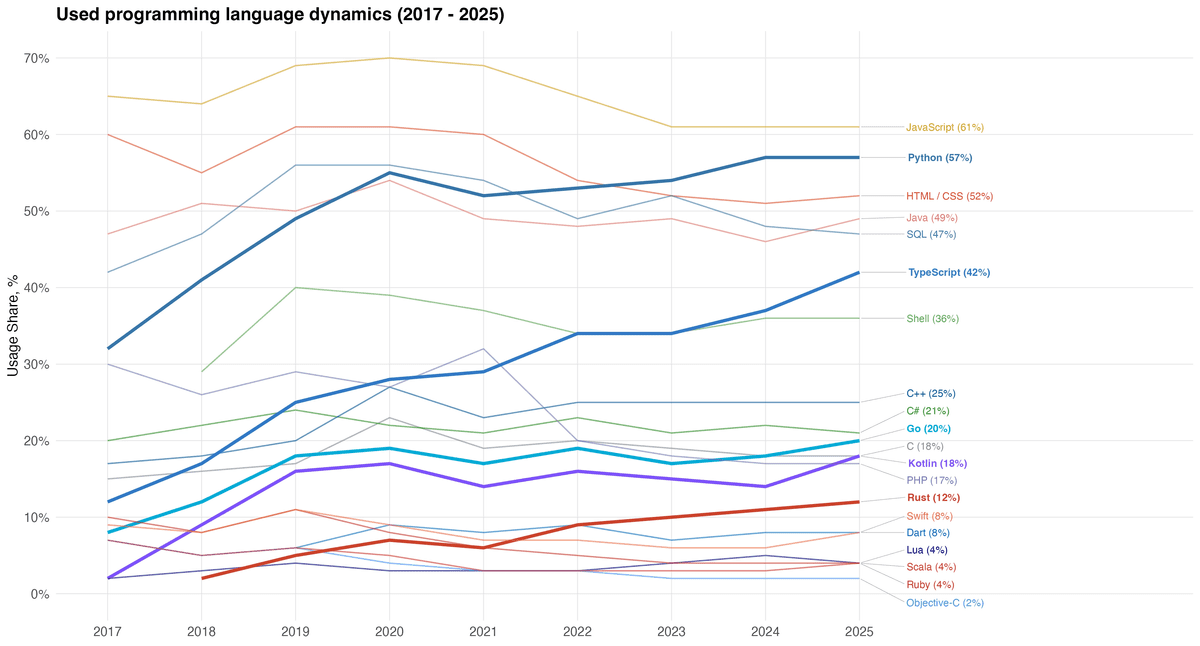
In written form, the rankings for 2025 are as follows:
1st place: JavaScript
2nd place: Python
3rd place: HTML/CSS
4th place: Java
5th place: SQL
6th place: TypeScript
7th place: Shell
8th place: C++
9th place: C#
10th place: Go
11th place: C
12th place: Kotlin
13th place: PHP
14th place: Rust
15th place: Swift
16th place: Dart
17th place: Lua
18th place: Scala
19th place: Ruby
20th place: Objective-C
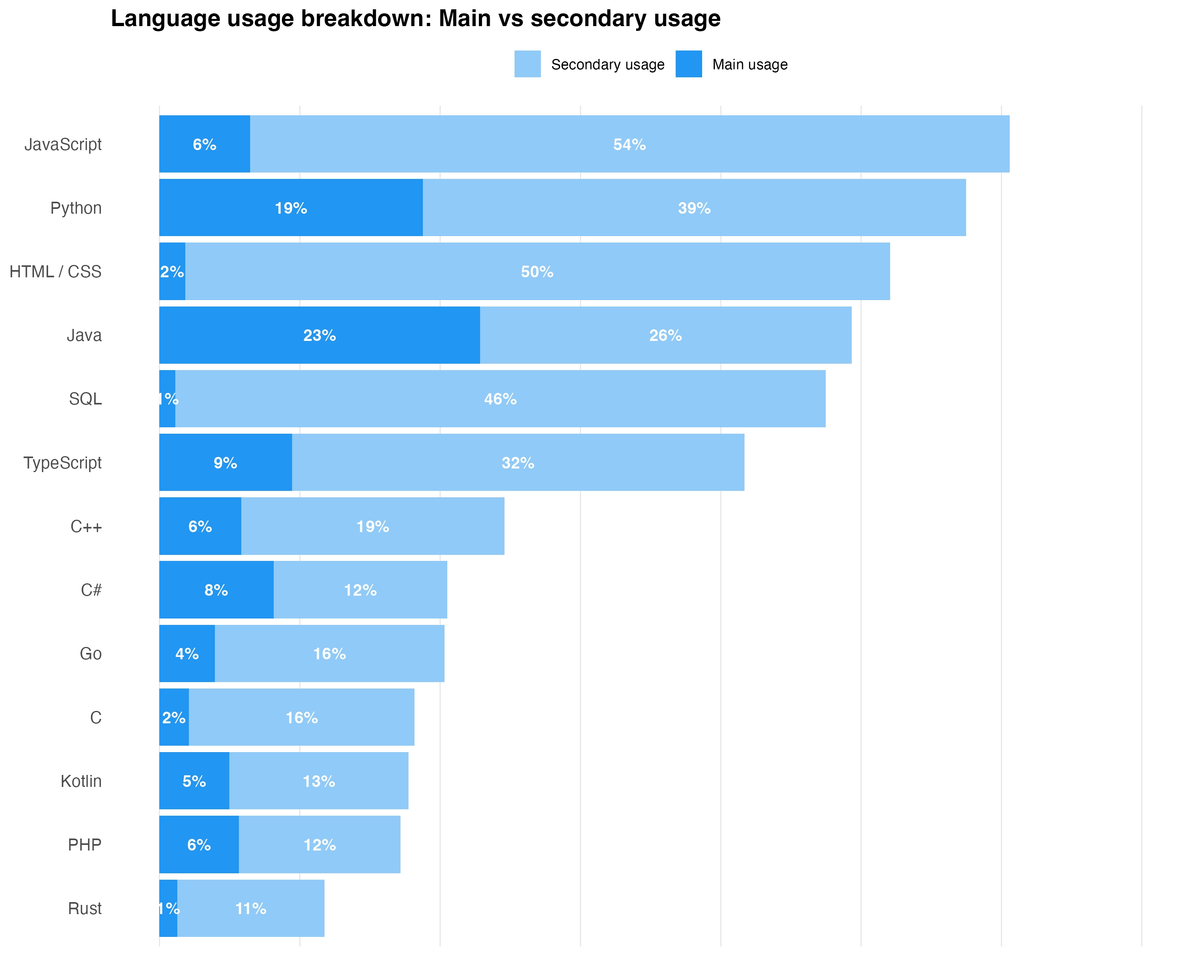
In response to the question, 'Please select the three main programming languages you use,' an interesting result was revealed: only 6% of respondents primarily used JavaScript. Java was the most widely used language, followed by Python.
Then, we asked, 'What was your main programming language 12 months ago?' and investigated whether users switched from their previous main language to another language. The results are as follows: Red indicates 'users who switched from their main language to another,' green indicates 'users who used a programming language for the first time this year,' blue indicates 'users who switched from another language,' and gray indicates 'users who did not switch.'
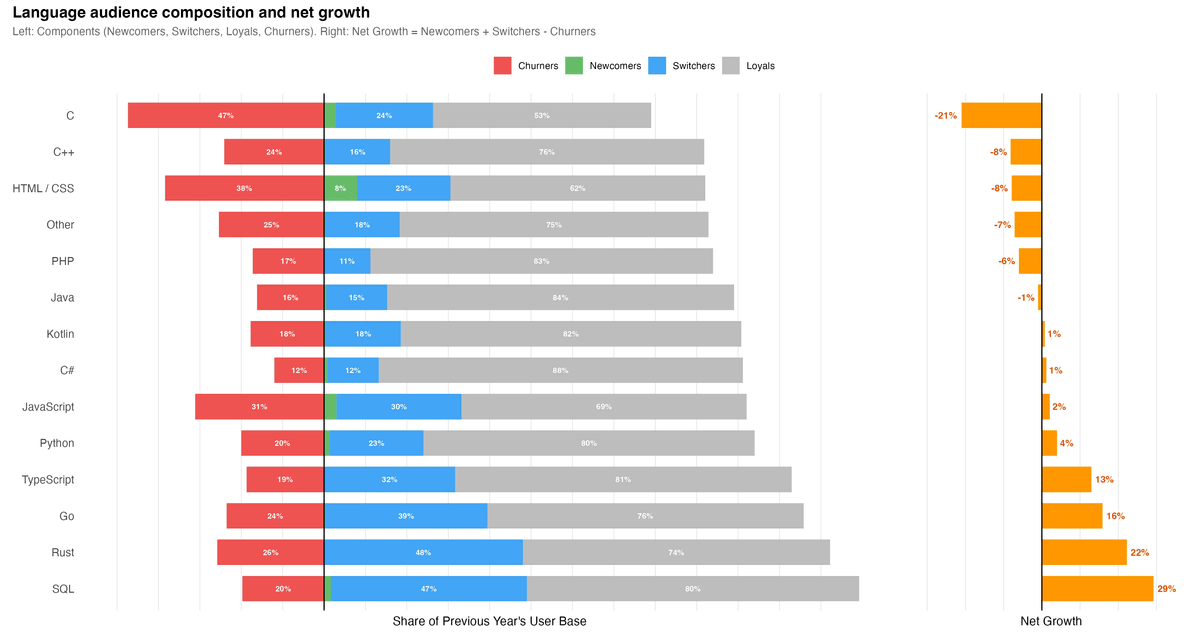
The results above show that the retention rate for the C language is the lowest. Approximately half of those who used C as their main language 12 months ago have switched to another language. JetBrains stated, 'Initially, we thought that this might consist of students who learned C through their curriculum and then switched to another language. However, when we took into account the developers' years of experience, we found that this was irrelevant. Half of those who left C cited 'wanted to learn a new language' as their reason for switching, which is a higher percentage than those who switched from other languages.'
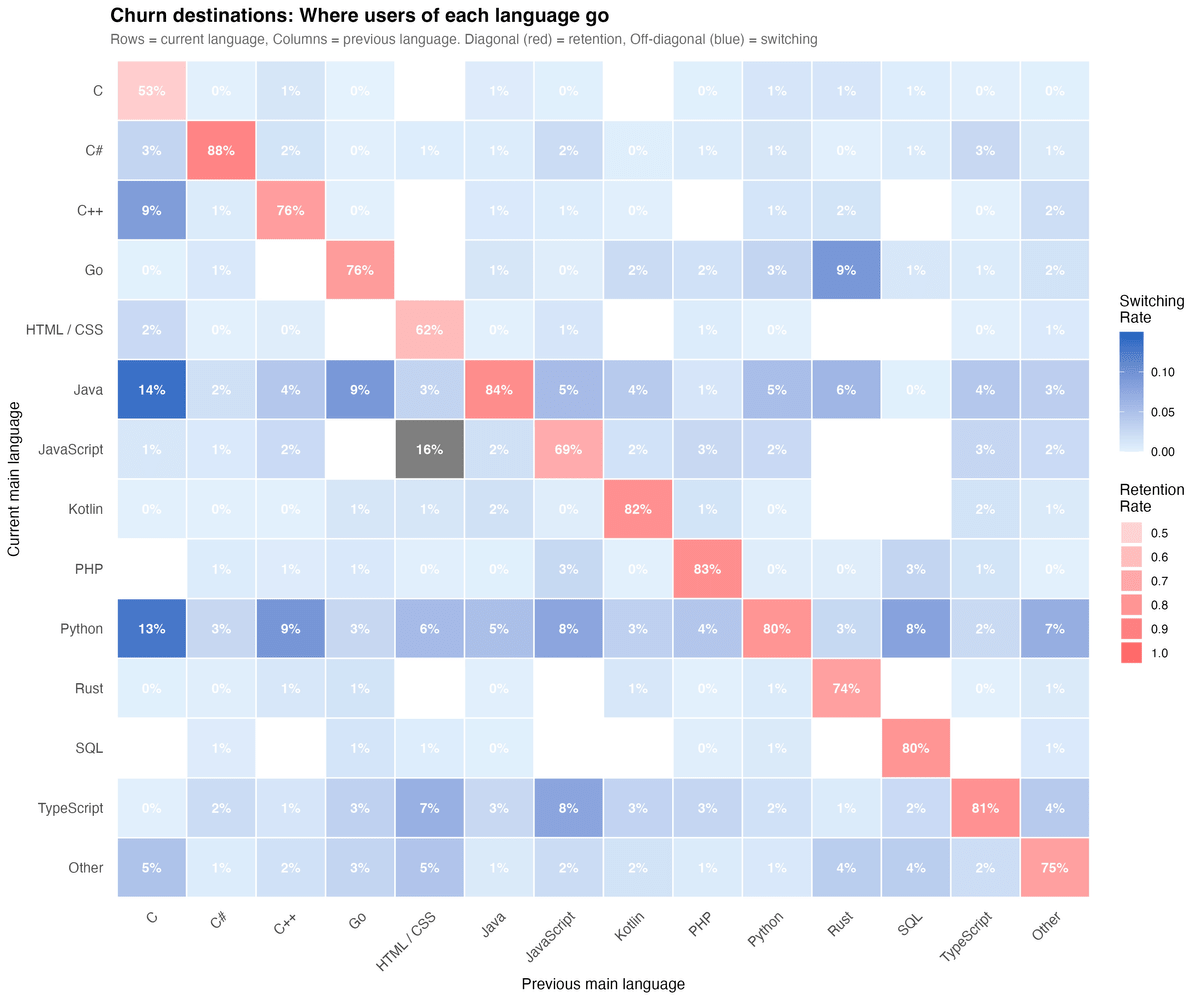
The following graph shows the migration rates from one language to another. Blue represents the migration rate, red represents the retention rate, the vertical columns represent the language used 12 months ago, and the horizontal rows represent the current language. For example, looking at the C column, we can see that 9% of people switched from C to C++, 14% switched to Java, and 13% switched to Python.
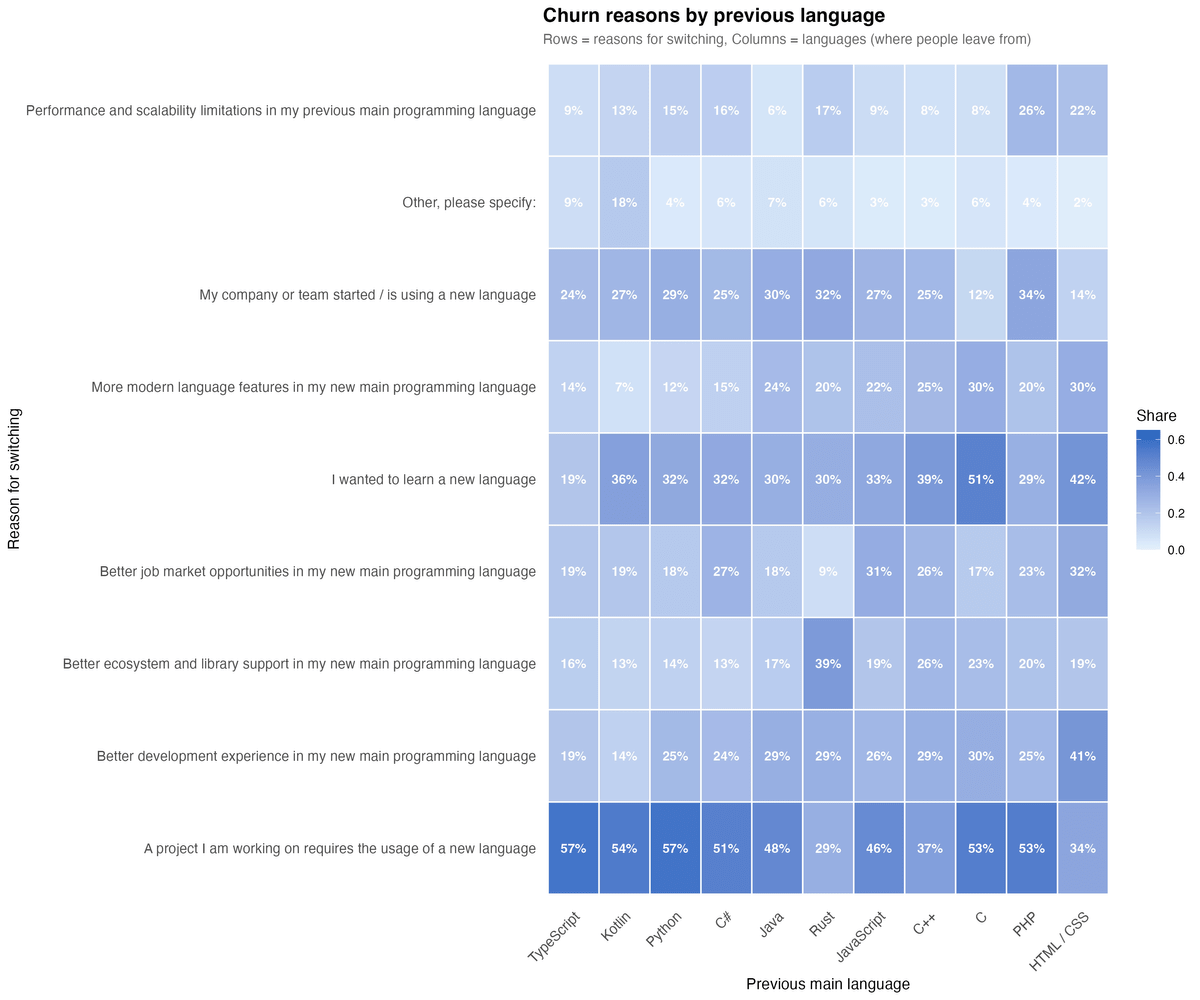
The report also summarizes the results of asking 'Why did you stop using that language as your main language?' The most common reason for switching languages is 'to comply with project requirements.' In particular, for C, the most frequently cited reasons were 'wanting to learn a new language' and 'seeking more modern language features.' For JavaScript, 'seeking better job market opportunities' was a common reason, and for PHP, 'performance and scalability limitations' was frequently cited.
Conversely, there are also results from the question, 'Why did you make that language your main language?' For JavaScript, a significant percentage chose the exact same reason as for 'Why did you stop using it as your main language': 'To seek better job market opportunities.' For C# and C++, 'To meet project requirements' was the most common reason, suggesting that many developers are simply migrating to these languages out of necessity. The main reasons for Go are performance and scalability, while Python is favored for its ecosystem and library support. JetBrains also emphasized that they are migrating to Kotlin not out of necessity, but because it offers a better development experience and more modern language features.
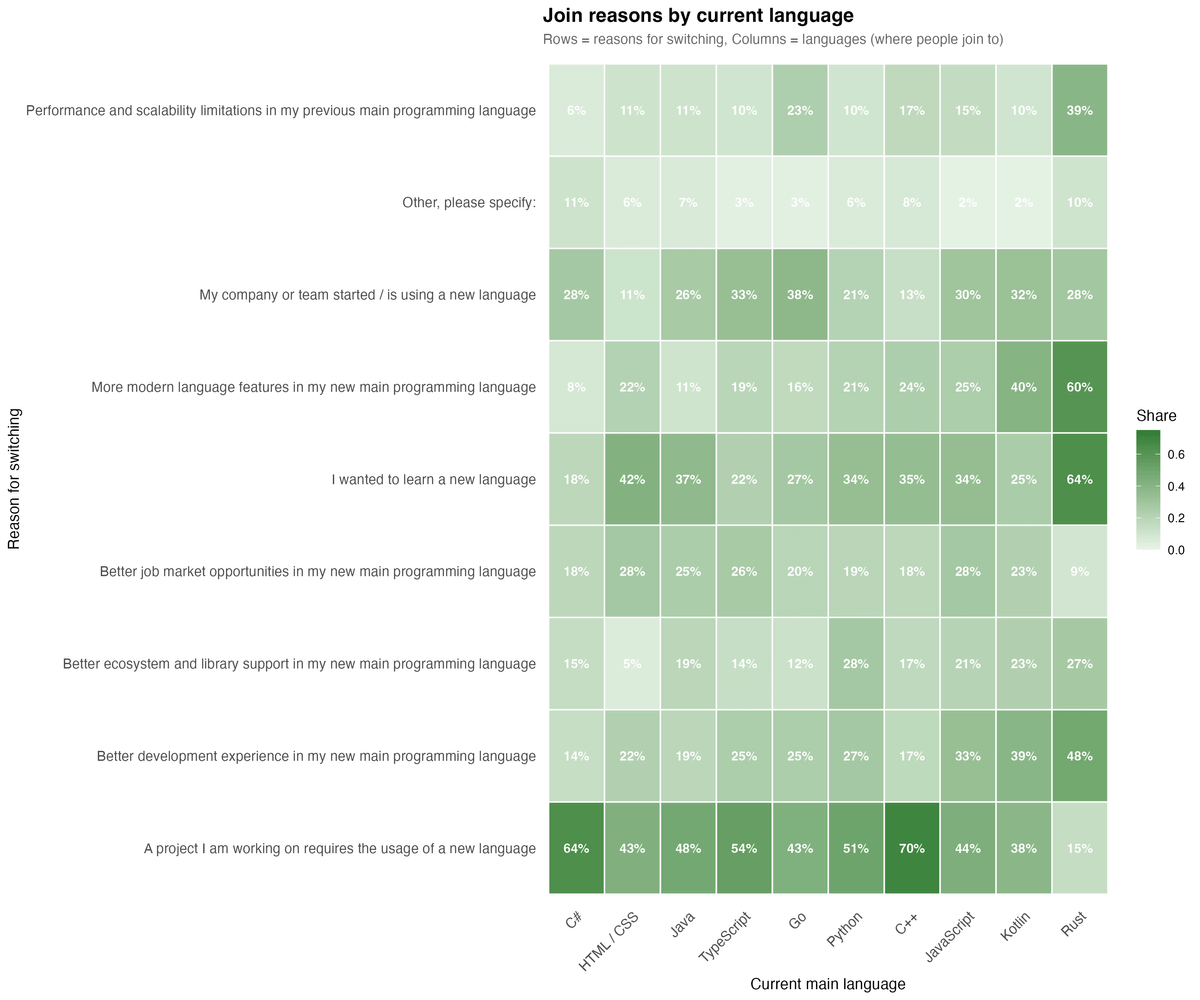
JetBrains summarized the results by noting, 'C shows a surprisingly high dropout rate, with Java developers tending to migrate to Python or TypeScript. Python is acting as a gateway for all languages. HTML/CSS developers are learning JavaScript to increase their job opportunities, while JavaScript developers are migrating to almost any other language for the same reasons. TypeScript and Rust still appear to be the cutting-edge languages.'
Related Posts:






in Software, Posted by log1p_kr