Google has launched 'Operation Blue Skies,' an initiative that uses AI to select flight paths with fewer contrails, aiming to mitigate global warming.

Contrails are formed when water vapor condenses on soot particles in the exhaust gases of jet engines on aircraft. They are one of the causes of global warming and account for approximately one-third of the aviation industry's impact on climate. For this reason, Google is working with the British government and the aviation industry to use AI to make air routes over the North Atlantic less prone to contrail formation. The initiative is called 'Operation Blue Skies.'
Google and UK Government launch AI contrail avoidance trial
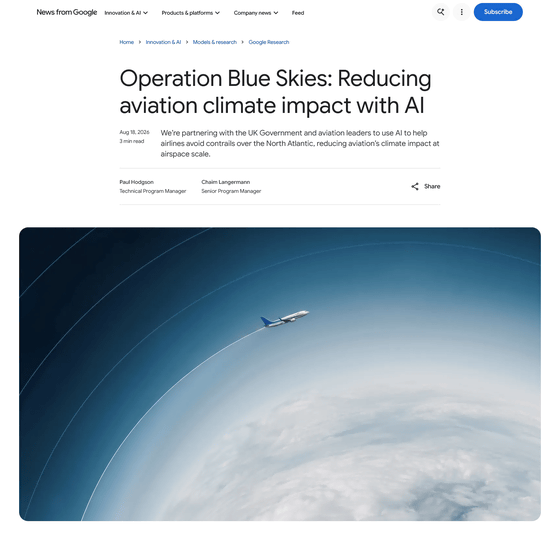
Since announcing 'Project Contrails,' a study using AI to mitigate global warming caused by contrails, Google has been collaborating with the entire aviation industry, including airlines, air traffic control agencies, and flight planning software manufacturers. They have demonstrated that preventing contrail formation can mitigate global warming, and AI-powered predictions are now enabling crew members and air traffic controllers to make accurate adjustments to avoid airspace that may be affected by contrails.
Contrails - Project Contrails
'Operation Blue Skies' takes this initiative a step further, aiming to reduce contrails not only through the operations of individual airlines, but also through a coordinated effort across the entire airspace.
The target area is the 'Shanwick airspace,' which is the eastern half of the North Atlantic airspace and accounts for 5% of the contrails that contribute to global warming. The program will run for 30 months (2.5 years), during which time the program will prevent the formation of contrails by changing the routes of some of the approximately 10,000 flights that pass through Shanwick airspace that are thought to contribute to contrail formation.
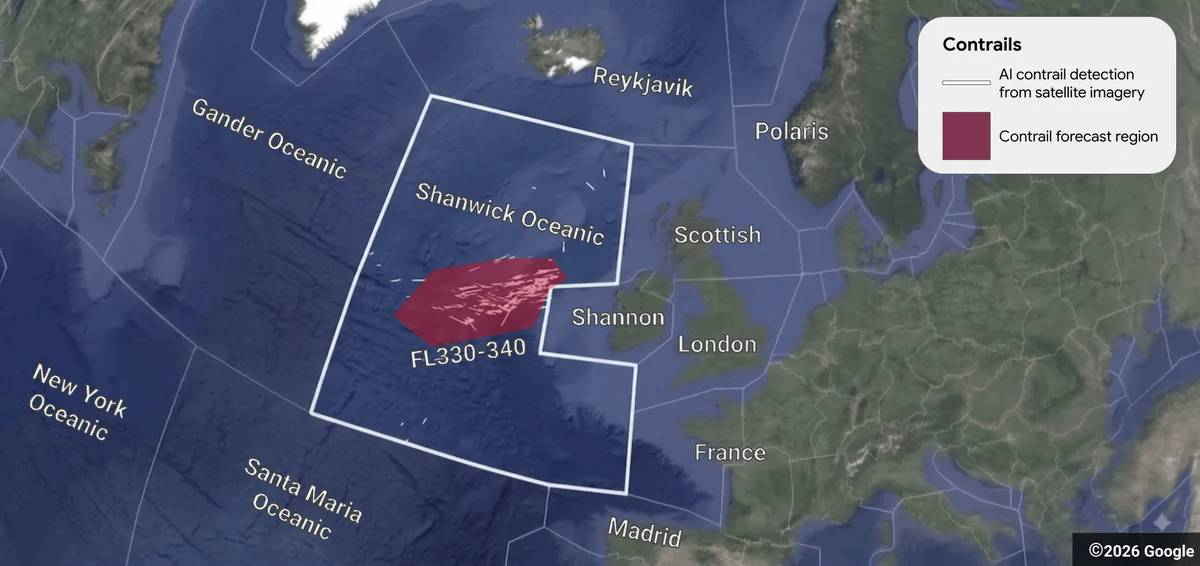
Google is developing AI models to predict and avoid the formation of contrails that contribute to global warming, and will track and verify their effectiveness using machine learning and satellite imagery.
In addition, NATS, a leading UK air traffic control company, will be responsible for conducting airspace operation tests, coordinating air traffic control, safety assessments, and training air traffic controllers. The non-profit research organization Contrails.org will oversee the evaluation, design test parameters, and provide data analysis support. Imperial College London and the University of Cambridge will evaluate the results and conduct independent verification, while the UK Met Office will work to build a contrail forecasting system and ensure the accuracy of weather information.
Related Posts: