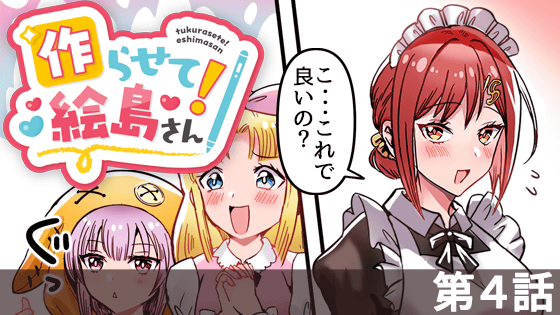
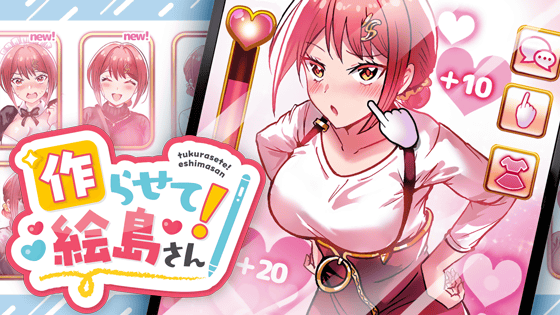
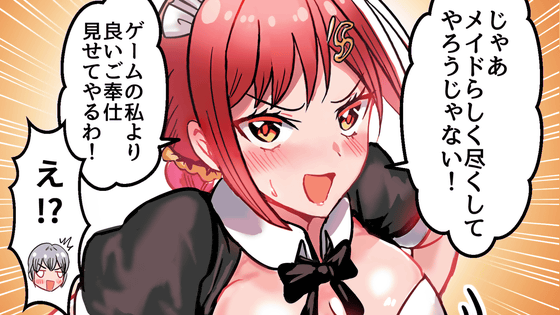
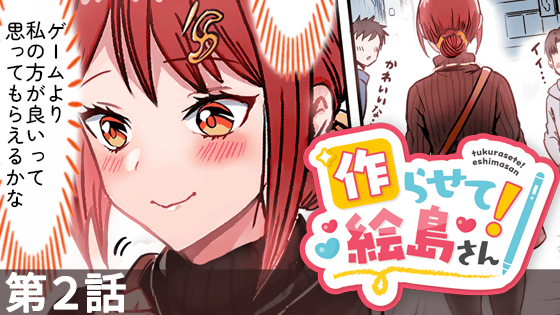
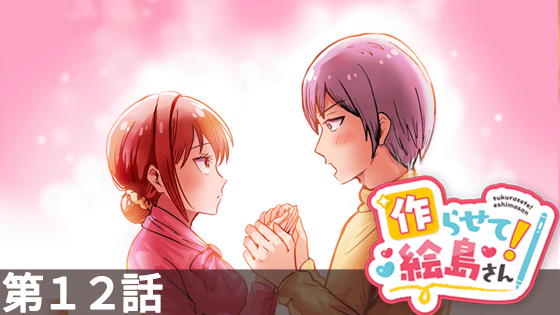
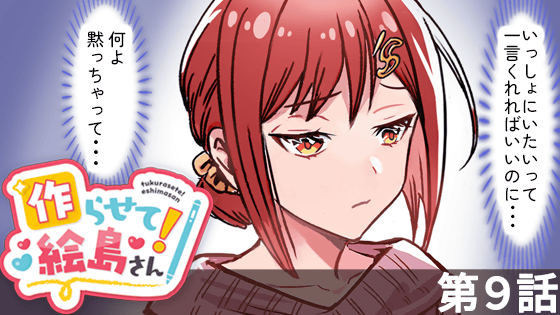
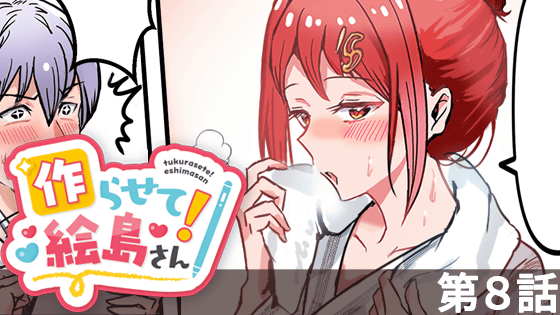
We interviewed the author of the manga 'Let Me Make It! Ejima-san' to ask about the points he focuses on and how he manages to balance working a full-time job with drawing manga.
We spoke in depth with Benihaa, the author of the full-color manga '
A full-color manga titled 'Let Me Make It! Ejima-san,' about a man who wants to turn his dream woman into a game VS a woman who wants to be seen for who she is, not as a game, has been released with plenty of newly drawn manga and bonus materials - GIGAZINE

GIGAZINE (hereinafter referred to as G):
First, I'd like to ask about the concept behind the work. When 'Let Me Make It, Ejima-san' was submitted, the first episode was almost finalized, and then the 'date episodes' of episodes 2 and 3 were created, and the flow of 'Ejima goes on the offensive, but Kaido sublimates it into game creation' was solidified. On the other hand, it seems that the ending where Ejima and Kaido get together, and the 'working adult arc,' were conceived in prototype works. Could you tell us about the parts you worked hard on and the difficulties you faced, such as creating the story along the way, brainstorming ideas, and structuring it to connect with the concept of the ending?
Benihaa:
In the prototype submitted for the contest, 'Sensitive Girl and Complicated Boy,' the story focused on the interactions between Kaido, whose passion for the things he likes goes a little too far, as he ends up creating romance games and touch games based on the girl he likes, and Ejima, who tries to get the girl to see him for who he is, not just in the game, but ends up blushing himself.
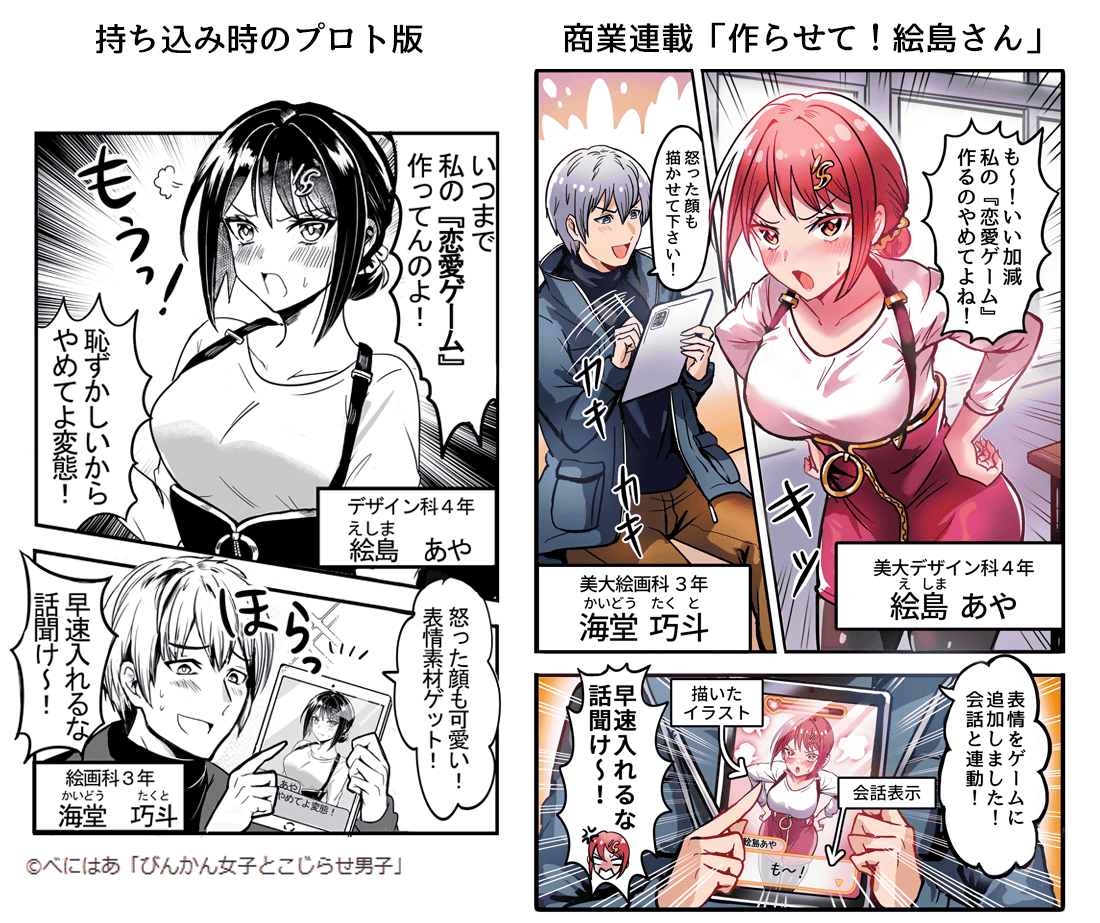
On the other hand, even from the prototype stage, I had been thinking about the relationship between the two after they started dating. In the working adult arc, which I drew as a hobby before commercialization, I depicted the two from dating to married life, showing the contrast between Ejima, who is strict and reliable at work, and at home, who cosplays for the games that Kaido makes.
Ejima is usually a strong-willed character, but instead of dismissing what Kaido likes, she enjoys it with him no matter what, tries to learn about games, and ultimately accepts him with kindness. I wanted to depict the relationship between these two, which is unique to them. In the commercial version, in order to lead to their future, I first focused on 'why these two come to like each other' and 'how they build a relationship of trust.'
G:
The themes of 'how to connect the two of them to a future' and 'how to build a relationship of trust' were evident throughout the story, as Ejima, who was mostly the one making sarcastic remarks in the first episode and during their dates, gradually became interested in Kaido's game creation and began to understand and accept his love little by little. I felt that these changes matched the events in the story (school festival, trip, etc.), but when creating the story, which was prioritized: the events or the changes in their relationship?
Benihaa:
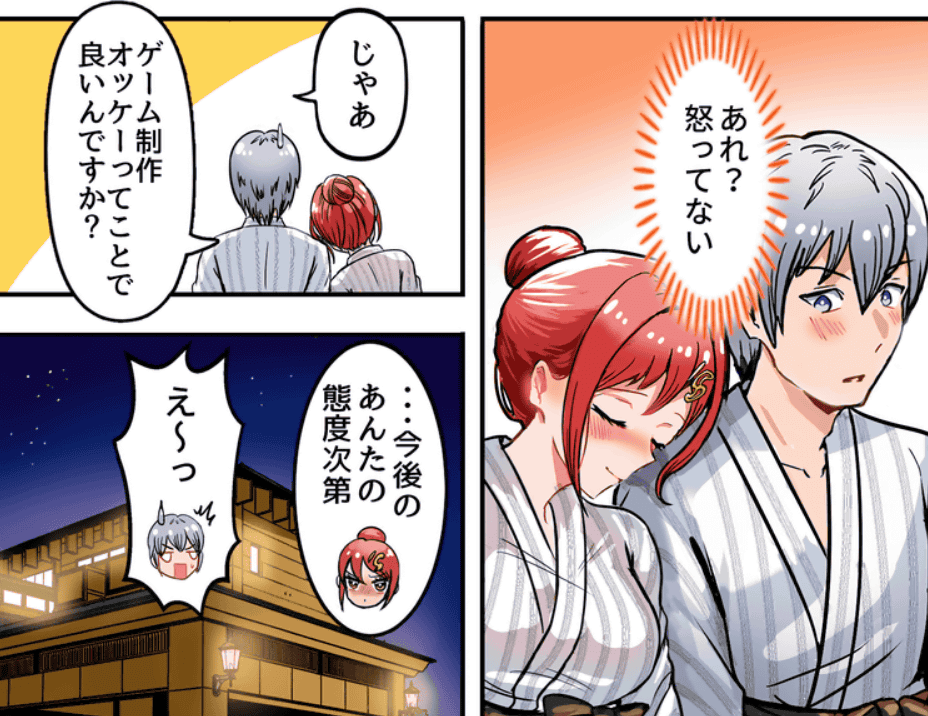
I'm glad to hear you said it was a good match, thank you. When creating the story, I prioritized thinking about 'what kind of event should I have to bring about this kind of change in their relationship?' For example, in the case of the school festival in episode 7, in order to depict 'they want to be together even more,' it was necessary to deliberately avoid the everyday situation where 'it's natural for them to meet at the game club.' So, in the school festival event, Ejima and Kaido become anxious when they can't contact each other. Through a series of coincidences, they are able to go around the school festival together, and this episode became about how they want to become the kind of people who can naturally make plans to meet up just the two of them from now on. The same goes for the hot spring trip before graduation in episode 8. In order to show Ejima and Kaido's true feelings and bring them closer together, I made the 'hot spring trip event at the game club' an episode where they can relax in a space separate from university.
G:
In the meetings for the serialization, the basic storyline was already decided, and the meetings mostly consisted of adjusting the finer details. Were there any parts that you struggled with or any particularly memorable points during the revision process in the meetings?
Benihaa:
In the commercial version, it was necessary to depict the gradual change in the relationship between the two characters within the limited number of 12 episodes. The prototype submitted for the competition had a strong focus on Kaido's unique game-making and Ejima's sex appeal, with self-contained gag elements in each episode, and there was still little depiction of the change in their relationship. Also, in terms of direction, there were many close-ups and upper-body shots, and there was room for improvement in the way the manga was presented, such as the background and wider shots. In terms of direction, we increased the number of panels with backgrounds, wide shots, and full-body shots, and adjusted the settings to better convey the characters' emotions and situations.
G:
What changes have there been in terms of the storyline?
Benihaa:
In terms of the story, at first glance, Kaido seems like a weirdo who just makes games however he wants, but at its core, it's about showing that he 'likes Ejima,' and Ejima, in addition to the sexy elements, is also shown to 'accept Kaido's enthusiasm' while making sarcastic comments about the game. This process was pointed out to the readers, and we adjusted it so that it would become a romantic comedy where the relationship between the two progresses.
The episode that was particularly difficult to develop was episode 8, the hot spring episode. It was an important episode where the distance between the two characters would significantly shorten, so instead of the usual gag-centered development, we needed to depict the change in their feelings naturally, and I remember making many revisions. As a result, it became an episode that conveyed that Ejima had accepted Kaido's game. I think it was an important episode as it served as a prelude to the turning point that would later be graduation.
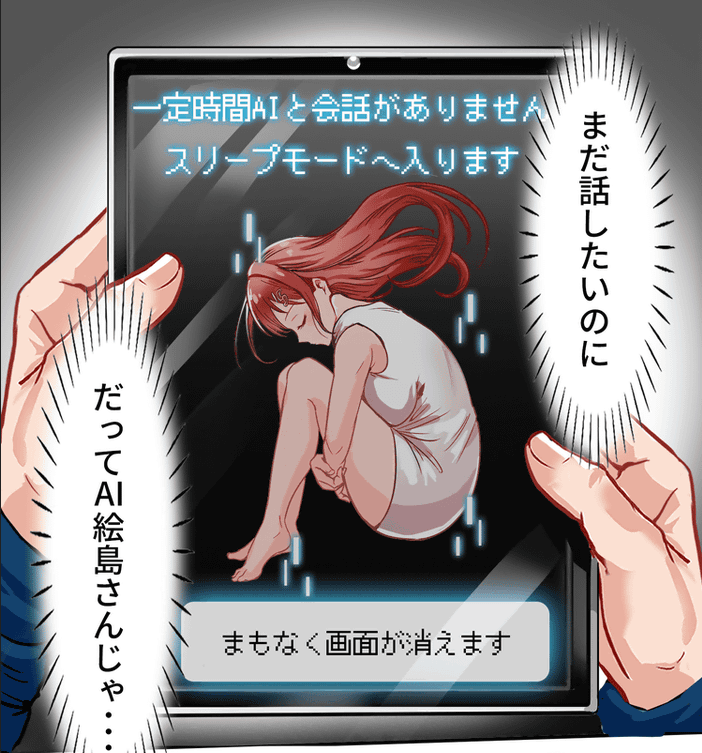
I also have fond memories of episode 10, the episode featuring 'AI Ejima.' As Kaido interacts with the AI Ejima, he notices the discrepancies between her and the real Ejima. The suggested direction for the conversation scene with the AI Ejima, particularly regarding the sense of unease she evokes, was excellent and led to the emotional reunion of Kaido and the real Ejima after their temporary separation. I also received a lot of advice on the direction of this episode. Throughout all the episodes, the editor-in-chief and my editor provided me with detailed revision suggestions, allowing me to learn many perspectives I wouldn't have noticed on my own. There were challenging parts, but I made new discoveries with each episode, and I thoroughly enjoyed the production process. Thank you so much.
G:
Since the topic of 'AI Ejima' came up, I'd like to share some behind-the-scenes stories from the production process. There was an idea to gradually incorporate the word 'AI' throughout the entire work. At the time of production, AI was already a huge trend, and I think there was also an intention to use it as a foreshadowing of AI Ejima towards the end, but ultimately, there was no depiction other than AI Ejima. Could you tell us about the intentions behind this as well?
Benihaa:
As you said, AI is a popular topic these days, so I thought it might be good to include the word in relation to the theme of the work. However, I felt that including the word 'AI' from the first chapter would be incompatible with this manga, so I didn't include it. In chapter 3, as a foreshadowing, Ejima expresses concern that 'she might create an AI of me,' the word is introduced. In chapter 7, AI is added as a messaging function. In chapter 8, the function to have the AI create travel plans is added. Chapter 9 is an introduction to AI Ejima, and chapter 10 is the full appearance of AI Ejima. I kept the AI setup to a minimum.
The reason we didn't start with episode 1 is that if we made AI the theme, it would be difficult to create a game about the desires of the girl you like. Kaido is capable, but he only makes silly games. I think AI is inherently capable. The touching game in episode 1 is an easy-to-understand desire game where you think, 'Ah, he wants to touch the girl he likes,' but if it had appeared as a touching game with AI, we would have had to explain a lot to the readers about the relationship with the AI, and I thought it would no longer be enjoyable as a romantic comedy about making games. We would have had to explain what it means to make a game about the girl you like, and then also explain what AI is, which I thought would make it difficult for readers to get into the story.
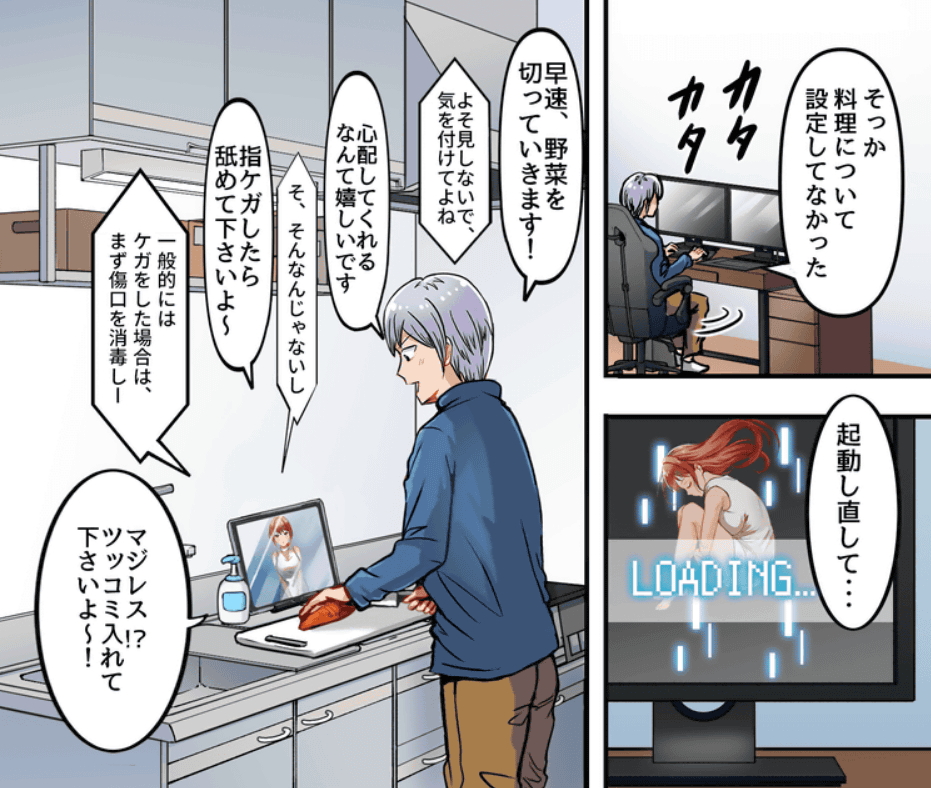
Therefore, to first show how Kaido's enthusiasm leads him to create a game, I didn't include the word 'AI.' If I had portrayed him as a guy who creates AI, I think the madness would have been stronger than the perverse humor. In fact, when Kaido was talking to AI Ejima in episode 10, I thought that if he had been like this from episode 1, readers would have found it more frightening than funny (lol).
G:
Benihaa-san creates manga while working a full-time job, and there were times during the serialization when she was busy with other matters, but she never missed a deadline for her manuscripts according to the initially set schedule, and her responses for confirmation and revisions were very quick. She has actually continued to create works like this while working another job, but are there any tips or tricks she keeps in mind in her daily life to make time for creative work while juggling two jobs?
Benihaa:
Thank you so much for your kind words. I believe the biggest reason I was able to continue creating while working full-time was the flexibility with which the editor-in-chief and staff at GIGAZINE accommodated my schedule. I was attracted to the part of the job posting that said 'there are no strict deadlines and scheduling is easy,' which was one of the reasons I aimed to create a series.
I've always loved creating manga, and before my child was born, I used to work on it on weekends. Even while balancing it with a full-time job, there were times when I could concentrate on creating, but my production time fluctuated depending on my work situation, so I was looking for a way to continue serializing at a stable pace in the long term. Therefore, I thought it was important to secure production time in advance in order to continue creating manga while continuing my main job. So, when I told them that if serialization was decided, I wanted to build up a backlog of drawings and that I wanted to start serialization later, they readily agreed. In fact, I was given about six months to a year to work on before serialization began, and being able to flexibly adjust the start date of serialization while considering my life after giving birth was a huge help.
G:
In fact, once the serialization was decided, Benihaa-san gave me very detailed suggestions regarding the timing of finishing the manuscript and the publication schedule.
Benihaa:
Looking back now, I realize that I was planning my schedule quite far into the future, so my anxious nature may have actually been helpful in an unexpected way (laughs). But it was because they accepted that plan that I was able to continue creating without difficulty and achieve my goal of juggling two careers.
G:
This overlaps somewhat with what you said in the bonus section of the comic, but you mentioned that because you're involved in game development, you wanted to create a work related to games, and that's how you came up with the original concept for 'The Awkward Boys Are Invading.' What was theきっかけ (trigger/reason) for deciding to put the theme of game development into the 'romantic comedy' genre? Also, the concept of 'a weird guy who tries to make his own game' was impactful as a game development x romantic comedy concept, so I'd like to hear more about what came about and how that idea was born.
Benihaa:
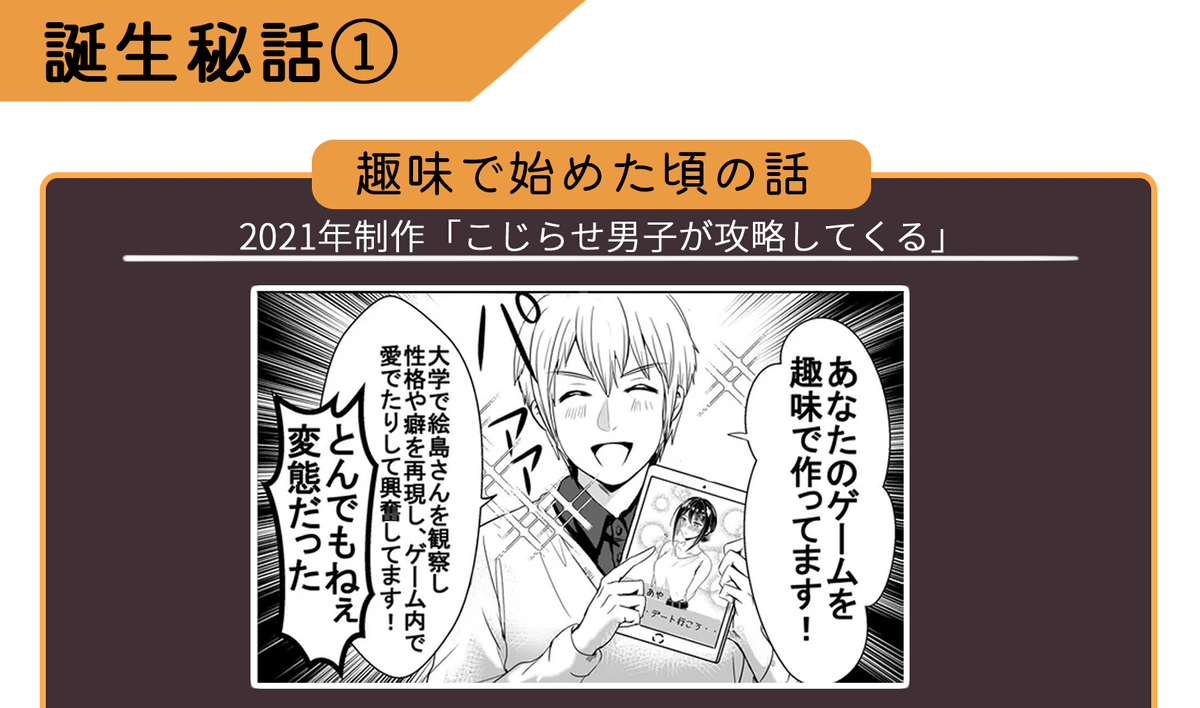
Because I work in game development myself, I wanted to create a story about game creation. However, I felt that if I made game development itself the main focus of the manga, it might be a little difficult for readers to get into, and I also felt that it would be difficult for me to continue drawing it for a long time. So, since I've always liked characters whose passion for something is so strong that it goes a little astray, I thought I would create a protagonist who, as a result of being engrossed in something, ends up making a game. While thinking about what kind of game to make, I remembered how I was obsessed with a game where I took care of hamsters when I was in elementary school. I love hamsters, but actually raising and taking care of them is hard work. But in a game, I could dote on them as much as I wanted. I remember how much fun that feeling was back then. From there, I thought, 'What if the protagonist made a game about the girl he likes?' However, simply making a real girl the subject of a simulation game felt unnatural, so I thought that if it was in the form of a romance game, it would naturally work as a romantic comedy, and that's how the character of Kaido, who makes a game about the girl he likes, was born.
However, simply creating a romance game for the girl he likes wouldn't make for interesting characters, so I thought, 'It would be fun to have a character who reflects their desires in the game.' Creating the game on the spot would give it a better tempo, and the game's implementation could be presented in a manga-like style, making it visually appealing. This led to the creation of Kaido, a quirky, eccentric guy with an intense obsession with games who always carries a tablet. However, this alone would have resulted in a rom-com style gag that was almost entirely a one-man comedy, and it wouldn't have been a rom-com where the relationship changes, so I needed to properly define the other character. To make the heroine just as distinctive as Kaido, I thought, 'A strong-willed character who initially doesn't agree to game creation would be good,' and that's how Ejima was created. Also, on a personal note, I'd always wanted to draw a strong-willed female character blushing, so that motivated me. As for Ejima, I've always liked strong-willed older sister characters in anime and such, so I created her as a girl who is usually reliable but a little clumsy when it comes to romance.
G:
As for the titles of works based on the same concept, including the prototype version, there were 'The Awkward Boys Are Invading,' 'The Sensitive Girl and the Awkward Boy,' and 'Ejima-san, Who's Sensitive But Acts Strong,' and the work serialized on GIGAZINE was titled 'Let Me Make It, Ejima-san!' Please reflect on the intentions behind each title and the process that led to the final decision on 'Let Me Make It, Ejima-san!'
Benihaa:
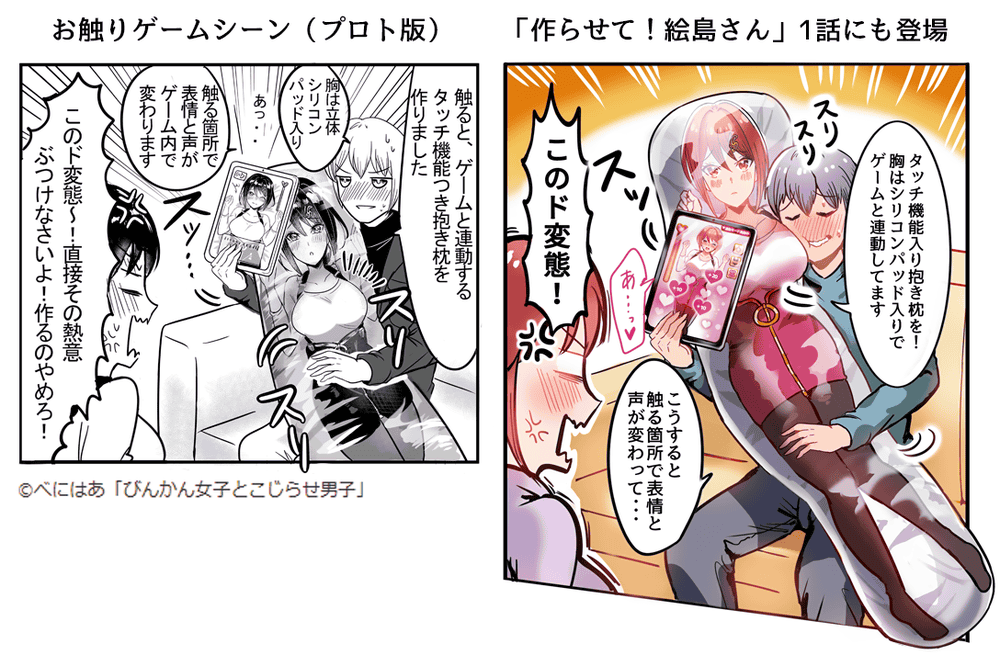
'The Awkward Boys Are Invading' was a title that highlighted the strong personality of the character Kaido. However, at that stage, the focus was on the 'fun of Kaido pursuing what he likes,' and the structure of Kaido unilaterally creating a game using Ejima as the subject was stronger than the relationship between the two. So, in 'The Sensitive Girl and the Awkward Boys,' we changed the game content to a 'touching game' that is easier for readers to imagine, so that readers can enjoy the relationship between the two more.
G:
The story shifted from focusing on one 'complicated man' to focusing on two people: a sensitive woman and a complicated man.
Benihaa:
Yes, that's right. Ejima, being a 'sensitive girl,' doesn't just mean she's physically sensitive, but also that she's sensitive to Kaido's actions in setting up games. I also wanted to create a scenario where Ejima doesn't just become the subject of a game, but takes the initiative to get Kaido to notice her for who she is. So, I included an element where Ejima tries to boldly approach Kaido with physical contact, but then gets embarrassed and sabotages herself, which helps to show the distance between the two and adds to the humor of the romantic comedy. In the end, when I was discussing 'Let Me Make It, Ejima-san,' the editor-in-chief told me, 'Let's convey to the readers that their relationship progresses through the act of making something.' Hearing that, I realized that the theme of the work wasn't just about making games, but about the two deepening their relationship through the act of 'making' something, so I suggested changing the title, and it became 'Let Me Make It, Ejima-san.' The phrase 'Let me make it' also appears as a key line in episode 12, so I hope everyone will read it to the very end.
G:
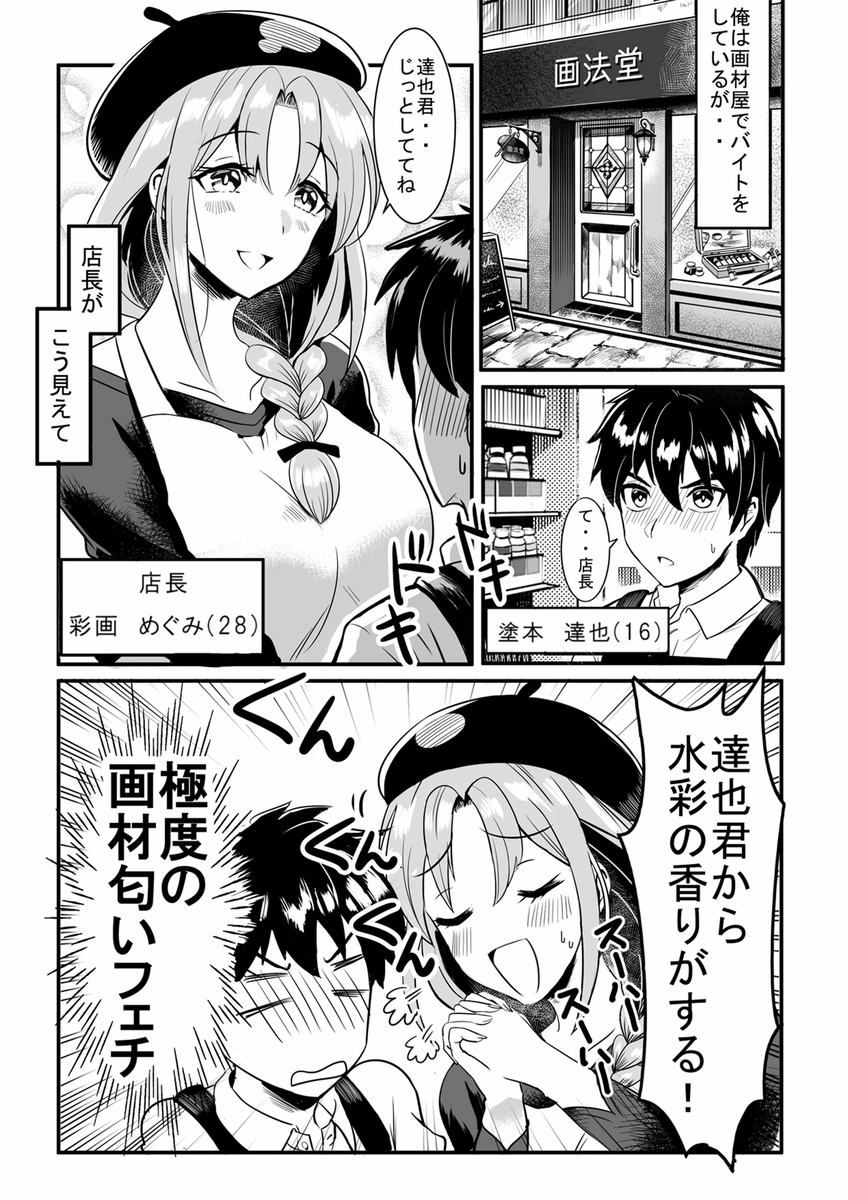
I also read Benihaa's previously published works, 'The Art Supply Shop Lady' and 'Reincarnated Office Worker Magical Girl.' Although the concept is different, 'The Art Supply Shop Lady' is basically a comedy with a thrilling romance, and the reading experience is similar to 'Let Me Make It, Ejima-san.' I would like to hear about any lessons learned from your experience and feedback on past works, and any aspects that were incorporated into 'Let Me Make It, Ejima-san.'
Benihaa:
Looking back at my past works, 'Reincarnated Corporate Slave Magical Girl' was based on the toxic work environment I experienced before changing jobs, and I was conscious of creating a different kind of tension and relatable elements compared to romance. Also, in 'The Art Supply Store Lady,' I was conscious of depicting theドキドキ (heart-pounding) feeling of characters growing closer within a comedy. However, in my previous works, in addition to the niche nature of the theme of explaining art supplies, I included too many elements that I personally liked, which sometimes made it difficult to understand the core of the work and what I wanted to convey to the reader. Learning from that experience, in 'Let Me Make It! Ejima-san,' I was conscious of making the elements that I wanted readers to enjoy clearer, focusing on the theme of turning the girl you like into a game and the development of their relationship as a romantic comedy.
In terms of direction, I made sure to keep in mind the aspect of 'making the moments when the characters' emotions change dramatically impactful,' which I had been conscious of since my previous four-panel comics, even in this commercial serialization. With the relationship between Ejima and Kaido, I made sure to convey their feelings not only through their usual comical banter, but also through subtle changes in their expressions and the distance between them. Because of the trial and error experience I had with my previous works, I think I was able to be more conscious of the balance between what I wanted to draw and what readers would enjoy in 'Let Me Make It, Ejima-san!'
© Benihaa 'The Lady at the Art Supplies Shop'
G:
'Let Me Make It, Ejima-san!' basically revolves around Ejima and Kaido, and the story features them almost constantly. Starting with scenes from their university life, they change outfits in each episode, from dating outfits to cosplay, swimsuits, and yukata, and are depicted in memorable panels. Do you have any particular favorite Ejima, outfits, or episodes?
Benihaa:
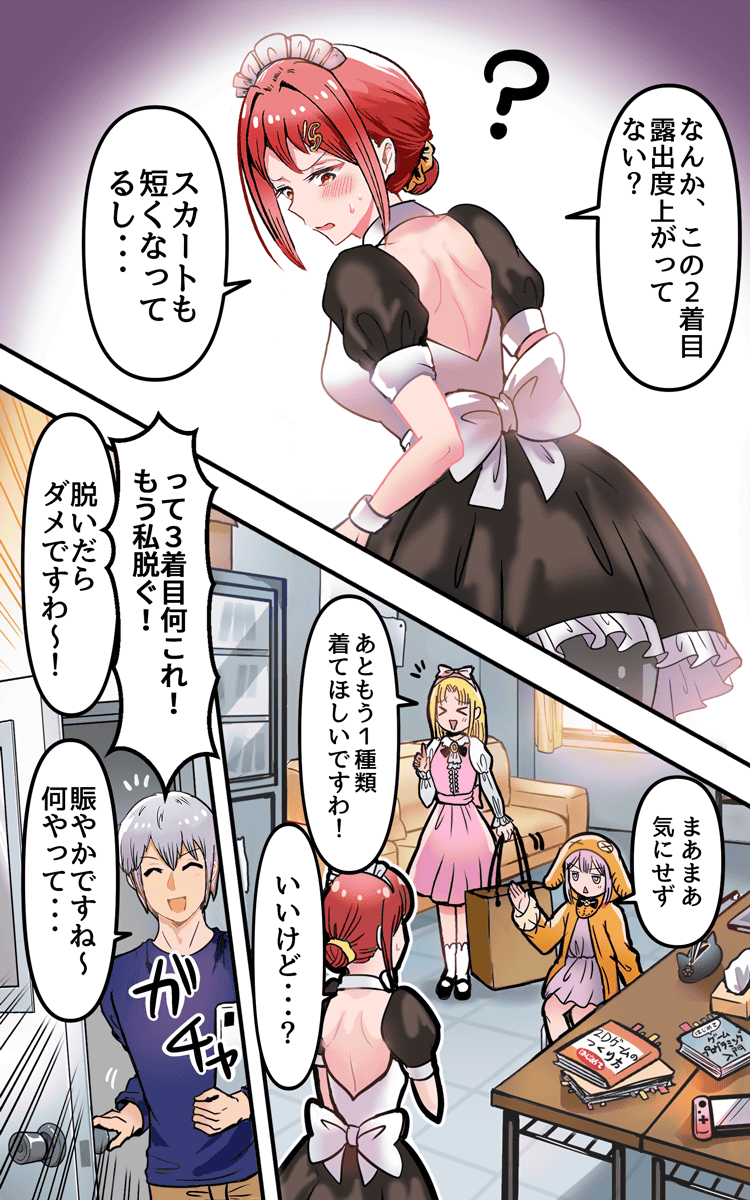
My favorite outfit is the one in the maid cosplay episode. I love seeing Ejima blushing in that maid outfit. In the planning for this episode, we received feedback that 'it might feel a little out of character for Ejima to wear a highly revealing maid outfit from the start.' So, the younger characters, Kaneori and Kobari, prepared three different maid outfits, starting with a classic long maid outfit and gradually increasing the level of exposure in three stages. I think we were able to make the most of Ejima's personality, her strong-willed but shy side, while also bringing out the fun of a romantic comedy. Overall, we were conscious of not just changing the outfits, but also making sure that viewers could enjoy the characters' reactions and the changes in their relationships when they wear those outfits.
G:
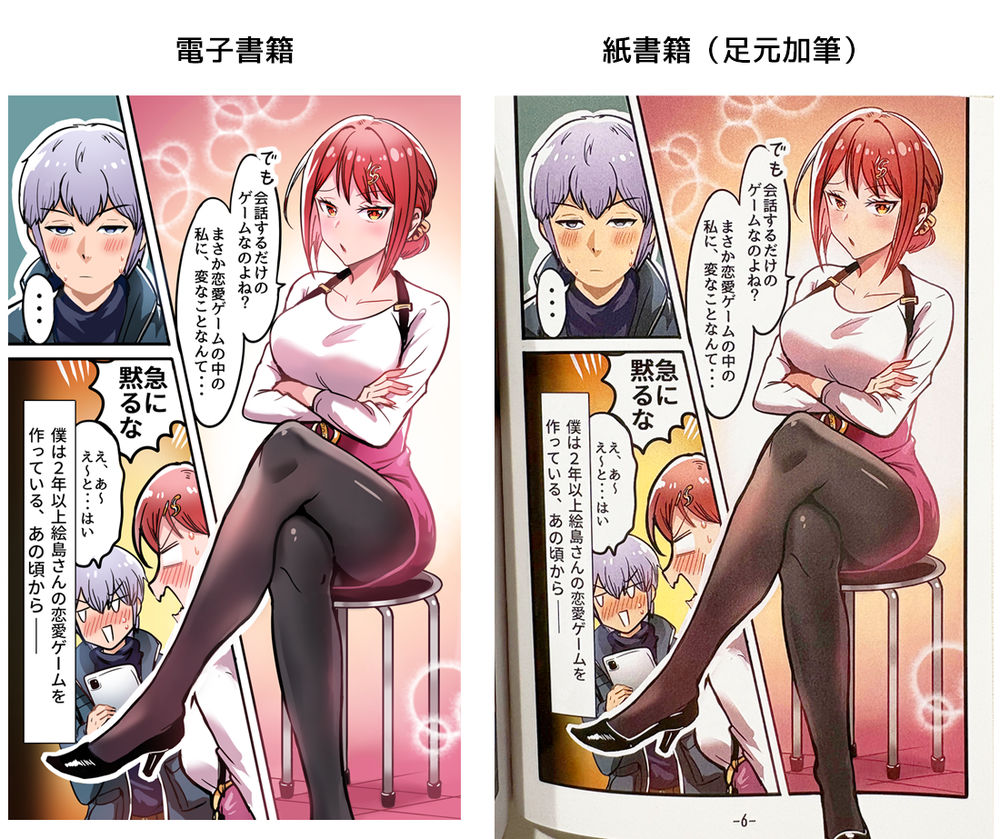
For this comic book, Benihaa-san proposed all the designs for the cover, back cover, and table of contents, created an original episode for the comic book, and added bonus pages. Also, regarding the paperback version, while it's common for us to convert the ebook data into a paperback format, Benihaa-san created the final data for the paperback version of 'Let Me Make It, Ejima-san!' Thanks to her, we were able to incorporate pages and designs that look great on paper. Was her proactive approach to creating the paperback data due to a strong commitment to and passion for paper books?
Benihaa:
I've always had a strong desire to have my work published as a physical comic book. Because my work in game development involves not only illustrations but also design elements like buttons and banners, I wanted to focus on the overall design of the book, including the cover, table of contents, and page layout, not just the manga itself. While ebooks are primarily read on a screen, I believe that the experience of turning pages and the desire to have a physical book that you want to keep are equally important. Therefore, I created the cover, back cover, table of contents, and bonus pages with the thought of 'how can I make this work enjoyable as a complete book?' in mind. Furthermore, I wanted the newly drawn content to be more than just extra pages; I wanted it to be something that those who supported me until the end could truly enjoy. I'm incredibly happy that I was able to deliver the work in its final form. Being able to handle the data creation for the physical book allowed me to rediscover the joy of creating not just the manga, but the entire book. Thanks to the editor who patiently handled numerous revisions and adjustments, I was able to complete the book to my satisfaction. Thank you so much.
G:
Thank you so much for sharing everything in detail, from the smallest details to the behind-the-scenes stories.
Benihaa:
Thank you so much. I was really happy that you delved into the topic so deeply. I'm glad my commercial debut was with GIGAZINE. Thank you for letting me complete the project successfully. Thank you so much.
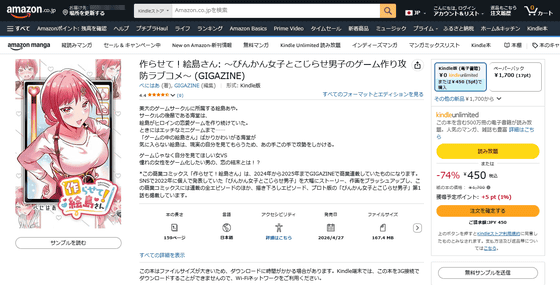
'Let Me Make It, Ejima-san!' is available for order on the Amazon Kindle Store.
Amazon.co.jp: Let Me Make It! Ejima-san: ~A Romantic Comedy About the Game-Making Battle Between a Sensitive Girl and a Complicated Boy~ (GIGAZINE) eBook: Benihaa, GIGAZINE: Kindle Store
Related Posts: