What are the differences between '5.1ch,' '7.1ch,' 'Dolby Atmos,' and 'DTS:X'? What are the types and mechanisms of surround sound?
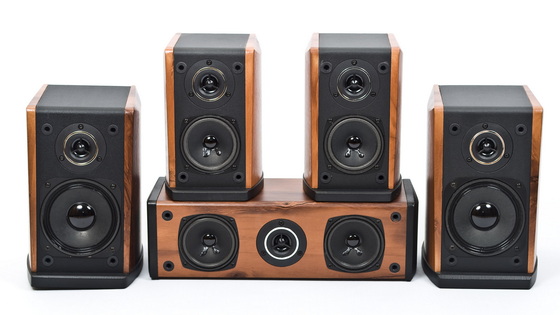
Movie theaters, televisions, game consoles, and soundbars utilize various sound systems such as 5.1ch, 7.1ch, Dolby Atmos, and DTS. While these names are commonly seen, it can be a little confusing to understand what each one represents and how they differ. Surround sound names indicate both the number and placement of speakers and the method of recording and reproducing sound in three dimensions, and these are often used in combination.
Dolby Digital vs DTS: our experts explain the two big surround sound technologies | What Hi-Fi?
https://www.whathifi.com/advice/dts-vs-dolby-digital-whats-the-difference
spatial overview - ARVUS.COM
https://www.arvus.com/spatial-overview.html
Understanding Dolby and DTS surround sound formats
https://www.crutchfield.com/S-NY8YvS8TfHv/learn/learningcenter/home/hometheater_surround.html
Typical stereo sound from television and music consists of two channels, left and right. In contrast, surround sound places multiple speakers in front of, behind, or to the sides of the listener, creating a sense of being surrounded by sound. The most affordable configuration is 2.1ch, which consists of two speakers (left and right in front) and a subwoofer.
5.1ch consists of five channels: front left, center, front right, surround left, and surround right, plus an LFE channel that handles bass effects. The system works by primarily playing dialogue from the center speaker and playing ambient sounds and sound effects from the speakers placed diagonally behind on the left and right, making it easier to perceive the direction of sound. Note that the '.1' does not represent the number of speakers, but rather indicates that the LFE channel, which handles low sounds such as explosions and rumbling, deals with a narrower frequency range than a normal channel.
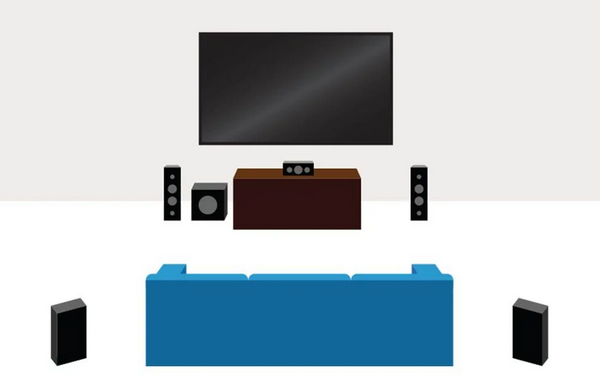
7.1ch is a configuration that moves the surround sound of 5.1ch to the sides of the listener and adds two channels for the rear. Because separate speakers handle the sides and rear of the listener, it can reproduce sounds that cross the rear or sounds that approach from behind with more detail than 5.1ch. However, more channels do not necessarily mean better sound. In rooms where the rear speakers cannot be placed far enough apart, it may sound more natural to properly position a 5.1ch system rather than forcing a 7.1ch system into place.
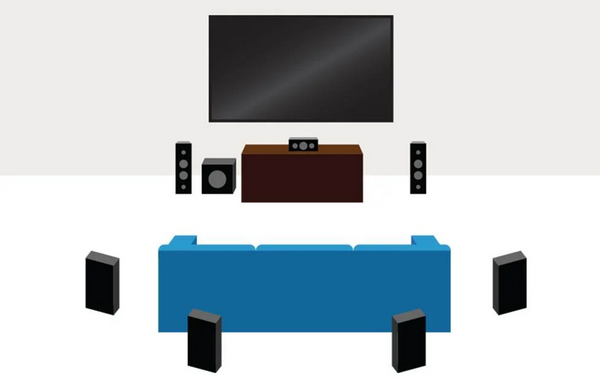
In 5.1ch and 7.1ch systems, the order in which sounds are played from which channels is basically determined during production. This type of system is called channel-based audio.
The reason why the term 'surround sound' has become more common is not only because of the encoding methods used to compress audio, but also because audio technology has evolved to suit various applications such as movie theaters, DVDs, Blu-rays, television broadcasts, video streaming services, and games.

The 'linear PCM' data format, which stores sampled data as is, does not compress audio at all, resulting in the highest sound quality, but inevitably a large amount of data. In particular, with multi-channel audio such as 5.1ch and 7.1ch, the amount of audio data can strain the limited capacity of media, potentially sacrificing the crucial image quality. Therefore, media supporting surround sound compresses the audio data using methods such as Dolby Digital (AC-3) or DTS (Digital Theater Systems). This makes it possible to fit the audio onto the media without sacrificing image quality, and also enables distribution on broadcasts and the internet where bandwidth is limited.
Dolby Digital is widely used in DVDs and television broadcasts, and its advanced version , Dolby Digital Plus , is also used in video streaming. Dolby TrueHD is a lossless format that can completely restore the original audio before compression, and is mainly used in Blu-ray discs.
DTS is a similar method for compressing surround sound, and DTS-HD Master Audio can handle lossless audio. DTS tends to use a higher bitrate than Dolby Digital, but the actual sound quality depends on the original sound source, mixing, playback equipment, and speaker placement.
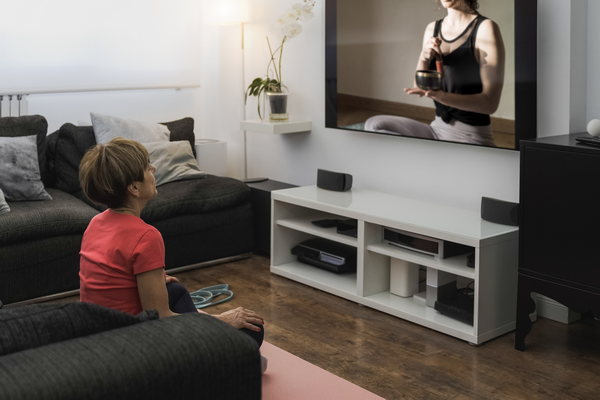
Dolby Atmos and DTS:X are spatial audio systems that place sound in a three-dimensional space, including height. While conventional systems assign sound to specific channels, these systems treat some sounds as 'audio objects,' allowing their position and movement to be recorded. In other words, Dolby Atmos and DTS:X can be described as standards for 'how to place sound in a three-dimensional space.'
For example, instead of specifying that the sound of a helicopter should 'play from the left speaker,' you might specify that it 'moves from the front left, over your head, and to the rear right.' The playback device reads this information and distributes the sound according to the actual speaker configuration.
Introduced in 2012 for theaters, Dolby Atmos is unique in that it treats sound as an 'audio object' rather than fixing it to a specific channel, allowing you to specify where to place it and how to move it in three-dimensional space. During playback, Atmos-compatible equipment distributes the sound according to the actual number and placement of speakers, so the same mix can be reproduced in a way that closely matches the creator's intentions in movie theaters and home theaters of different sizes and configurations. In homes, configurations such as 5.1.2ch and 7.1.4ch are commonly used, with the last number indicating the number of channels in the height direction, such as ceiling or upward-facing speakers.
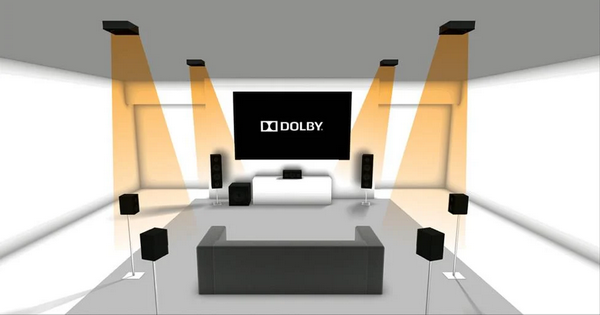
DTS:X, which debuted in 2015 as a standard for home theaters, shares the same basic concept, but because it was designed for home theaters from the start, it is characterized by its ability to support relatively flexible speaker placement. Since DTS:X is based on the open platform MDA (Multi-Dimensional Audio), it is easier to develop components that support DTS:X, and it has the advantage that sound engineers do not need to map sound to specific speaker placements.
In short, while Dolby Atmos developed with an emphasis on consistent reproduction in theaters, DTS:X is a format that strongly emphasized flexible speaker placement from the outset.
For home use, Dolby Atmos is widely adopted in video streaming, televisions, games, and soundbars, while DTS:X is mainly used for Blu-ray and Ultra HD Blu-ray.
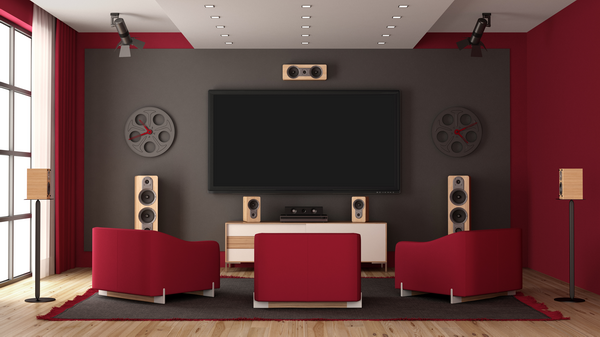
Furthermore, while Dolby Atmos, used in movie theaters, homes, and smartphones, shares the same basic concept of arranging sound in a three-dimensional space, the actual number of speakers, the method of audio transmission, and the playback processing differ.
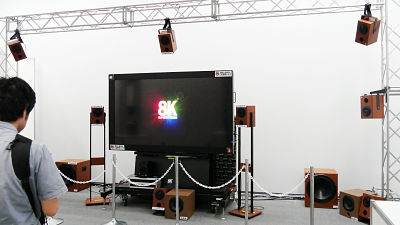
In movie theaters, numerous speakers are placed around the audience seating area and on the ceiling to play sound according to its location. At home, ceiling speakers, upward-facing speakers, soundbars, etc., are used to distribute sound according to the scale, such as 5.1.2ch or 7.1.4ch.
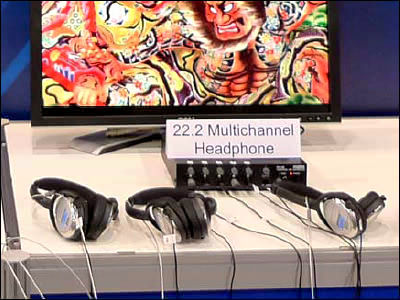
When playing audio using only the TV or smartphone itself, it's not possible to place actual speakers behind or above your head. Therefore, signal processing using the built-in speakers or headphones virtually recreates the sound's breadth and height. As a result, even if a device is labeled 'Dolby Atmos compatible,' the sound and the accuracy of the reproduction will differ significantly between movie theaters, home theaters, and smartphones.
Therefore, when choosing audio equipment, it is important not only to look at labels such as '7.1ch' or 'Atmos compatible,' but also to check how many speakers are actually used, and whether the height-direction sound is reproduced by actual speakers or virtually.
The evolution of surround sound continues. In 2025, Google and Samsung began rolling out 'Eclipse Audio,' based on 'IAMF,' an open spatial audio standard developed by the Alliance for Open Media. IAMF is characterized by its ability to reproduce spatial sound according to the playback environment, from headphones to systems with multiple speakers, without depending on the specific codec.
Samsung and Google announce 'Eclipse Audio,' an open spatial audio standard to compete with Dolby Atmos - GIGAZINE

Meanwhile, Dolby Atmos has expanded its applications beyond 5.1.2ch and 7.1.4ch to include larger configurations such as 9.1.6ch and 11.1.8ch, as well as features like Dolby Atmos FlexConnect, which automatically adjusts wireless speakers based on their placement.
Dolby Atmos FlexConnect, which enables a Dolby Atmos audio experience using only wireless speakers, has been announced - GIGAZINE

Related Posts: