Google DeepMind's weather forecasting model, 'WeatherNext Cyclones,' can now provide more accurate cyclone forecasts, adding one day's worth of information compared to previous models.
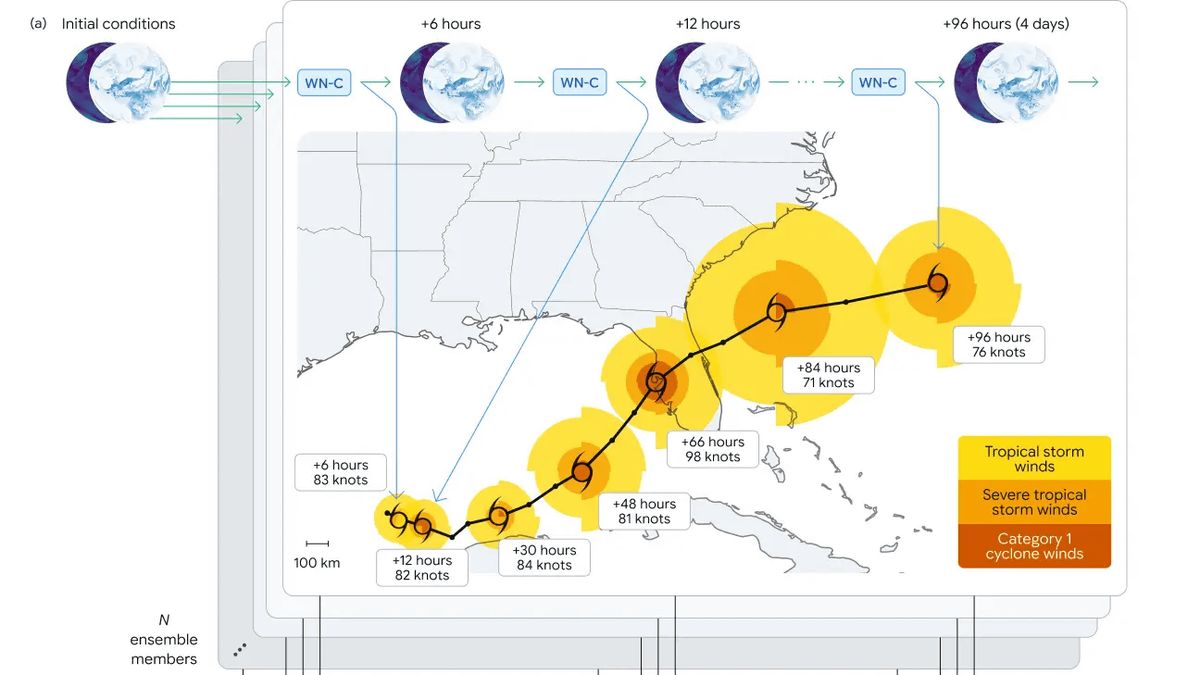
Google DeepMind has announced WeatherNext Cyclones, a practical weather forecasting model. It boasts an average lead time advantage of more than one day compared to major weather forecasting models. Furthermore, WeatherNext 2 and WeatherNext Cyclones will be open source to improve the research community's hurricane preparedness capabilities.
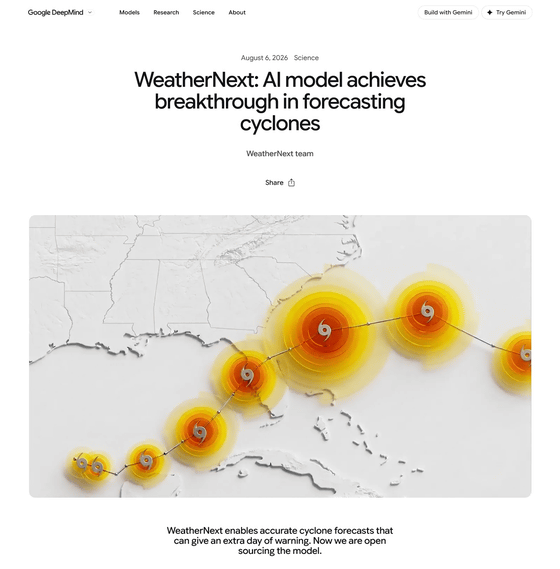
AI model achieves breakthrough in forecasting cyclones — Google DeepMind
Google DeepMind has been developing and improving its weather forecasting model 'WeatherNext' in collaboration with Google Research and various research institutions, and released 'WeatherNext 2' in November 2025, which is capable of high-resolution forecasts on an hourly basis.

As explained on the Japan Meteorological Agency's '
Although there are differences in the definition of maximum wind speed, all of them are 'names used to classify developed tropical cyclones,' and the damage caused by them over the past 50 years has amounted to $1.4 trillion (approximately 158 trillion yen), with more than 700,000 deaths, making timely and accurate forecasting essential.
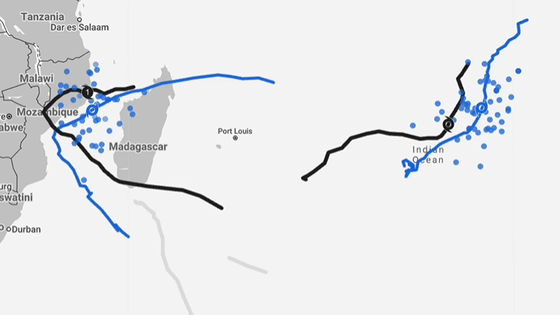
'WeatherNext Cyclones' is an AI model developed through a joint research project by Google DeepMind, Google Research, the U.S. National Hurricane Center (NHC), the Joint Laboratory for Atmospheric Sciences (CIRA), the UK Met Office, and meteorological agencies around the world. It achieves state-of-the-art accuracy in predicting the paths, intensity, and wind structures of tropical cyclones (typhoons, hurricanes, and cyclones).
The new model can now provide forecasts three days in advance with the same level of accuracy as the previous model's two-day forecasts. This improvement represents a decade's worth of advancements in meteorology.
WeatherNext's efforts predicted that Hurricane Melissa would intensify and make landfall in Jamaica during the 2025 hurricane season. The NHC's early warning provided valuable time for local response teams to prepare. The collaboration continued into 2026, with WeatherNext assisting meteorologists in their decision-making by forecasting 1,000 different scenarios for each developing tropical cyclone.
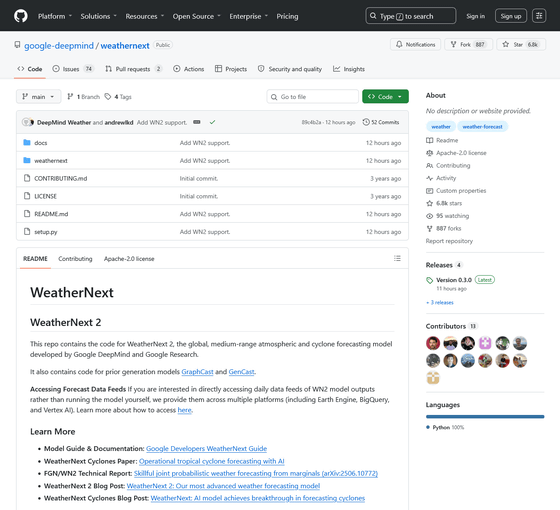
Because weather affects everyone, Google DeepMind has also announced that it will open-source its 'WeatherNext 2' and 'WeatherNext Cyclones' models, which it used during hurricane season.
Google DeepMind stated, 'By making our technology widely available, we aim to empower the research community and expand the role of AI in building a more resilient community by supporting their activities, such as providing local weather forecasters with the tools they need to prepare for natural disasters, supporting the spread of renewable energy, and predicting extreme weather events.'
GitHub - google-deepmind/weathernext · GitHub
https://github.com/google-deepmind/weathernext
Related Posts:


in AI, Posted by logc_nt