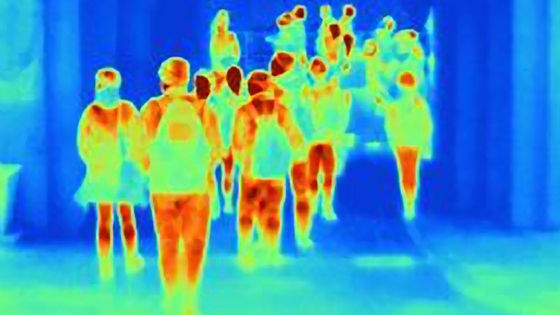
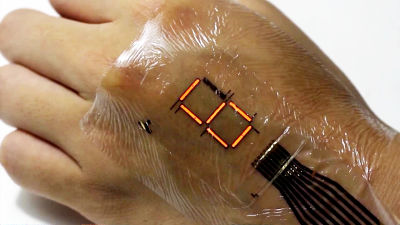
A technology has been developed that enables full-color night vision goggles, but there are challenges to practical application.

A research team at Beijing Institute of Technology has developed a photoelectric conversion device that converts the wavelength and intensity of infrared light into the color and brightness of visible light, allowing humans to see infrared light in 'full color.' The prototype, a translucent pair of glasses weighing 23g, makes it easier to distinguish subtle differences in infrared light than conventional monochrome displays, and is expected to have applications in low-light visibility, augmented reality, and visual assistance technologies.
Multispectral infrared-to-full-color upconversion expanding human vision | Science Advances
Researchers devise a full-color night vision goggle - Ars Technica
https://arstechnica.com/science/2026/07/see-the-heat-an-infrared-imaging-system-that-outputs-in-color/
The human eye cannot directly see infrared light with wavelengths exceeding approximately 700 nm. This is because infrared photons have low energy and do not reach the approximately 1.6 electron volts required for the visual pigments in the retina to change their structure.
Conventional night vision devices convert the signals received by infrared sensors into monochrome images, such as green, and display the intensity of infrared light as a difference in brightness. However, since the human eye is better at distinguishing color differences than subtle differences in brightness, monochrome display does not fully utilize the sensitivity of the human eye.
The research team combined colloidal quantum dots of mercury telluride, which detect infrared radiation, with a two-layer organic EL display that emits red and cyan light, in order to convert the wavelength and intensity of infrared radiation into the color and brightness of visible light. The quantum dots are approximately 4 nm in size, and the amount of charge they generate changes depending on the wavelength and intensity of the infrared radiation.
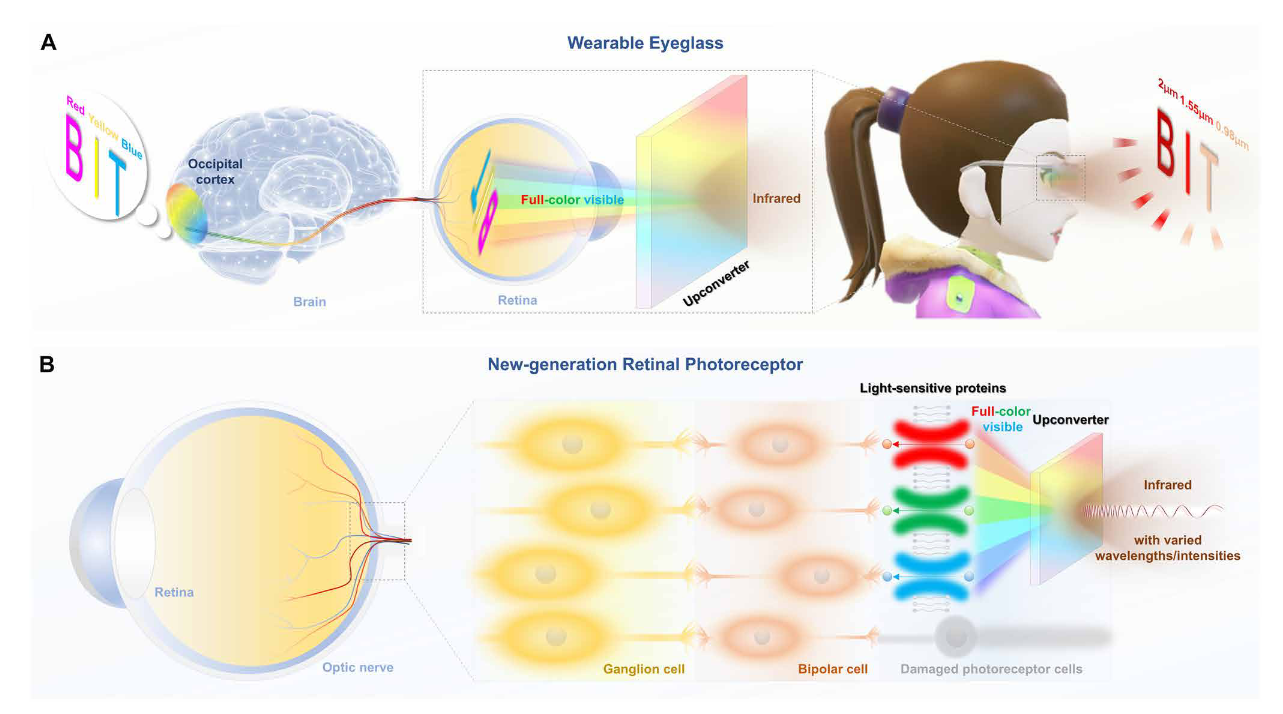
When exposed to long-wavelength or weak infrared light, less charge is generated, so mainly the red light-emitting layer glows. On the other hand, with short-wavelength or strong infrared light, the charge increases, and the charge reaches not only the red layer but also the cyan layer, causing a change in the color and brightness of the emitted light.
An energy barrier of 0.82 electron volts is placed between the two light-emitting layers. With long wavelength infrared light and weak infrared light, less charge is generated, and the charge remains in the red layer in front of the barrier, resulting in a dim red emission. On the other hand, with short wavelength infrared light and strong infrared light, the charge increases and flows across the barrier into the cyan layer, resulting in a bright emission that is a mixture of red and cyan. In this way, the wavelength and intensity of infrared light are correlated with the color and brightness of visible light.
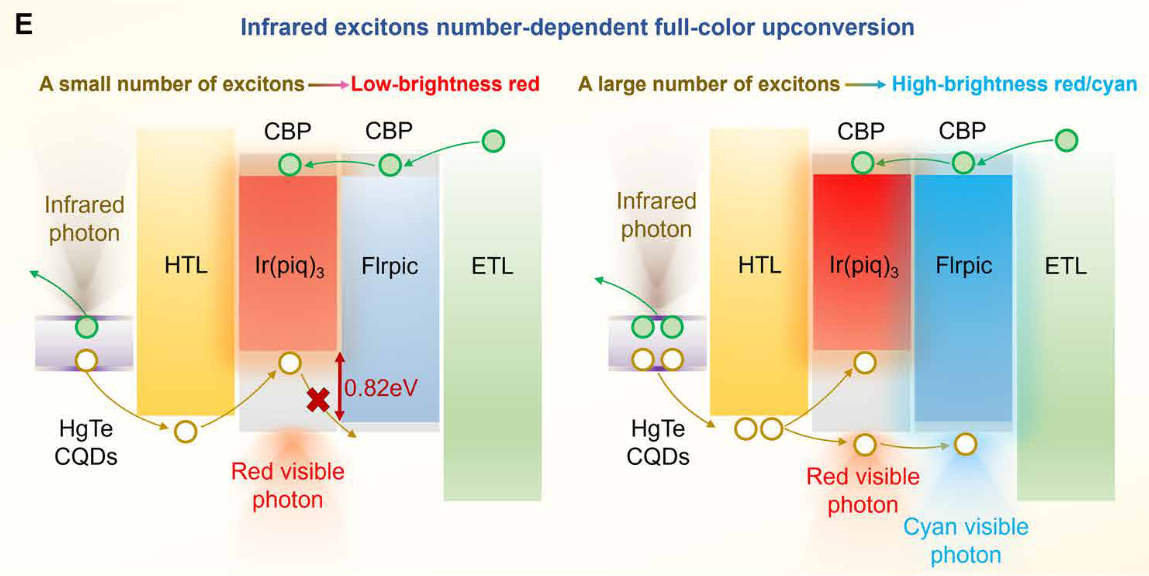
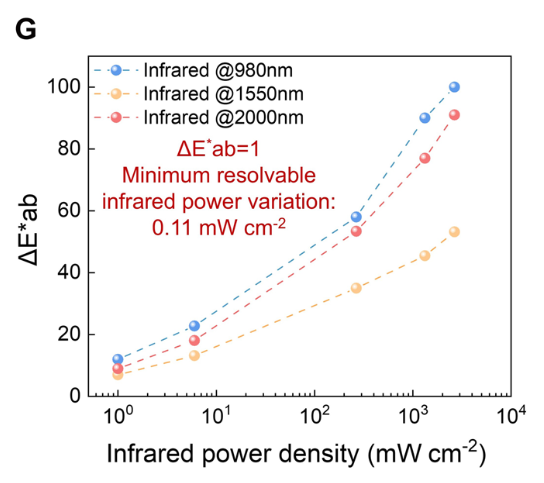
The device developed by the research team can convert infrared light at 980nm, 1550nm, and 2000nm into different colors, and its detectable wavelength range extends beyond 2μm. When illuminated with 980nm infrared light, the brightness exceeded 700 cd/ m² , and the efficiency of converting infrared photons into visible light photons was 3.85%.
According to the research team's calculations, a difference of 23.71 mW/ cm² in infrared intensity was required for humans to perceive a difference using only brightness. In contrast, a display combining color and brightness could distinguish a difference of 0.11 mW/ cm² , achieving approximately 200 times higher sensitivity compared to a monochrome display.
The research team also created a translucent, glasses-type prototype incorporating this mechanism. The prototype, including the sealing material, weighed 23g and had an effective area of 3.57cm² . It was able to display letters, shapes, and moving/rotating objects illuminated by infrared light as colored images.
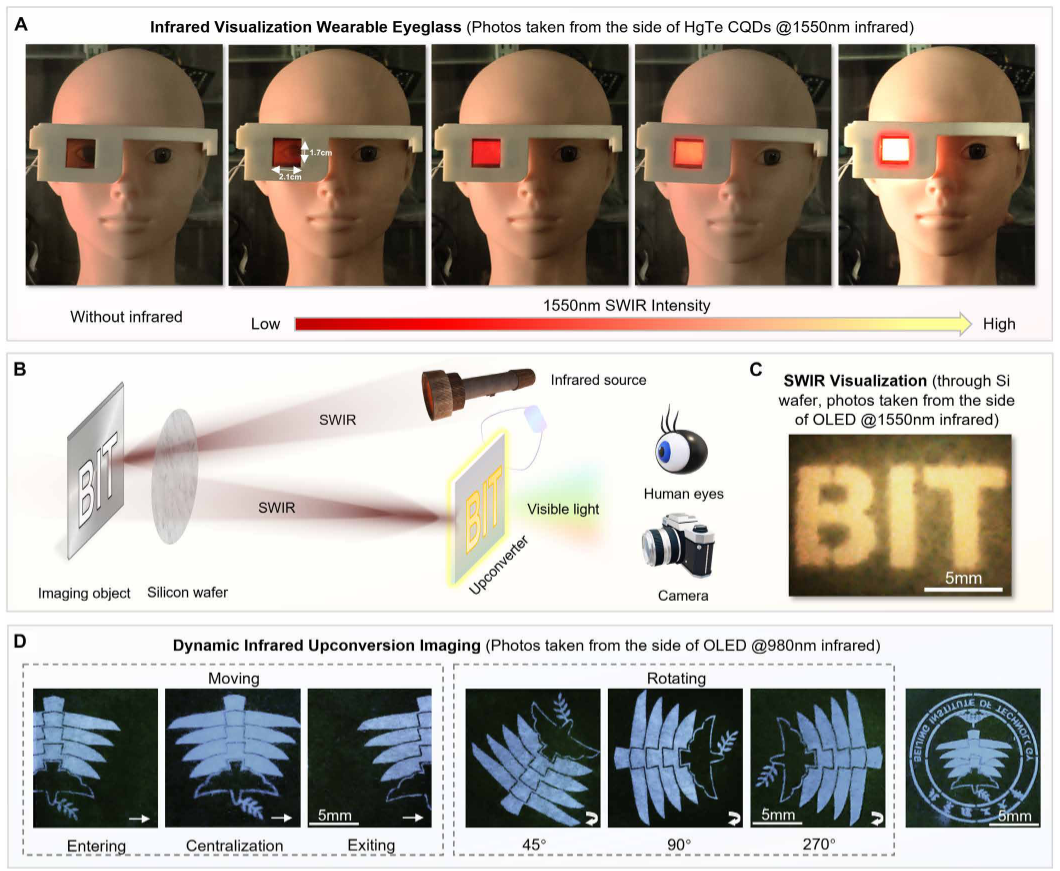
Because the device is semi-transparent, it is possible to overlay infrared information while viewing a landscape in normal visible light. By adding a filter that blocks visible light, it is also possible to switch to a night vision mode that displays only infrared light.
Furthermore, the research team investigated whether the visible light emitted from the converter could stimulate the visual system of living organisms. When the device was combined with nerve cells expressing the blue light-responsive protein 'channelrhodopsin-2,' photocurrents were generated by infrared irradiation.
In another experiment, brain waves were measured in mice and electroretinograms in human subjects, and their responses were observed when infrared light was shone through the device. No measurable response was observed when only infrared light was shone without the device, but a response was observed when it was shone through the device, indicating that the converted visible light reaches the visual system.
The research team cites future applications such as assisting movement in low light, infrared-based object identification, augmented reality, and artificial retinal receptors that can function as replacements for damaged photoreceptor cells. However, the experiments were conducted in a controlled environment using simple letters, shapes, and a calibrated blackbody light source, and it has not yet been confirmed how well the color coding will function in complex real-world environments.
Furthermore, the OLED portion requires an external power supply, making it more like a small electronic display than a passive lens. The quantum dots use mercury telluride, which contains the heavy metal mercury, but its safety and biocompatibility regarding long-term skin contact and implantation in the eye have not been verified, and further research is needed before practical night vision glasses or retinal implants can be realized.
Related Posts: