Anthropic has stated that while they welcome open models, they should not export high-performance AI chips to China.
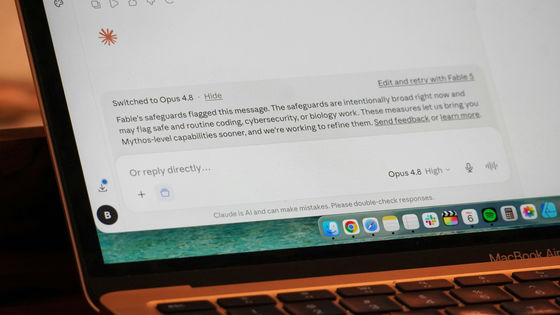
Anthropic, the developer of Claude, has released a statement titled 'Our View on Open Weight Models.'
Our position on open-weights models \ Anthropic
There's been a lot of speculation about where we stand on open-weights models. We've outlined our views in full here: https://t.co/NtXQuWm2g5
— Anthropic (@AnthropicAI) July 27, 2026
There is ongoing discussion regarding open weight models made in China, and some reports suggest that some U.S. officials are considering 'banning American companies from using Chinese-made open weight models.'
Trump administration reconsiders de facto ban on foreign-made open-source AI models due to concerns over China's rise - GIGAZINE
In response, the Little Tech Association, an industry group comprising approximately 200 companies including Proton and Y Combinator, sent a letter to the Trump administration urging them to refrain from restricting Chinese-made open weight models.
American startup appeals to Trump administration not to ban Chinese-made OpenWaite AI - GIGAZINE
Anthropic CEO Dario Amodei argues that such a ban is not an effective measure, stating, 'Anthropic has never advocated for a ban on open weight models.'
CEO Amodi stated, 'Open weight models, which do not have dangerous features, are a public good. There are no costs other than the computational costs required for execution, and they provide value to companies, developers, and researchers.'
CEO Amodi stated, 'Protectionist bans will not address my most serious national security concerns.' Specifically, he cited two nightmare scenarios as his concerns. The two nightmare scenarios cited by CEO Amodi are as follows:
1: What CEO Amodi is most concerned about is the risk that authoritarian governments (not just the Chinese Communist Party, but the Chinese Communist Party is clearly the most powerful threat) could build AI models that are more powerful than those built by the United States, and use them to gain permanent military superiority or to carry out extremely severe repression against their own people.
This concern is widely shared within the U.S. government. In 2025, Vice President Vance warned in Paris that 'authoritarian regimes are stealing AI and using it to enhance their military, intelligence, and surveillance capabilities.' The intelligence agency's 2026 annual threat assessment concluded that 'rapid advances in AI by other world powers threaten America's economic competitiveness and national security advantage.'
Whether these models are made public or used by American companies is irrelevant. In fact, Amodi argued that the most dangerous models might be 'models that are secretly trained and handed over only to the Ministry of National Security for surveillance and repression.'
2: Amodi's second concern is the risk that powerful AI models could be misused to carry out cyberattacks or bioweapons attacks, and that they could have serious alignment problems. Open weight models, whether made in China or elsewhere, are extremely difficult to guard against or monitor their usage, and once the weights are released, they cannot be undone, thus potentially posing a higher risk than closed models.
However, prohibiting American companies from using these models would not address this risk, because it is unlikely that the malicious actors would be legitimate American companies. In addition, while prohibiting the use of some open weight models would protect American AI companies from competition, CEO Amodi asserted that 'that is not my goal.'

To address these concerns, CEO Amodi said he supports three measures.
1: High-performance chips and chip manufacturing equipment should not be sold to China.
The rampant smuggling and the loopholes used to obtain such chips must be thoroughly cracked down upon. Due to China's limited domestic production capacity, scaling laws prevent it from building models that outperform the US without American-made chips. This is the most efficient and direct way to block 'Threat 1,' and by hindering the development of models outside the reach of US law, it also indirectly addresses 'Threat 2.'
2: Regulation of industrial-scale distillation
Distillation is a far more computationally efficient process than training a model from scratch. This has allowed China to build models far superior to those possible with conventional chips, partially circumventing export bans on high-performance chips. While distillation won't give the Chinese Communist Party AI capabilities equal to or greater than those of the United States, it could bring China's cutting edge technology within months of that of the United States. Sure, many of the companies performing these operations publish open weight models, but this is far less significant than the fact that open weight models are being supported by operations carried out by authoritarian states seeking to overtake the United States in cutting edge technology. The United States should intervene in policy to deter this behavior. A complete ban on open weight models is neither the right solution nor what we have been seeking.
3. All models with sufficient capabilities, whether open or closed, should undergo mandatory safety testing.
The best way to address 'Threat 2' is to directly test the model for all risks before its release. The Trump administration has been moving in this direction for the past few months, and there are
Whether open models increase or mitigate risks should be determined through testing, not predetermined. There may be promising ways to improve the safety of open weight models, such as Anthropic's latest research on modular training strategies . Note that effective testing will require global testing and the support of the Chinese Communist Party. Regarding this feasibility, CEO Amodi said, 'It may actually be possible. Limited cooperation on AI-based bioweapon prevention may be possible, as it would also be in China's interest.'

While AI companies like OpenAI and Google, which are competitors of Anthropic, have endorsed Microsoft's statement that 'open models should be developed under American leadership to secure AI leadership,' Anthropic does not endorse this.
Microsoft issues statement declaring that 'American-made open models are essential for the advancement of AI,' with support from NVIDIA, OpenAI, Google, AMD, and others - GIGAZINE
Regarding the reasons for this, Anthropic said, 'I agree with much of Microsoft's statement. Open weight models expand access to the AI economy, enhance competition in at least some use cases, and give customers greater control. The concerns about distillation are the same measures that have been proposed and should be addressed through targeted legal and commercial frameworks. However, I disagree with the letter's assertion that open weight models will not necessarily facilitate the development of security measures, or that broad access to functionality will not necessarily favor defenders over attackers. At least to me, the opposite seems more likely to be true. For example, I am concerned about the strong asymmetry between attackers and defenders in biology. A sufficiently capable model could potentially weaponize pandemic-level viruses rapidly using widely available materials, while defending against these pathogens could be an operational challenge that, in the best-case scenario, could take several years.'
Related Posts:




in AI, Posted by logu_ii