Research shows that moss exhibits surprisingly complex electrical activity similar to that of neurons.

Multi-scale electrical activity and signal propagation in the moss Brachythecium rutabulum | Royal Society Open Science | The Royal Society
https://royalsocietypublishing.org/rsos/article/13/7/252341/482568/Multi-scale-electrical-activity-and-signal
Moss Is Generating Electrical Waves That Look Startlingly Like a Neural Network : ScienceAlert
https://www.sciencealert.com/moss-behaves-a-little-like-a-really-slow-brain-scientist-discovers
Professor Andrew Adamacky , a computer scientist at the University of the West of England, Bristol, studies unconventional computing, including slime molds, hyphae networks, and crowds.
In his new research, Adamattsky investigated the electrical activity of Brachythecium rutabulum , a common moss species found in the UK and other regions. Adamattsky states, 'Plants and mosses exhibit diverse forms of electrical activity, but the organization of endogenous signals in mosses has received little attention.'
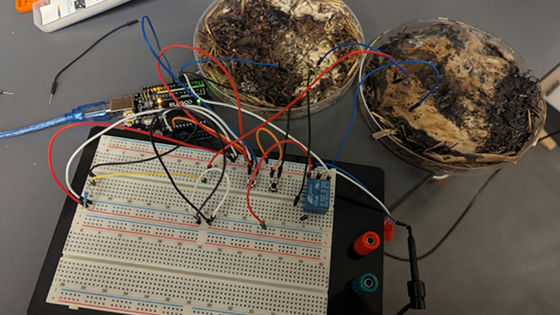
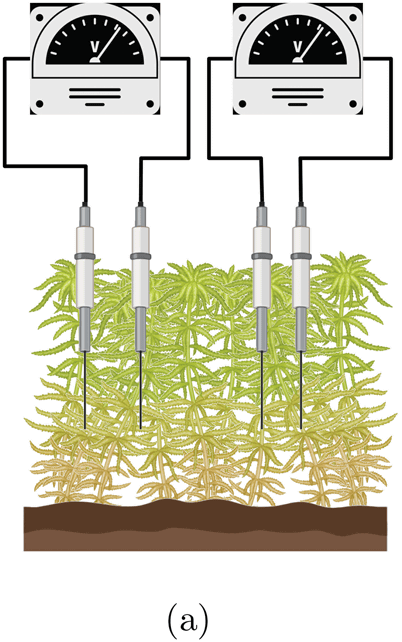
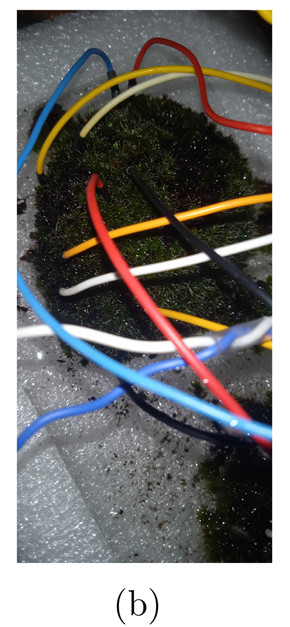
Adamattsky collected cushion-like clumps of the moss *Hypnum cupressiforme* from an outdoor environment in North Somerset, England, and brought them back to his laboratory. He then inserted electrodes into these clumps of moss and recorded the electrical activity flowing through the entire moss over several days.
Figure (a) below is a schematic diagram showing electrodes inserted into moss.
The following photograph (b) shows the actual moss and electrodes taken from above.
Analysis of the data revealed diverse patterns of electrical activity consistent with the physiological activity of mosses. These included fast oscillatory spikes, slower rhythmic fluctuations, and very gentle depolarization waves .
The electrical waves emitted by the moss varied in speed, some being fast and others slow, and these tended to spread throughout the entire moss mass rather than remaining confined to specific areas. This result suggests that the moss mass is not a collection of independent cells, but rather a dynamic, interconnected system.
Adamattsky argues that, when viewed abstractly, the electrical activity of mosses is similar to the dynamics observed in typical excitatory systems, such as cultured neurons and mammalian brain tissue. 'Taking these findings together, it suggests that moss cushions function as spatially dispersed excitatory systems, capable of coordinating and integrating electrical signals across both space and time,' he said.
In this study, to rule out the possibility that electrical signals originated from devices other than moss, the electrodes were not tested on an inert substrate. Furthermore, since the moss used was collected from nature, it is possible that some contamination or variations in moisture content may have affected the results.
Related Posts: