Google has announced 'Gemini 3.6 Flash,' 'Gemini 3.5 Flash-Lite,' and 'Gemini 3.5 Flash Cyber,' and is also developing Gemini 4.
On July 21, 2026, Google announced three new models in its 'Gemini Flash' series of AI models, which prioritize high-speed and low-cost processing: ' Gemini 3.6 Flash ,' ' Gemini 3.5 Flash-Lite ,' and ' Gemini 3.5 Flash Cyber .' Gemini 3.6 Flash is positioned as a general-purpose model that improves coding and knowledge work, Gemini 3.5 Flash-Lite is a lightweight model that performs large amounts of processing at low cost, and Gemini 3.5 Flash Cyber is a cybersecurity model specialized in vulnerability detection and remediation.
3.6 Flash, 3.5 Flash-Lite, and 3.5 Flash Cyber
Gemini 3.6 Flash — Google DeepMind
https://deepmind.google/models/gemini/flash/
Introducing Gemini 3.5 Flash Cyber — Google DeepMind
https://deepmind.google/blog/introducing-gemini-3-5-flash-cyber/
◆Gemini 3.6 Flash
Gemini 3.6 Flash is an enhanced model for coding, knowledge work, and multimodal processing, based on developer and user feedback on Gemini 3.5 Flash, which was announced in May 2026. It can accept text, images, video, audio, and PDF as input, and supports up to 1 million tokens for input and 64,000 tokens for output.
According to Google, Gemini 3.6 Flash reduces the number of output tokens by 17% compared to Gemini 3.5 Flash in the Artificial Analysis Index. It also requires fewer inference steps and tool calls when performing multi-stage tasks, allowing for more efficient execution of long-running agent processes.
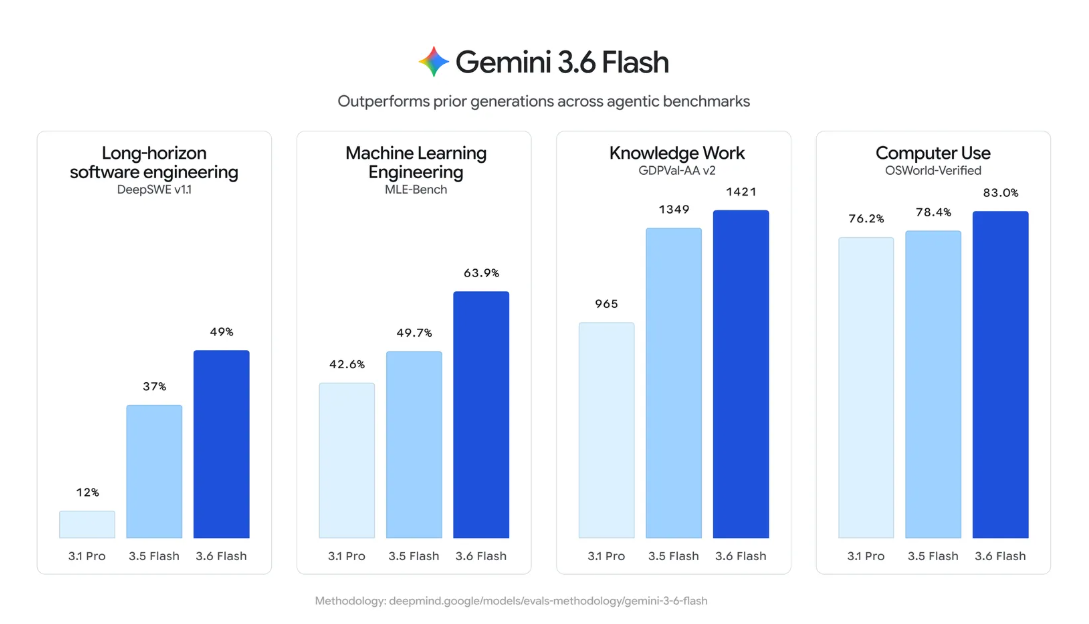
In DeepSWE, which measures software development capabilities, Gemini 3.6 Flash scored 49%, surpassing Gemini 3.5 Flash's 37%. In MLE-Bench, which evaluates machine learning engineering capabilities, Gemini 3.6 Flash scored 63.9% compared to Gemini 3.5 Flash's 49.7%, and in OSWorld-Verified, which measures agent-based computer operation, it improved from 78.4% to 83.0%.
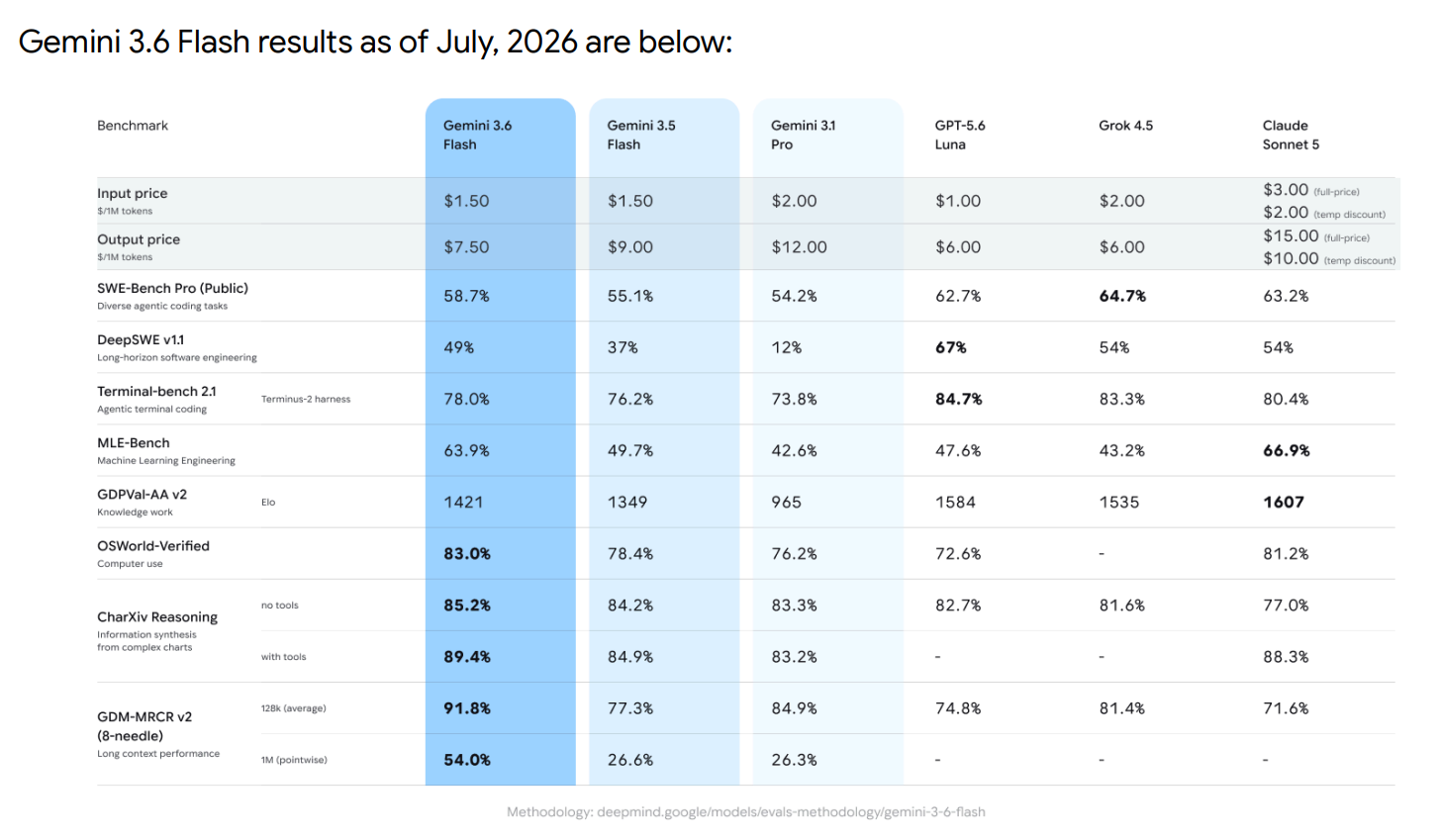
In addition, GDPval-AA v2, which evaluates practical knowledge work, recorded 1421 compared to Gemini 3.5 Flash's 1349. CharXiv, which extracts information from complex graphs, achieved 85.2% without tools and 89.4% with tools, while GDM-MRCR v2, which searches for multiple pieces of information from a long text of 1 million tokens, recorded 54.0%.
Gemini 3.6 Flash builds directly on feedback from 3.5 Flash.
pic.twitter.com/UsVzHv0VOQ — Google DeepMind (@GoogleDeepMind) July 21, 2026
Watch how it compares on quality and token usage ↓
The API pricing for Gemini 3.6 Flash is $1.50 (approximately 245 yen) per 1 million input tokens and $7.50 (approximately 1220 yen) per 1 million output tokens. The input price is the same as Gemini 3.5 Flash, but the output price has been reduced from $9 (approximately 1470 yen). Google explains that this, along with the reduction in the number of output tokens, will lower the cost of tasks performed by agents.
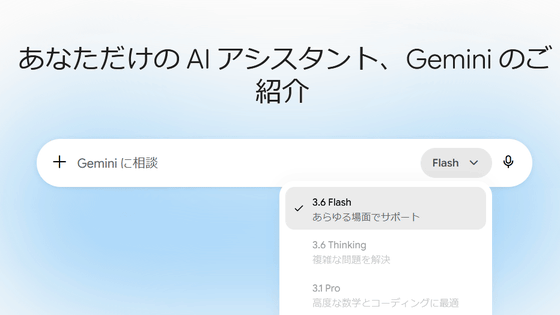
Gemini 3.6 Flash is available from the announcement date in Gemini apps, Google AI Studio, Android Studio, Gemini API, and Gemini Enterprise Agent Platform. It will also be available in Google Antigravity and Gemini Enterprise apps.
◆Gemini 3.5 Flash-Lite
The Gemini 3.5 Flash-Lite is the fastest model in the Gemini 3.5 series, prioritizing response speed and processing capacity. It is intended for applications that require processing large volumes of requests quickly and at low cost, such as agent search, document processing, translation, and summarization.
According to measurements by Artificial Analysis, a site that compares generative models, Gemini 3.5 Flash-Lite generated 350 output tokens per second. Google positions this model as suitable for applications and services that prioritize speed and price-performance ratio.
Gemini 3.5 Flash-Lite allows you to adjust the inference strength depending on your application. You can set a lower inference level if you prioritize low latency and low cost, or a higher inference level if you are using it as a sub-agent handling multi-stage processing.
Furthermore, the Gemini API allows you to use computer control functions as embedded tools. This means that Gemini 3.5 Flash-Lite can be integrated into agents that work while interacting with websites and apps.
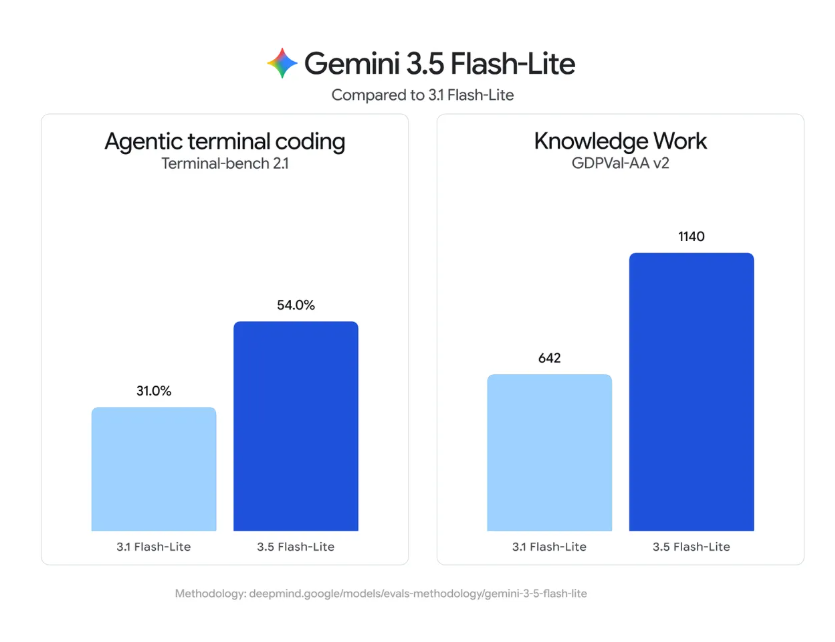
In benchmarks, the Terminal-Bench 2.1 score, which measures terminal-based work capabilities, reached 54%, surpassing the Gemini 3.1 Flash-Lite's 31%. The GDM-MRCR v2 score, which evaluates long-text processing, improved from 60.1% to 72.2%, and the GDPval-AA v2 score increased from 642 to 1140.
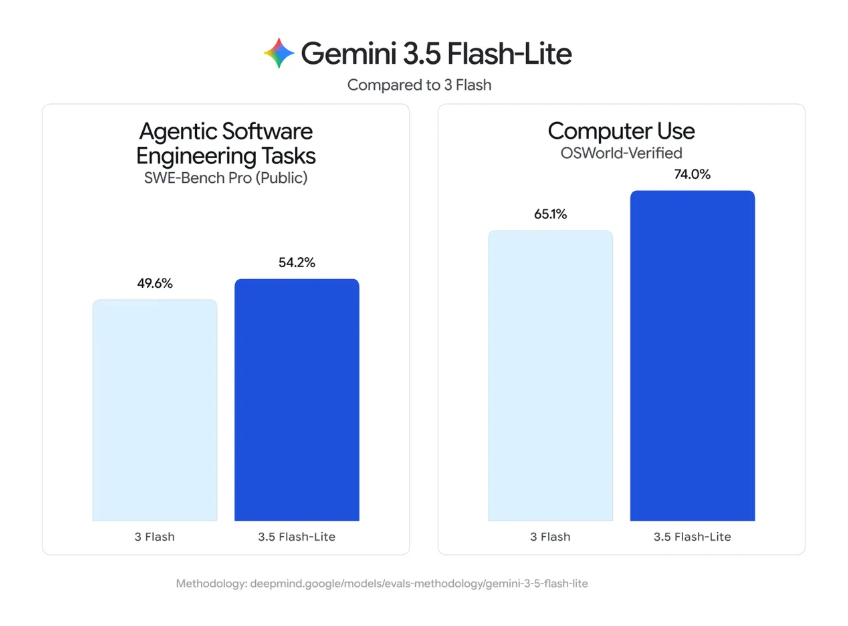
In some evaluations, the Gemini 3.5 Flash-Lite has even outperformed its predecessor, the Gemini 3 Flash. In SWE-Bench Pro, which deals with actual software development challenges, it achieved 54.2% compared to 49.6% for the Gemini 3 Flash, and in OSWorld-Verified, it recorded 74.0% compared to 65.1% for the Gemini 3.5 Flash-Lite.
The API pricing is $0.30 (approximately 49 yen) per 1 million input tokens and $2.50 (approximately 410 yen) per 1 million output tokens. Google explains that 'Gemini 3.5 Flash-Lite is a model that balances processing speed and price-performance ratio while significantly improving quality compared to Gemini 3.1 Flash-Lite.'
Gemini 3.5 Flash-Lite is available from the announcement date in Google Search, Gemini apps, Google AI Studio, Android Studio, Gemini API, and Gemini Enterprise Agent Platform.
◆Gemini 3.5 Flash Cyber
Gemini 3.5 Flash Cyber is a lightweight cybersecurity model based on Gemini 3.5 Flash, with additional training to improve its ability to discover, verify, and fix software vulnerabilities. It is integrated into Google's code security agent, CodeMender, and is used in conjunction with other models.
CodeMender uses multiple Gemini 3.5 Flash Cyber instances to examine the code from different perspectives and combines their results into a single report. Google explains that by repeatedly running relatively inexpensive models rather than running a large model only once, they can explore the numerous execution paths contained within a massive codebase.
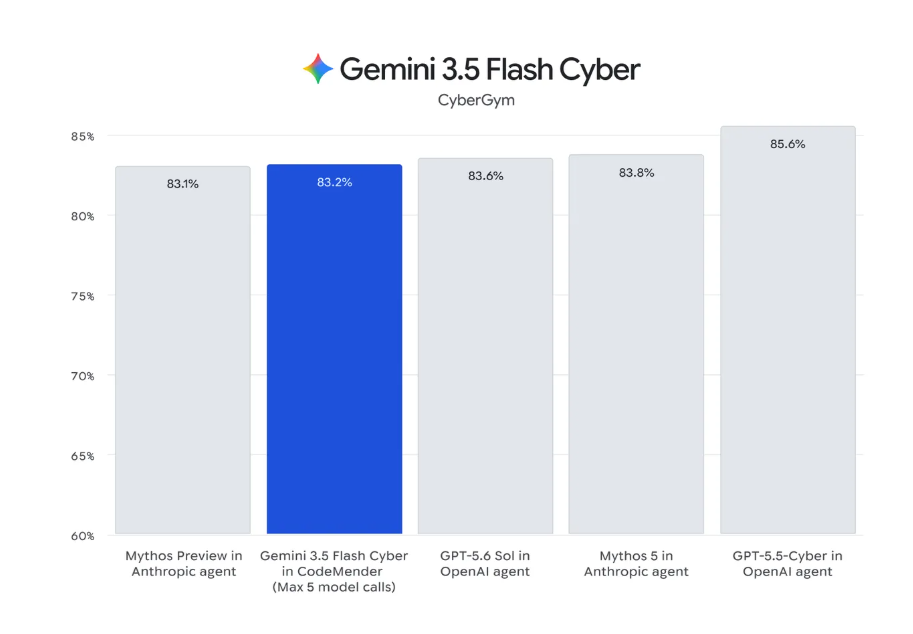
CyberGym, which uses hundreds of real-world vulnerabilities, achieved performance comparable to large-scale models by calling the model up to five times to generate a single final report. The design not only focuses on the performance of a single model but also combines multiple trials to increase the vulnerability detection rate.
The results of evaluations conducted in CyberGym using real-world software vulnerabilities show that by calling Gemini 3.5 Flash Cyber up to five times from CodeMender, it achieves performance comparable to larger models, according to Google.
In evaluations targeting the V8 JavaScript engine, the Gemini 3.5 Flash Cyber found 55 unique and confirmed issues. The Gemini 3.5 Flash found 47 issues, and the Claude Opus 4.6 found 36. Ten of the issues found by the Gemini 3.5 Flash Cyber were not found in the other two models.
Within Google, CodeMender, powered by Gemini 3.5 Flash Cyber, is used to discover and fix vulnerabilities in the code of Chrome, Android, Google Cloud, Google Ads, and YouTube. A verification conducted by the Google Cloud vulnerability research team reportedly discovered a remote code execution vulnerability in a public API and a memory corruption vulnerability in a production service in just two hours.
Gemini 3.5 Flash Cyber will initially be offered to government agencies and trusted partners through CodeMender as a limited pilot program. Google has indicated that it will expand the availability in the future while verifying its security. Although Google has indicated that it will not release Gemini 3.5 Flash Cyber to the general public, the underlying functionality of CodeMender itself will be made available to customers as a general availability model via the Gemini Enterprise Agent Platform.
In addition to the three models announced, Google explained that the Gemini 3.5 Pro is in the testing phase with partners and will be widely available once it is ready. The development team has also begun building the next generation model and revealed that they have started their most ambitious pre-training yet for the Gemini 4. Google says that the pre-training is progressing smoothly.
We have started our most ambitious pre-training run yet, for Gemini 4, and are excited by the progress : )
— Logan Kilpatrick (@OfficialLoganK) July 21, 2026
- Continued
Here are the benchmark results for Gemini 3.6 Flash - GIGAZINE
Related Posts: