In a trial concerning 'The Diary of Anne Frank,' the EU's Supreme Court ruled that 'there is no liability if geoblocking technology is circumvented by a VPN.'

'
EU's Top Court: Geo-Blocking Protects Publishers in Copyright Disputes, VPNs Not Liable * TorrentFreak
https://torrentfreak.com/eus-top-court-geo-blocking-protects-publishers-in-copyright-disputes-vpns-not-liable/
In Germany, basic copyright is protected for 70 years after the death of the last deceased author, so 'The Diary of Anne Frank' entered the public domain in 2016 and was made available online. However, the Anne Frank Foundation , based in Switzerland, strongly protested this, threatening to take legal action. The Anne Frank Foundation, established in 1963 by Anne Frank's father, Otto Frank, claims that Otto acquired the copyright to 'The Diary of Anne Frank' because of his efforts to publish it and spread it to the world, and therefore the copyright will not expire until 2050, 70 years after Otto's death in 1980. Another argument is that since the diary was published after Anne's death, the protection period for posthumously published works should be extended to '50 years from the date of publication,' meaning that the version published by the Netherlands Institute for War Documentation in 1986 would be protected until 2037.
'The Diary of Anne Frank' to be made available for free after copyright expires; Anne Frank Foundation warns of taking 'legal action' - GIGAZINE

Therefore, the Anne Frank Foundation , which manages and operates the Anne Frank House in Amsterdam, Netherlands, has published an academic version online using state-of-the-art geoblocking technology, restricting access to residents of the Netherlands. The access check page below states that 'due to copyright restrictions, it is not available in all countries,' and that it is only accessible from countries listed as 'accessible only from the following public domain countries.' Although Japan is included in the list, clicking 'Yes' resulted in the message 'This website is not accessible from your country.'
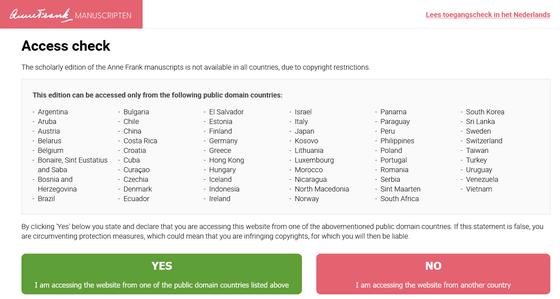
The Anne Frank Foundation published 'The Diary of Anne Frank' using geoblocking technology to reflect differences in regional copyright laws, but the Anne Frank Foundation argued that 'unless blocking is 100% unavoidable, the content should not exist online.' The Anne Frank Foundation then requested an order to cease publication of the manuscripts, or at least to configure the website so that these manuscripts cannot be accessed from within the Netherlands, even via VPN or proxy services.
In March 2023, the Amsterdam Court of Appeal in the Netherlands ruled that 'there is no issue of intentionally inadequate geoblocking, nor has the foundation infringed any copyright,' and that posting 'The Diary of Anne Frank' on a website does not infringe copyright. The Anne Frank Foundation appealed the ruling, and the Dutch Supreme Court referred several issues regarding the neutrality of the VPN and the appropriateness of geoblocking to the Supreme Court of the EU.
In July 2026, the Second Chamber of the Court of European Justice (CJEU), the judicial body of the EU, issued its final ruling that 'works that are in the public domain in some EU member states but are protected by copyright in other member states are not considered 'public communication' that infringes copyright in the protected countries and can be posted on restricted websites.' The court acknowledged that geoblocking can be circumvented by using a VPN, and stated that if state-of-the-art geoblocking technology is chosen to block visitors from a specific country, the geoblocking would not be considered 'insufficient' even if those individuals are able to access the work, because VPN users are clearly not the intended users.

The court also rejected arguments that publishers should be required to implement stricter access controls, such as subscription or login requirements, because this would disproportionately restrict free access from public domain countries. In addition, based on past rulings that the EU Supreme Court considers VPN providers to be 'neutral intermediaries,' they are not liable even if VPNs are used to circumvent geoblocking. The ruling states that 'providers of VPNs and similar services are not considered to have transmitted the works to the public because they are technical tools that are legally available to users and are used to circumvent ineffective geoblocking measures.'
While the European Court of Justice's ruling is valid under EU law, it must be interpreted by national courts. The case surrounding 'The Diary of Anne Frank' has been remanded to the Dutch Supreme Court, which will need to determine whether the geoblocking technology used by the Anne Frank Foundation to publish 'The Diary of Anne Frank' actually meets the standards of 'state-of-the-art technology.'
Related Posts:







in Web Service, Posted by log1e_dh