Online bookstores cannot completely replace physical bookstores; when physical stores close, book sales decrease.

In recent years, it has become possible to order a wide variety of books online, so some avid readers may think, 'Even if physical bookstores close, I can just order online,' or 'Online bookstores with unlimited selections are more convenient than physical bookstores with limited shelves.' However, a study on the number of bookstores and book sales in Germany has shown that when physical bookstores close, book sales decrease, indicating that online bookstores are not a substitute for physical bookstores.
The substitutability between brick-and-mortar stores and e-Commerce: the case of books | Journal of Cultural Economics | Springer Nature Link
Online stores do not fully replace closed bookshops, study finds
https://www.scienceofmoney.org/when-a-bookstore-closes-where-do-the-sales-go-a-german-study-counts-the-cost-644/
A research team from the University of Giessen and the Düsseldorf Institute for Competitive Economics in Germany investigated how substitutable online bookstores and physical bookstores are in book sales. In Germany, where the study was conducted, book prices are fixed, so the price of the same book is the same whether you buy it at a physical bookstore or an online bookstore, and the phenomenon of 'consumers using physical bookstores or online bookstores depending on price' does not occur.
Science of Money, a web media outlet specializing in sales psychology that covered this study, stated: 'In most retail price comparisons, price is the most important factor, and consumers often use online services to save money. By eliminating the price factor in the German book market, researchers were able to isolate other reasons why people choose a particular sales channel. These reasons include the convenience of being able to search a vast online inventory, the waiting time for delivery, and the ability to actually hold and examine a book before purchasing.'
Books are a type of product that economists call an ' experience good ,' meaning consumers don't know if they'll enjoy a book until they actually read it. Therefore, consumers scrutinize titles and summaries, consult booksellers' advice, and rely on online reviews to mitigate pre-purchase uncertainty. The research team reasoned that because these pre-purchase decision factors differ between online and physical bookstores, they may not be entirely interchangeable.

To investigate the relationship between online and physical bookstores, the research team created a monthly dataset from 2011 to 2017. This dataset analyzes the number of physical bookstores and book sales in both physical and online bookstores across 14 federal states and 9 book genres in Germany. Book sales figures were obtained from scanner records provided by market research firm
The data shows that the number of physical bookstores, which was over 6,300 in 2011, decreased to fewer than 4,900 by 2017, indicating that approximately 1,430 stores closed. While the surviving bookstores sold more books on average than before, overall sales of physical books also declined.
The following map shows the number of bookstores per 100,000 people at the beginning of 2011 (left) and the end of 2017 (right). Darker colors indicate a higher number of bookstores per 100,000 people. It can be seen that the number of physical bookstores is decreasing throughout Germany.
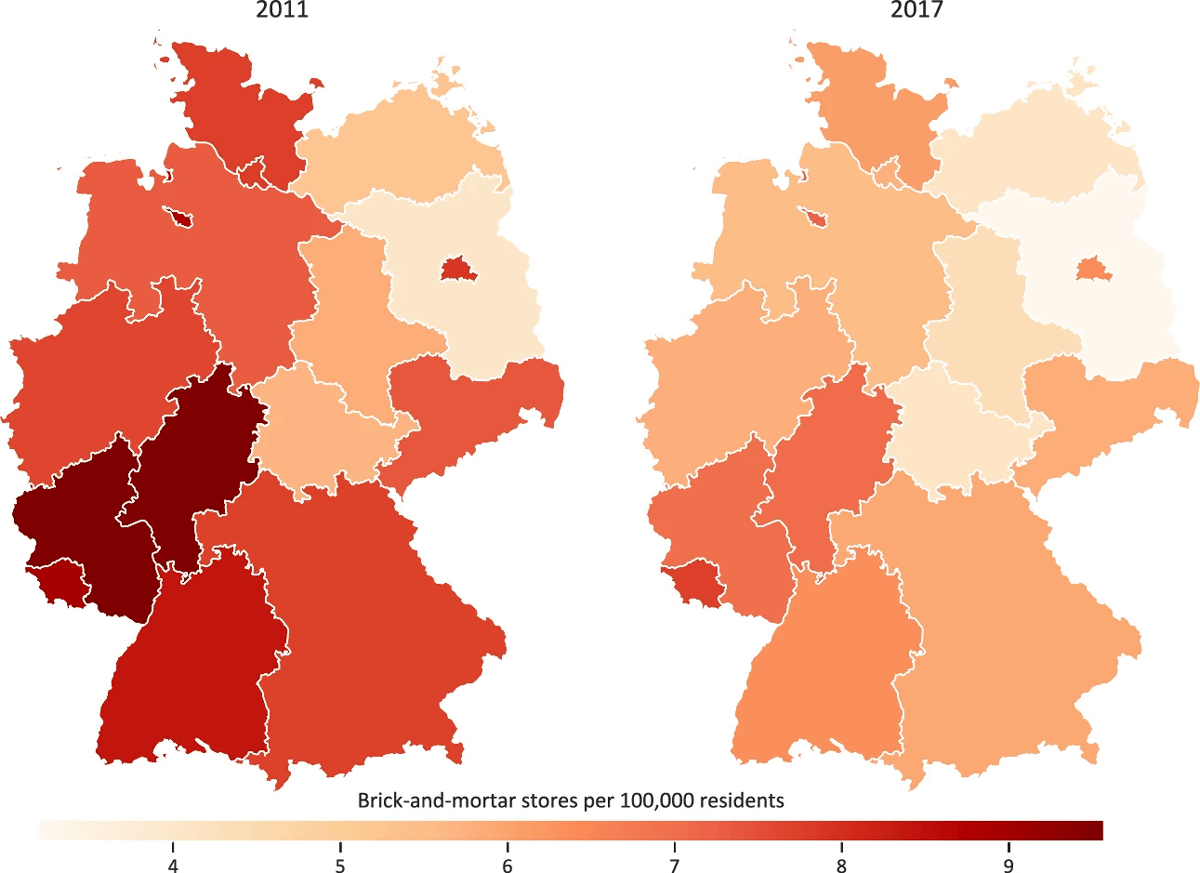
In 2011, approximately 297.2 million paper books were sold in physical stores and online, but by 2017, sales had fallen to approximately 264 million. During this period, the average price of books also rose, so while the decrease in sales was partially offset by the price increase, the decline in sales volume was still significant.
The following chart shows the number of paper books sold per capita in 2011 (left) and 2017 (right), with darker colors indicating higher sales. It clearly shows that paper book sales are declining throughout Germany.
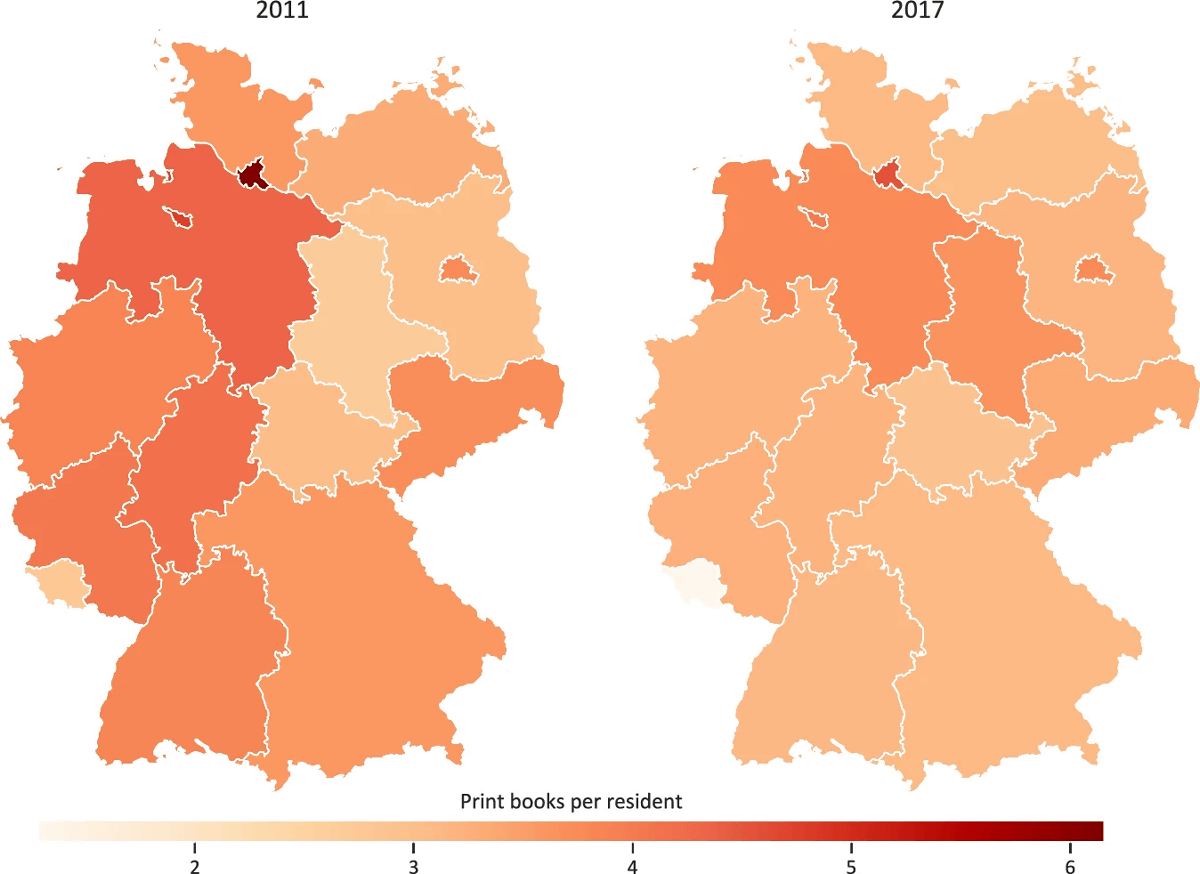
Analysis of this data revealed that for every brick-and-mortar bookstore that closes, the average monthly print book sales in a given state decrease by approximately 744 copies. Nationwide, the closure of approximately 1,430 bookstores between 2011 and 2017 resulted in a decrease of approximately 1 million monthly print book sales. This represents about 37% of the overall decline in monthly print book sales during the same period.
In short, the research findings indicate that the impact of closing physical bookstores could not be fully replaced by other nearby stores or online bookstores, negatively affecting the sale of paper books. One possible reason for this is that some consumers who had the habit of searching for and purchasing books in physical stores lost that habit due to the store closures, resulting in a decrease in the number of books purchased.
Furthermore, in certain genres, the closure of physical stores led to a decrease in online bookstore sales. Novels and children's books were particularly hard hit by the closure of physical bookstores, with monthly paper book sales decreasing by approximately 208 novels and 210 children's books, as well as online bookstore sales.
The research team believes this phenomenon is evidence that physical stores do not compete with online bookstores, but rather that the existence of physical stores actually promotes sales at online bookstores. For example, shoppers may order books they were interested in while visiting a physical store from an online bookstore after returning home or when they have the financial means. Furthermore, the mere fact that a book is available in a physical store can lead to word-of-mouth spread, potentially increasing sales at both physical stores and online bookstores.
On the other hand, the closure of physical bookstores did not have a significant impact on textbook sales. This is presumably because the demand for textbooks necessary for classes remains constant regardless of the presence or absence of bookstores, and if physical stores disappear, students have no choice but to purchase them from online bookstores.

To investigate whether ebooks were filling the gap left by the decline in print book sales, the research team incorporated ebook sales figures into their analysis using consumer survey data. However, they reported that even with ebooks included, the main trends remained unchanged and were unable to compensate for the decline in sales due to the closure of physical stores.
It should be noted that this study was conducted solely in Germany, and it is unclear whether similar trends can be observed in other countries or cultural spheres. Furthermore, as this is an observational study, it is not possible to understand the mechanisms by which the closure of physical stores had an impact.
Science of Money stated, 'The lesson readers can learn from this is quite simple: street corner bookstores seem to be doing more than just selling books displayed in their windows. When that light goes out, you realize they've created demand that wouldn't have existed anywhere else.'
Related Posts:






in Science, Posted by log1h_ik