Intel has announced 'Starfire,' a SoC designed for space use by the U.S. government.
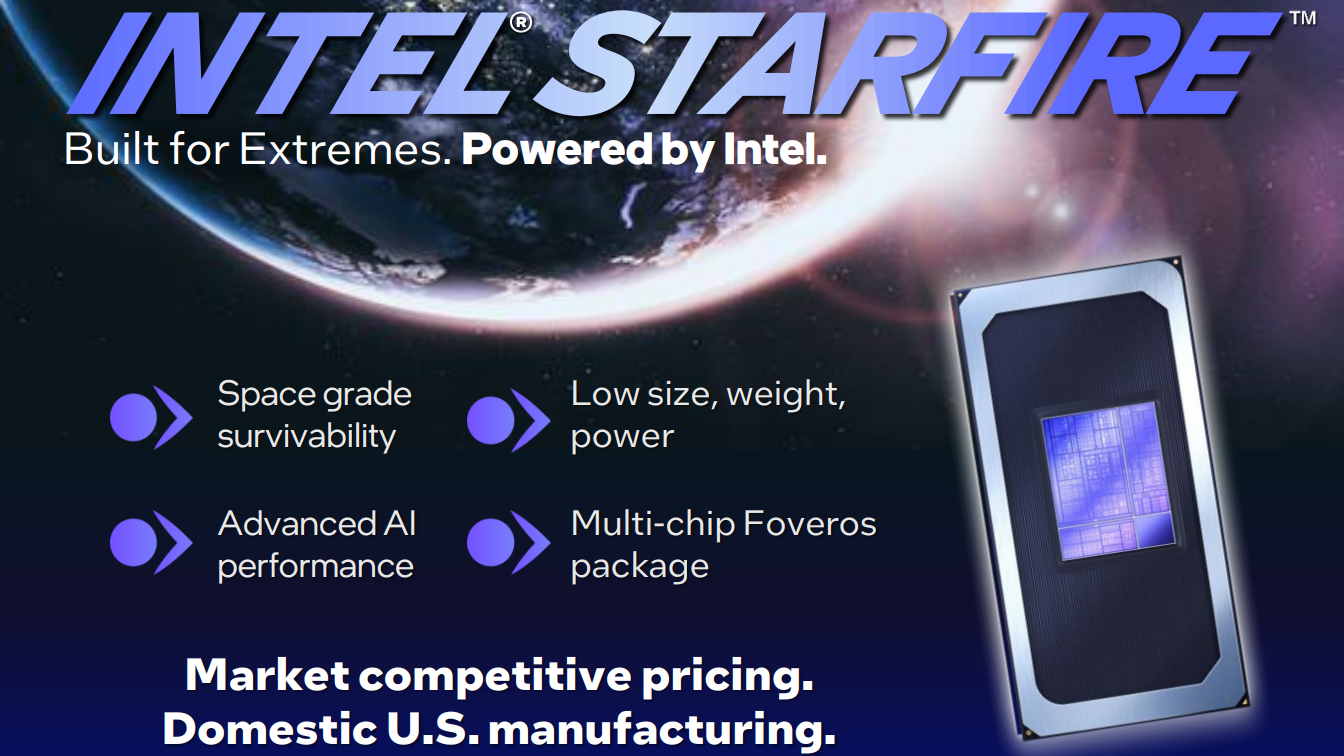
Intel has announced ' Intel Starfire ,' a system-on-a-chip (SoC) designed for use in space. It combines a CPU and NPU manufactured using
Intel® Starfire™ Intel-powered processors for ultimate use.
https://www.intel.co.jp/content/www/jp/ja/content-details/923451/intel-starfire-built-for-extremes-powered-by-intel.html
Intel's new space-grade Starfire chip is a Panther Lake SoC that puts an 18A CPU into orbit — chip designed for the US government leverages Intel 3 for the GPU | Tom's Hardware
https://www.tomshardware.com/tech-industry/semiconductors/intel-shows-off-starfire-space-grade-chip
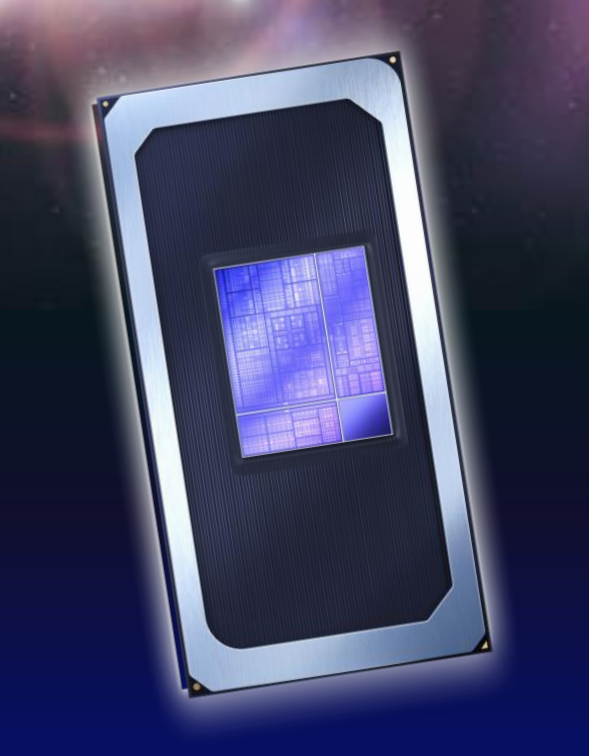
Starfire is a space-grade SoC developed for the U.S. government, integrating multiple chiplets such as CPU, NPU, and GPU into a single package using Intel's 3D packaging technology, 'Foveros.'
Starfire comes in two versions: 'Low Power' for reduced power consumption and 'Performance' for increased processing power. Both feature four P-cores and four low-power E-cores manufactured by Intel 18A, a 3-tile NPU, and a 64-execution Xe GPU manufactured by Intel 3.
The Low Power model features a P-core at 1.0GHz, an LP (Low Power) E-core at 850MHz, and a GPU operating at 800MHz to 1.0GHz, achieving a total AI performance of up to 45 TOPS and a TDP of 10W. On the other hand, the Performance model features a P-core at 3.1GHz, an LPE-core at 2.1GHz, and a GPU at 2.0GHz, achieving a maximum AI performance of 75 TOPS and a TDP of 35W.
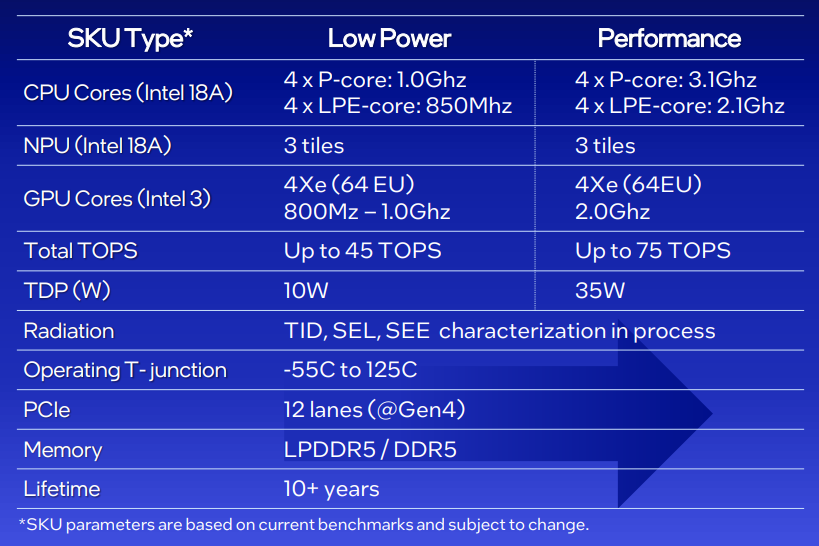
Both models feature 12 PCI Express 4.0 lanes and support LPDDR5 or DDR5 memory. They are designed for operation at temperatures ranging from -55°C to 125°C, with an expected lifespan of over 10 years. They are also characterized by their ability to perform advanced AI processing in space while minimizing size, weight, and power consumption.
In conventional spacecraft, relatively slow processors manufactured using older, large-scale processes were long employed to prioritize radiation resistance. For example, BAE Systems' radiation-hardened processor '
In contrast, Starfire is equipped with a dedicated NPU and is primarily intended for AI inference, processing images and sensor data acquired by satellites and other spacecraft in orbit. If the spacecraft can select and analyze the necessary information on its own, rather than transmitting all the data to the ground for analysis, it may be possible to alleviate the constraints of communication bandwidth and response time.
However, Intel's published documentation states that evaluations regarding total ionization dose, single-event latch-up, and single-event effects are still ongoing. Therefore, Starfire is not currently a product that has completed radiation resistance certification, and the specifications listed may change in the future.
Starfire is distributed by Intel Government Technologies, and Intel is emphasizing its competitive pricing and manufacturing within the United States. By incorporating the cutting-edge Intel 18A into a space-grade processor, Starfire aims to shift from traditional space computers focused on control and communications to high-performance computers capable of handling AI processing in orbit.
Related Posts:



in Hardware, Posted by log1i_yk