Qualcomm announces the Snapdragon X2 Plus SoC for PCs and the Dragonwing IQ10 processor for humanoid robots
At the technology trade show
Empowering Professionals and Aspiring Creators, Snapdragon X2 Plus Delivers Multi-day Battery Life, Fast Performance and Advanced AI | Qualcomm
https://www.qualcomm.com/news/releases/2026/01/empowering-professionals-and-aspiring-creators--snapdragon-x2-pl
Qualcomm expands Snapdragon on Windows with X2 Plus – 10-core ARM CPU boasts 35% single-core jump | Tom's Hardware
https://www.tomshardware.com/pc-components/cpus/qualcomm-expands-snapdragon-on-windows-with-x2-plus-10-core-arm-cpu-boasts-35-percent-single-core-jump
Qualcomm Announces Dragonwing IQ10 Robotics Platform at CES 2026
https://www.androidheadlines.com/2026/01/qualcomm-dragonwing-iq10-robotics-platform.html
News: Qualcomm unveils Dragonwing Robotics Development Platform at CES 2026
https://www.automate.org/news/ces-2026-qualcomm-targets-nvidia-jetson-with-new-robotics-developer-platform
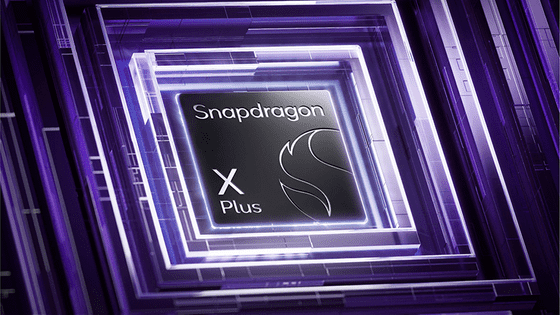
The latest addition to the Snapdragon X series, the Snapdragon X2 Plus, is designed with an emphasis on AI processing power and power efficiency, and Qualcomm claims it will 'transform every click and every moment for today's professional creators and everyday users alike.' The Snapdragon X2 Plus comes in two models: the 10-core X2P-64-100 and the 6-core X2P-42-100. Details are as follows:
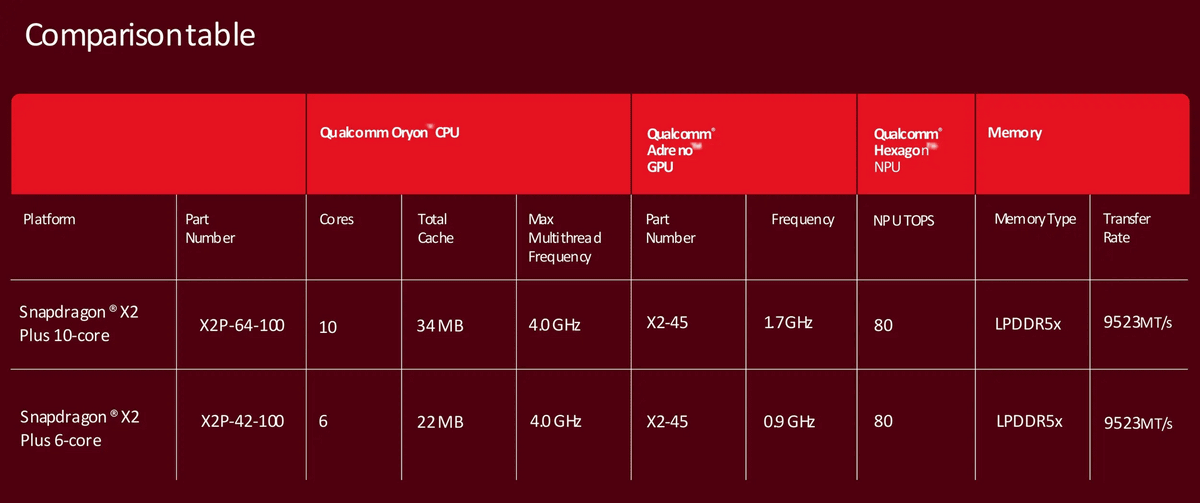
The main specifications are as follows.
・Process: TSMC N3P (equivalent to 3nm)
・NPU: 80 TOPS (INT8) inference capability
Memory: Supports up to 128GB and transfer speeds of 9523 MT/s
GPU: Adreno (X2-45) is used. The X2P-64-100 has a GPU clock speed of 1.7GHz, while the X2P-42-100 has a GPU speed of 0.9GHz.
The phone employs an ARM CPU with up to 10 cores, delivering up to 35% improvement in single-core performance compared to the previous generation. It also supports operation up to 4.0GHz, and its highly efficient 3nm process design reduces power consumption by approximately 43% compared to the previous generation, further enhancing the power efficiency that is a strength of the ARM architecture while covering a wide range of tasks from everyday work to creative work. Furthermore, the integrated 'Snapdragon Guardian' advanced security ensures users can maintain a smooth operation even on the go.

The Snapdragon X2 Plus uses a heterogeneous design that combines 'Prime' (high-performance) cores that handle high-load tasks with high clock speeds, and 'Performance' (efficiency-oriented) cores that maximize area efficiency and improve multi-threaded performance. Although the name has changed, the basic concept of 'optimization through role division' remains the same.
In benchmark tests conducted at the CES 2026 event, the 10-core X2P-64-100 achieved a single-core score of 3323 and a multi-core score of 15084 in Geekbench 6.5. However, Geekbench scores are based on press event results and may vary depending on cooling and settings. Qualcomm claims that both the 10-core X2P-64-100 and the 6-core X2P-42-100 offer up to 29% improved GPU performance compared to the previous generation.
'Today's professionals and creators want to do more, create more, and push the boundaries of generative AI and all-day performance,' said Kedar Kondup, senior vice president and general manager, Computing and Gaming, Qualcomm. 'The Snapdragon X2 Plus platform delivers the power, efficiency, and intelligence to exceed their ambitions, making every experience more responsive and personal.'
Furthermore, at CES 2026, Qualcomm announced a new robotics platform based on the Dragonwing IQ10 series, the latest high-performance robot processor for full-size humanoids. According to Qualcomm, Dragonwing IQ10 is not just a robot chip, but is designed as a full-stack robotics architecture that offers industry-leading power efficiency and scalability and is suitable for a wide range of applications, from personal service robots to next-generation industrial autonomous mobile robots, and full-size humanoid robots with the capabilities of reasoning, adaptation, and judgment.
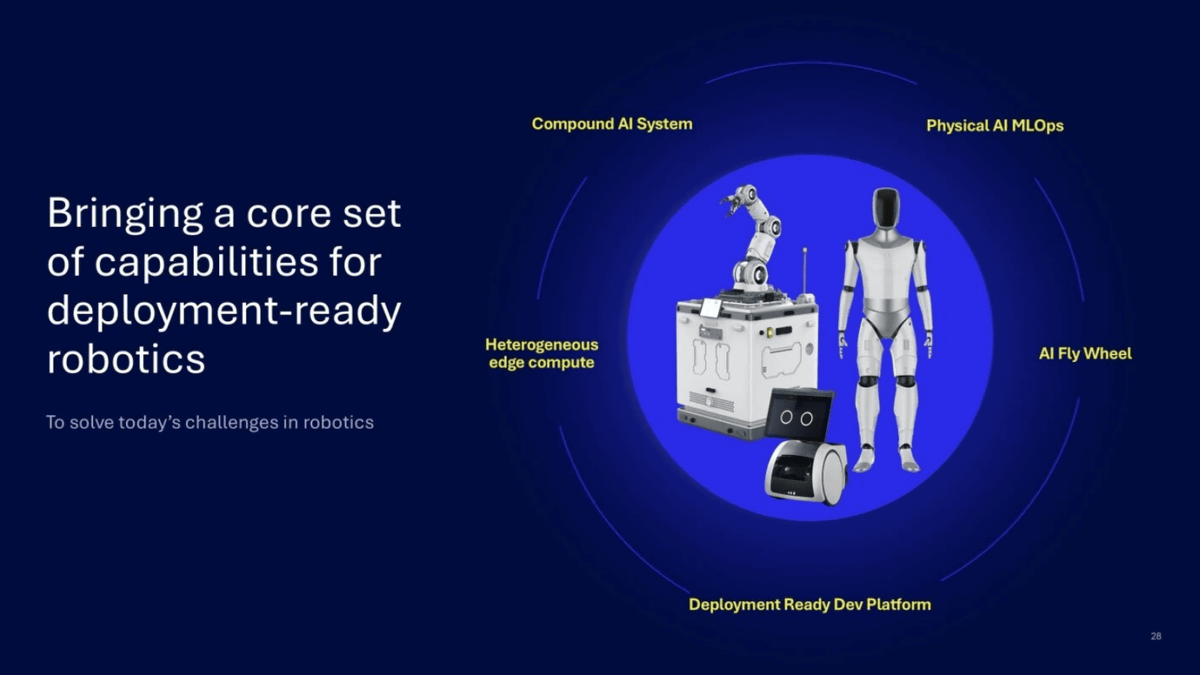
'As pioneers of energy-efficient, high-performance physical AI systems, we know what it takes to make even the most complex robotic systems operate reliably, safely and at scale,' said Nakul Duggal, executive vice president of Robotics at Qualcomm. 'By building on a foundation of low-latency, safe, high-performance technologies for sensing, perception, planning and action, we are moving intelligent machines from the lab into real-world environments and redefining what's possible with physical AI.'
Related Posts:




in Hardware, Posted by log1e_dh