It has been discovered that microorganisms can convert uranium dissolved in water into stable compounds.

A research team from Helmholtz Zentrum Dresden Rossendorf (HZDR) in Germany and the University of Granada in Spain has revealed that providing microorganisms living in uranium mines with specific nutrients significantly alters the state of uranium in water. Contaminated water generated at former uranium mines is an environmental problem requiring long-term treatment, and this research could lead to new treatment methods using microorganisms.
Pentavalent and tetravalent uranium formation via glycerol-stimulated bacteria in mine water | Nature Communications
Bacteria turn dissolved uranium into stable compound in 130 days, study finds
https://phys.org/news/2026-07-bacteria-dissolved-uranium-stable-compound.html
Uranium contamination is a global environmental problem stemming from past mining activities and phosphate fertilizers. In particular, at former mine sites, uranium contained in groundwater and mine water can have adverse effects on ecosystems and human health, requiring long-term treatment.
The research team focused on the Schlema-Alberoda uranium mine in the Erz Mountains of Saxony, Germany. This mine was one of the world's leading uranium mining sites until 1990, but after its closure, the tunnels became filled with water, and the treatment of the mine water continues to this day. Although the amount of pollutants has decreased due to existing chemical treatments, the mine water still contains about 1 mg/L of hexavalent uranium, or U(VI), which exceeds the Saxony state's emission standard of 0.20-0.50 mg/L.
by
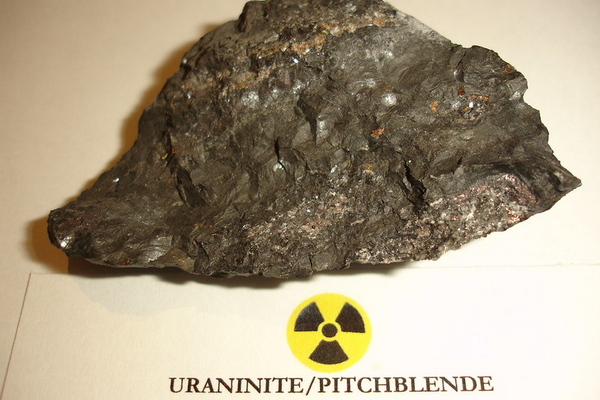
In environments with high oxygen levels in water, uranium primarily exists in the form of U(VI), which is easily soluble in water. On the other hand, when uranium is reduced to tetravalent uranium, or U(IV), by microorganisms, it tends to precipitate as a mineral that is poorly soluble in water, such as uraninite ( UO₂ ). Therefore, 'bioremediation,' which uses the action of microorganisms to change uranium into a form that is less mobile in water, has been studied as a promising option for treating contaminated water.
In this study, the researchers utilized the microbial community naturally present in the mine's underground water and added glycerol under oxygen-free conditions. Glycerol is a basic component of animal and plant fats and is also produced in nature through processes such as wood decomposition by fungi. The research team explained that they recreated conditions similar to those found inside the mine, which is located at a depth of approximately 2000 meters and contains very little oxygen.
When an environment was created in which microorganisms could utilize glycerol as a nutrient source, the concentration of uranium dissolved in the water decreased from the initial value of 1 mg/L to 0.04 mg/L after 130 days, a reduction of approximately 96%. While some decrease was also observed in control experiments without glycerol and in sterilized control experiments, the reduction was only about 25% to 36%, leading the research team to conclude that the microbial activity stimulated by glycerol played a significant role.
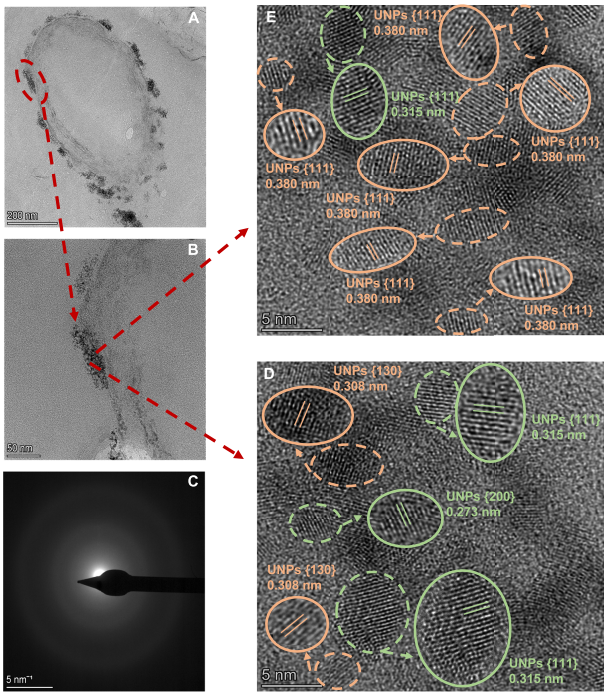
Furthermore, the research team conducted high-resolution X-ray absorption spectroscopy and electron microscopy to examine the formed black precipitate in more detail. As a result, they found that the precipitate contained not only U(IV) uraninite nanoparticles, but also FeU(V) O4 nanoparticles containing pentavalent uranium (U(V)) and U(V) carbonate complexes .
The following image shows uranium nanoparticles found in a black precipitate containing bacteria, observed under an electron microscope. Green circles represent uraninite particles, and orange circles represent FeU(V) O4 particles containing pentavalent uranium.
The graph below shows the oxidation states of uranium in the black precipitate. As the uranium concentration in the water decreased, U(VI) decreased and U(IV) increased, but U(V) was also observed at a constant rate.
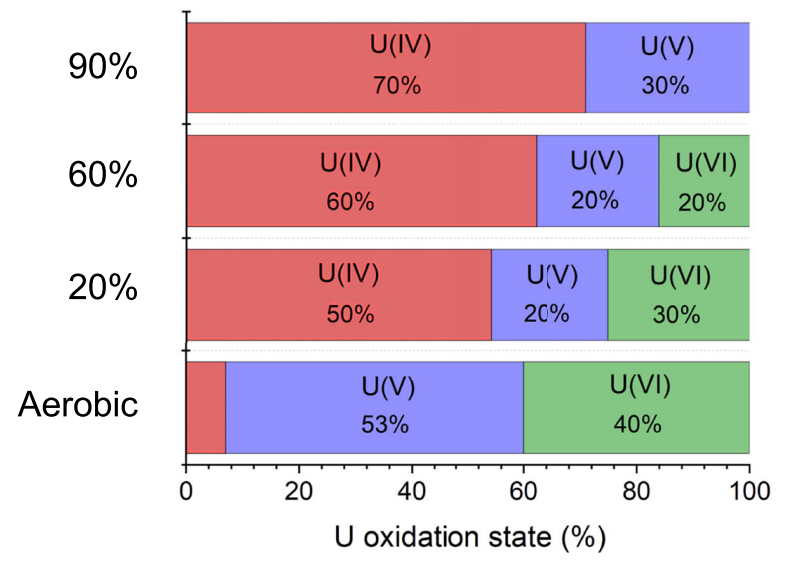
The research team emphasizes that U(V) was not merely a temporary intermediate state, but existed in a stable form. U(V) has often been considered an unstable, short-lived state, and it was unclear whether it would remain stable for extended periods under mine water conditions similar to natural environments. This study shows that U(V) persisted for at least 130 days in oxygen-free conditions and remained even after being exposed to oxygen for four weeks.
The research team initially suspected that uranium might be incorporated into the bacterial cell walls. Indeed, electron microscopy observations revealed electron-dense aggregates on the bacterial cell surface, showing that uranium, iron, and sulfur were distributed within them. Furthermore, most of the nanoparticles were about 2-3 nm in size, and of the 231 nanoparticles analyzed, 55.4% were classified as FeU(V) O₄ , 40.3% as uraniite, and 4.3% as pyrite.
FeU(V) O4 is a relatively recently discovered uranium compound. A 2020 study identified it in uranium-contaminated soil in Croatia, and it was reported to have remained stable for over 25 years. However, it was unknown how this compound is formed in nature, and whether microorganisms are involved in its formation.
This study is the first to demonstrate that glycerol-based microbial communities can convert uranium in water into stable compounds such as FeU(V) O4 .
Analysis of the microbial community revealed that the addition of glycerol increased the levels of fermentative bacteria and sulfate-reducing bacteria. Fermentative bacteria decompose glycerol to produce acetic acid, lactic acid, and hydrogen, which may act as electron donors for sulfate-reducing bacteria and metal-reducing bacteria involved in uranium reduction. The study detected sulfate-reducing bacteria such as Desulfobarbus and Desulfovibrio , suggesting that a redox environment suitable for uranium reduction was formed.
This discovery suggests that in the treatment of uranium-contaminated water, it may be possible not only to convert U(VI) to U(IV), but also to form a stable U(V) phase. If FeU(V) O4 is relatively stable even under oxidizing conditions, it could be a more robust immobilization method against re-leaching than conventional U(IV)-based treatments. However, the research team stated that further investigation into environmental compatibility and long-term stability is needed to determine whether this method can be used in actual environmental remediation.
Related Posts:




in Science, Posted by log1i_yk