Scientists have succeeded for the first time in growing and replicating artificial cells created from scratch.
Biotic | SpudCell
https://biotic.org/research/spudcell/
Lab-created 'SpudCell' marks 'stunning' step toward building life from scratch | Science | AAAS
https://www.science.org/content/article/lab-created-spudcell-marks-major-step-toward-building-life-scratch
For the First Time, a Cell Built From Scratch Grows and Divides | Quanta Magazine
https://www.quantamagazine.org/for-the-first-time-a-cell-built-from-scratch-grows-and-divides-20260701/
This Cell Feeds, Grows and Reproduces. And It's Manmade. - The New York Times
https://www.nytimes.com/interactive/2026/07/01/science/spudcells-synthetic-cell.html
Approximately 4 billion years ago, atomic life forms were formed from the aggregation of non-living atoms. These organisms absorbed nutrients, grew, and divided, undergoing repeated evolution over a long period of time. As a result, cells transformed into diverse life forms, and today, a wide variety of plants, animals, and bacteria inhabit our environment.
For decades, some scientists have been working to create artificial cells to investigate the origins of life. In some studies, they have succeeded in encapsulating simple gene molecules in hollow bubbles made from oily molecules, or replicating individual cellular functions such as feeding and growth. However, the conditions under which each of these functions can be successfully replicated differ, and combining multiple functions has proven difficult.
Artificial cells that take in and excrete only specific substances, like Pac-Man, have been successfully developed - GIGAZINE

Amidst this situation, a research team led by Associate Professor Kate Adamara, a synthetic biologist at the University of Minnesota, aimed to construct artificial cells capable of performing a complete cell division cycle. Adamara and her team developed and optimized components inspired by various studies and combined them within liposomes , which are vesicles with a lipid bilayer.
For the most basic cellular system—replicating the DNA of parent cells and passing it on to daughter cells—we adopted the DNA replication system reported in a 2018 study . Furthermore, we utilized the ' PURE system ,' a kit containing biomolecules such as proteins and ribosomes necessary for transcribing DNA into messenger RNA and translating RNA into proteins, to enable protein synthesis in artificial cells.
Previous researchers have used the PURE System to create systems with basic cellular functions such as protein synthesis, but these earlier systems could not take in nutrients or divide based on the genome. Adamara and his colleagues incorporated a gene that causes artificial cells to generate a special molecular tag and present it on the surface of liposomes. This molecular tag fuses with 'feeder liposomes' that supply nutrients such as lipids, ribosomes , enzymes, and small molecules necessary for membrane growth, enabling the artificial cells to take in nutrients from the outside and grow.
Furthermore, while natural cells use an internal scaffold called the cytoskeleton during division, creating a functional cytoskeleton from scratch requires the coordinated action of dozens of different proteins, which has been a major bottleneck in synthetic cell research. Therefore, Adamara and his colleagues adopted a method in which they generated molecular tags that bind to a molecule called streptavidin in artificial cells, and this binding physically bends the membrane of the artificial cells, causing them to divide.
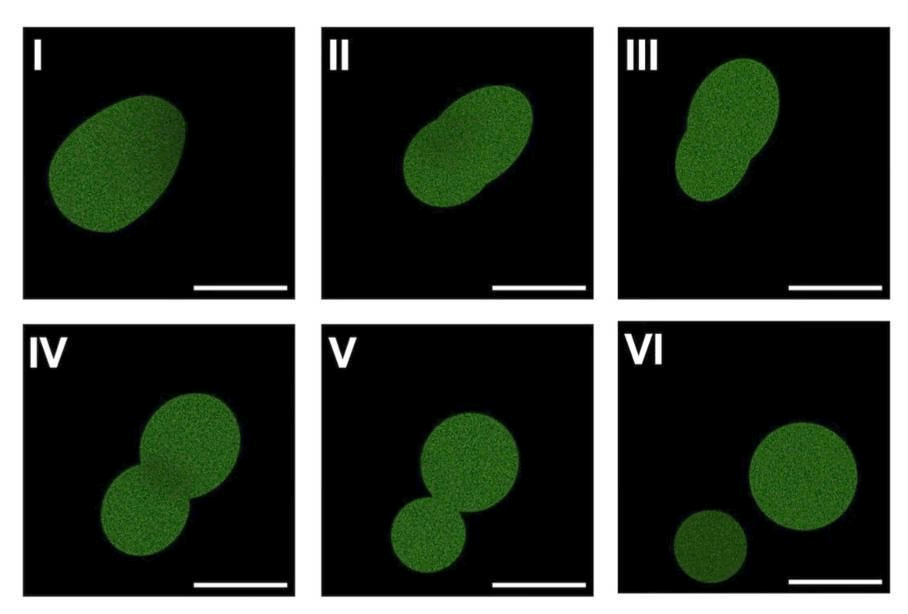
Thus, Adamara and his colleagues succeeded in developing 'SpudCell,' an artificial cell that absorbs nutrients, grows, replicates its DNA, and divides. SpudCell consists of 36 purified enzymes, a genome of 90,000 base pairs spanning nine DNA molecules, and a lipid membrane, and is capable of proliferation, genome replication, and division over multiple generations. The following diagram shows how SpudCell divides.
The problem is that the genome replicated by mechanical division does not separate cleanly, so only 30% of SpudCells retain a complete genome after five divisional cycles. Also, while ribosomes, which synthesize proteins, degrade over time, SpudCells lack a mechanism to create new ribosomes or remove old ones.
However, SpudCell is touted as the first artificial cell ever to be constructed from scratch using individually purified non-cellular materials and to demonstrate a basic cell division cycle. In additional experiments conducted by Adamara et al., they introduced gene mutations that increased the production of fusion proteins into some SpudCells, demonstrating that SpudCells with these mutations grew faster and produced more offspring.
Incidentally, Adamara and his colleagues attempted to publish their research paper in the life sciences journal Cell, but it was rejected by reviewers who deemed it not a biology paper. Therefore, Adamara and his team sent the paper to the press before uploading it to the preprint server bioRxiv, and then published it online. This has been pointed out as an unusual method, but some scientists have praised Adamara's approach to publication.
SpudCell can be applied to a variety of experiments and may be useful in creating new materials such as biofuels and pharmaceuticals in the future. Adamara and his colleagues established Biotic, a public interest research organization, with the aim of collaborating with various research groups and accelerating research. According to Drew Endy , a synthetic biologist at Stanford University who co-founded Biotic with Adamara, Biotic has raised $10 million (approximately 1.6 billion yen) in initial funding so far, and plans to distribute most of it as research grants in September 2026.
Related Posts:


in Science, Posted by log1h_ik