California law regulating loud streaming ads goes into effect on July 1st.

Starting July 1, 2026, it will be illegal in California, USA, to broadcast advertisements that are louder than the content being played on a streaming platform.
Streaming Ads Are About to Get Quieter
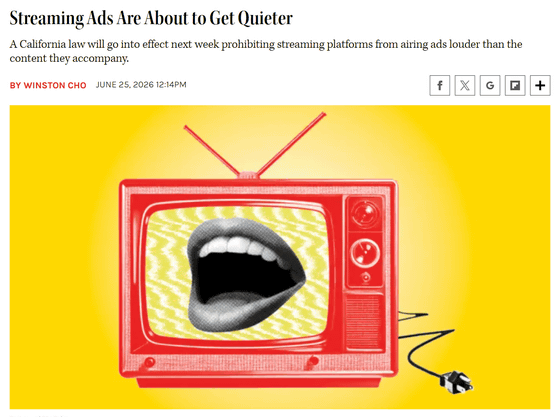
Streaming services' obnoxiously loud ads become illegal on July 1 in California - Ars Technica
https://arstechnica.com/gadgets/2026/06/streaming-services-obnoxiously-loud-ads-become-illegal-on-july-1-in-california/
California law targeting loud streaming ads takes effect on July 1 | TechCrunch
https://techcrunch.com/2026/06/28/california-law-targeting-loud-streaming-ads-takes-effect-on-july-1/
California Governor Gavin Newsom signed a bill ( SB 576 ) in October 2025 that would ban video streaming services from transmitting advertisements at a volume louder than the accompanying video content. This bill will go into effect on July 1, 2026.
California Governor signs bill banning 'noisy ads,' including those louder than the content being watched on Netflix and YouTube - GIGAZINE

According to the Federal Communications Commission (FCC), SB 576 is a law designed to bring a certain degree of equality between streaming services and broadcast, cable, and satellite television providers. The Commercial Advertising Volume Limitation Act ( CALM Act ) stipulates that broadcast, cable, and satellite television providers can only play commercials at the same average volume as the accompanying programs. In other words, SB 576 aims to impose the same regulations as CALM Act on video streaming services.
Technology media outlet Ars Technica reports, 'We haven't seen any explanation from streaming service providers about how they will comply with California law, or whether they will adjust the volume for streaming outside of California in the United States. Streaming providers can choose to apply volume adjustments only to customers they determine to be in California, but it's reasonable to assume that companies will apply these changes to other regions as well.'
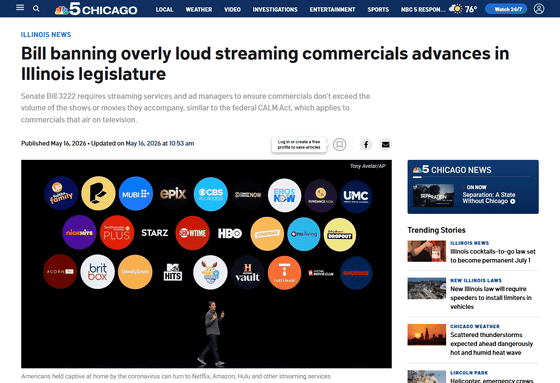
In June 2026, a similar bill was passed in the Illinois State Legislature in the United States. This bill is scheduled to go into effect on July 1, 2027, and will prohibit streaming services from making their advertisements louder than the content.
Illinois legislature moves to ban loud streaming commercial – NBC Chicago
https://www.nbcchicago.com/news/local/bill-banning-overly-loud-streaming-commercials-advances-in-illinois-legislature/3936758/
Furthermore, the Motion Picture Association , which includes streaming service providers such as Netflix, Disney, Amazon, and Paramount, and the Streaming Innovation Alliance , which includes Netflix, Disney, Peacock, and Pluto TV, have expressed opposition to this type of advertising volume regulation law.
The two organizations argued that many streaming services are trying to control the volume of 'server-side ads,' which are causing discrepancies between the volume of programs and the volume of advertisements. Ars Technica points out that server-side ads use various encoding pipelines from companies, which leads to variations in volume.
According to TV Tech , a media outlet in the television industry, for streaming services to comply with California's ad volume regulations, they will need to integrate file-based processing, and in some cases real-time processing and volume control, into their server-side ad insertion workflows, just as they do with their main programming.

According to the FCC, there were at least 1,700 complaints about the volume of advertisements on streaming services by 2025, approximately 825 in 2023, and approximately 750 in 2022.
Related Posts:






in Web Service, Posted by logu_ii