A fortune-telling app called 'A Quantum Magic 8-Ball' that uses a homemade quantum random number generator.
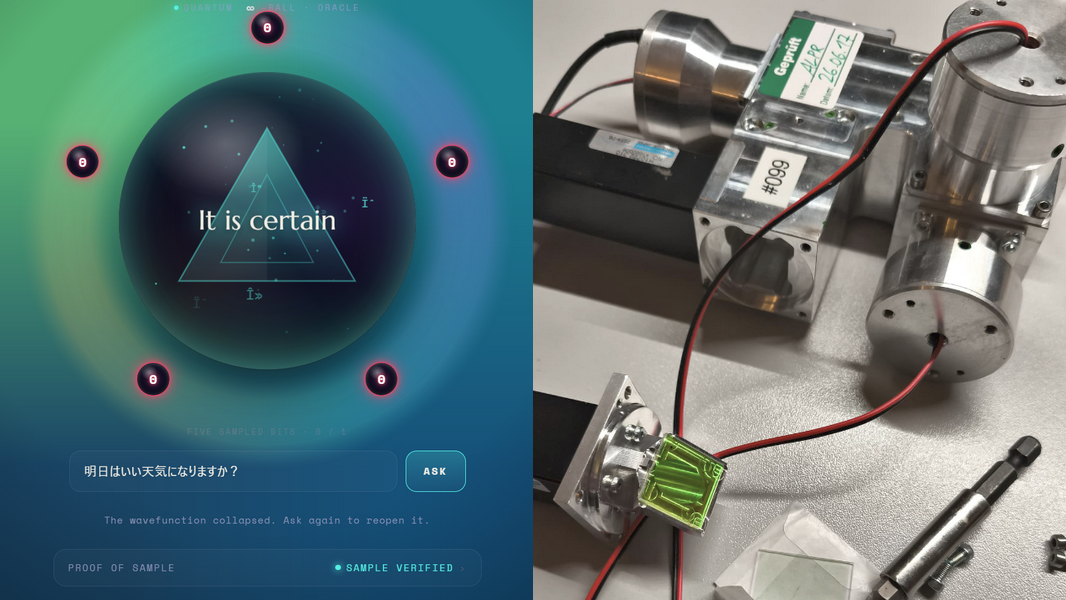
Researcher and engineer David Noel Ng built a device that generates random numbers using the results of quantum measurements, specifically 'which detector a photon reaches,' and created a web application called ' A Quantum Magic 8-Ball ' that uses these random numbers to select answers for fortune-telling.
Building the Beam Universe Splitter I: A Quantum Magic 8-Ball | David Noel Ng
A Quantum Magic 8-Ball is located at the bottom of the above website . Enter what you want to know in the input field and click 'ASK'.
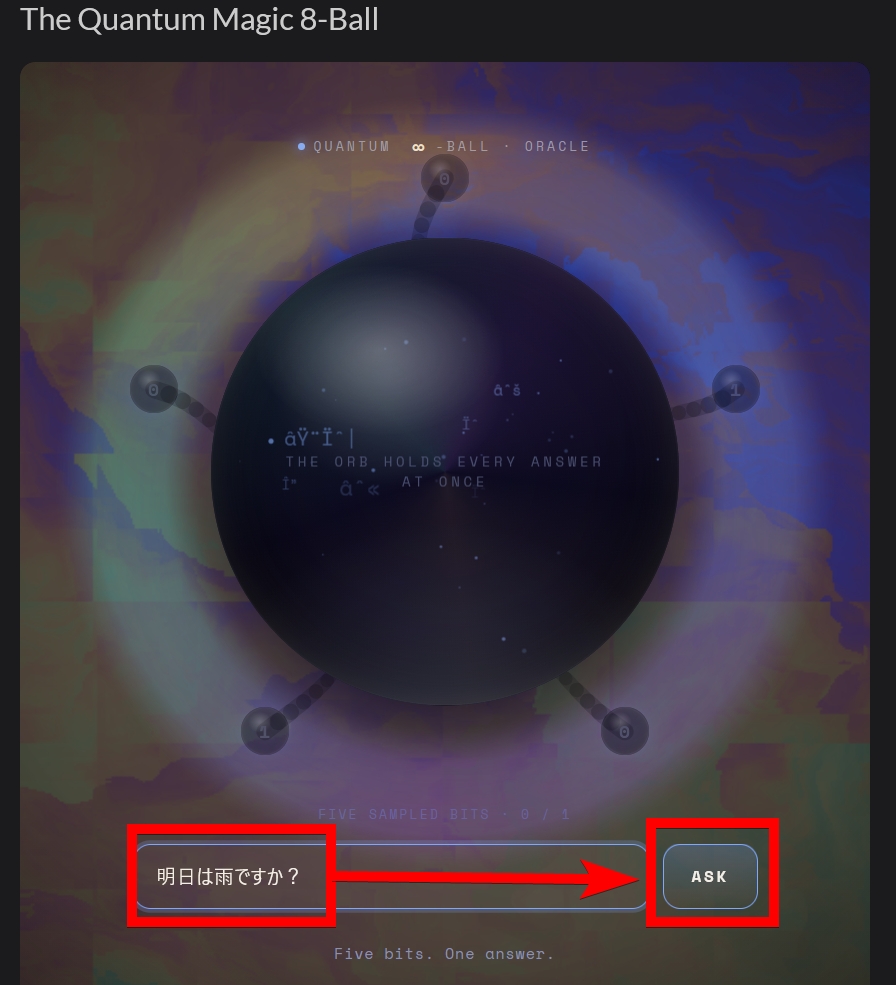
Five black spheres lined up around a giant central sphere flash with the numbers 0 and 1.
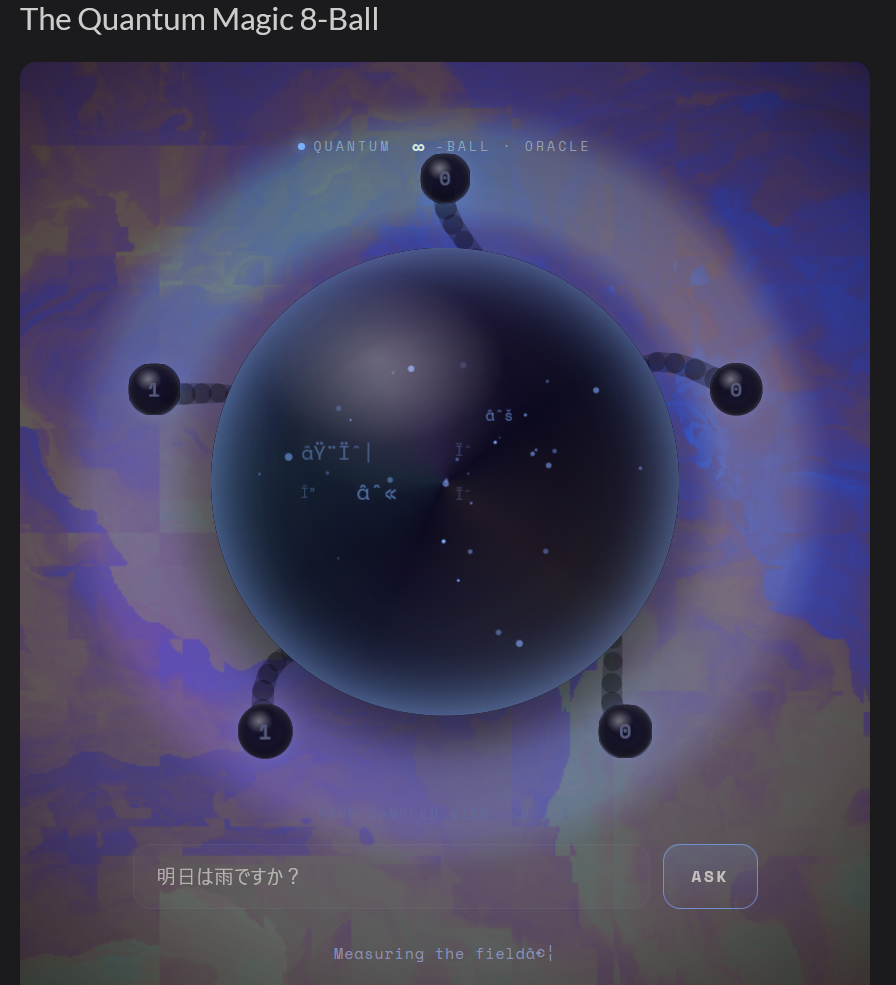
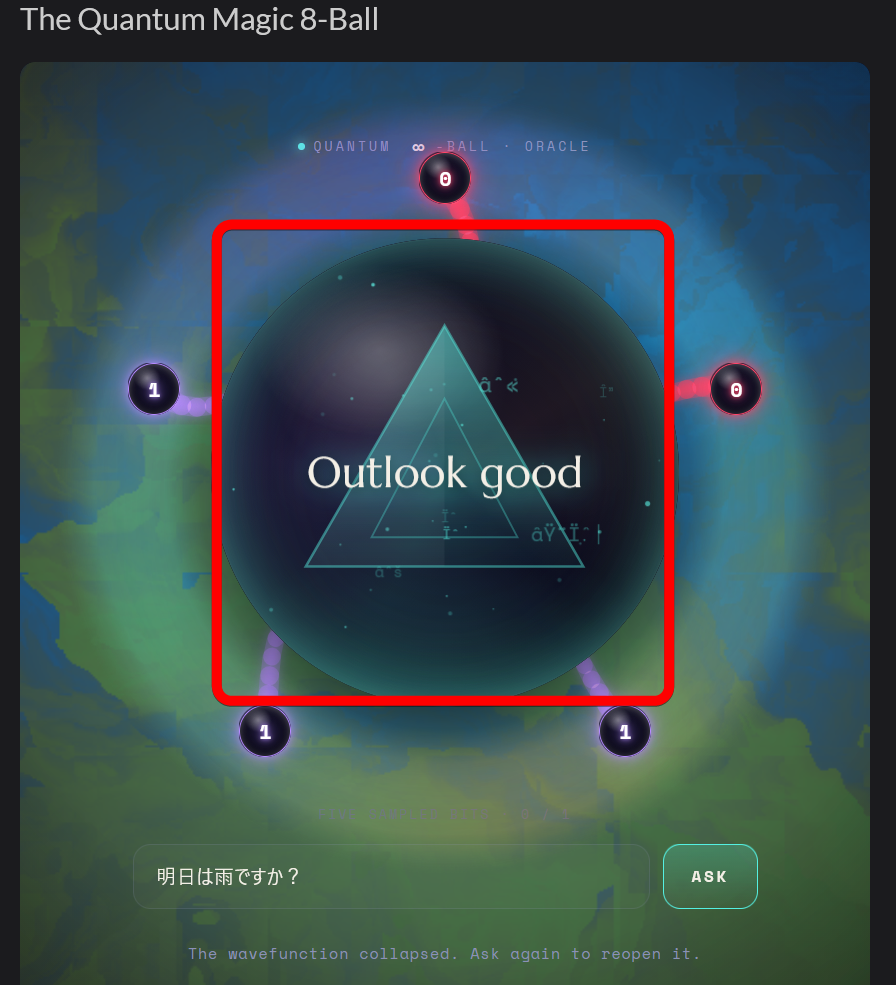
The message displayed was 'Outlook Good.' However, this response is not based on an AI review of the input; it simply displays one of 20 pre-prepared responses at random.
Magic 8-Ball is a plastic ball toy similar to a billiard 8-ball, containing a liquid and a regular icosahedron die with various messages written inside. You ask the question you want to know, shake the ball well, and when you look through the viewing window inside the ball, the die will float up and reveal the message. Invented in 1946, Magic 8-Ball is a historical toy in America and even appeared in the movie
Don't count on it! - YouTube
The random numbers used to select answers in A Quantum Magic 8-Ball are obtained from a quantum random number generator built by Mr. N. The content entered in the question field is not sent to the quantum random number generator; the system receives processed random numbers from the device only after clicking 'ASK.' The app's role is simply to associate the received random numbers with one of 20 predefined answers and display them.
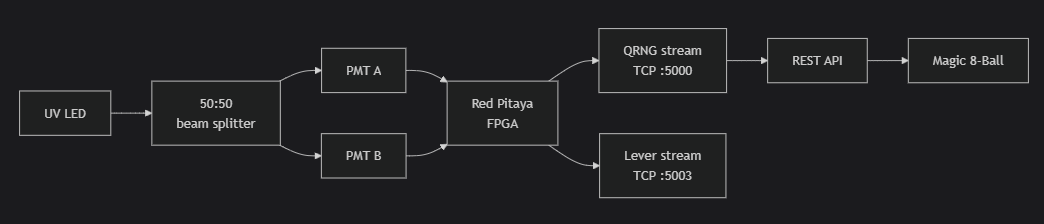
A 5-bit random number consisting of 0s and 1s is used to select the answer. There are 32 possible numbers that can be represented by 5 bits, from 0 to 31, but since there are only 20 possible answers in Magic 8-Ball, numbers from 0 to 19 are assigned to the answers, and if numbers from 20 to 31 are drawn, they are discarded and the next 5 bits are read. This process, called 'rejection sampling,' ensures that all 20 possible answers are selected with equal probability.
The random number generation device works by treating which PMT detects a photon as heads or tails in a coin toss. Light from an ultraviolet LED and fluorescence is weakened and directed at a 50:50 beam splitter that works in the ultraviolet range. The light that passes through the beam splitter reaches two photomultiplier tubes, PMT A and PMT B. If PMT A reacts, it is recorded as 0, and if PMT B reacts, it is recorded as 1.
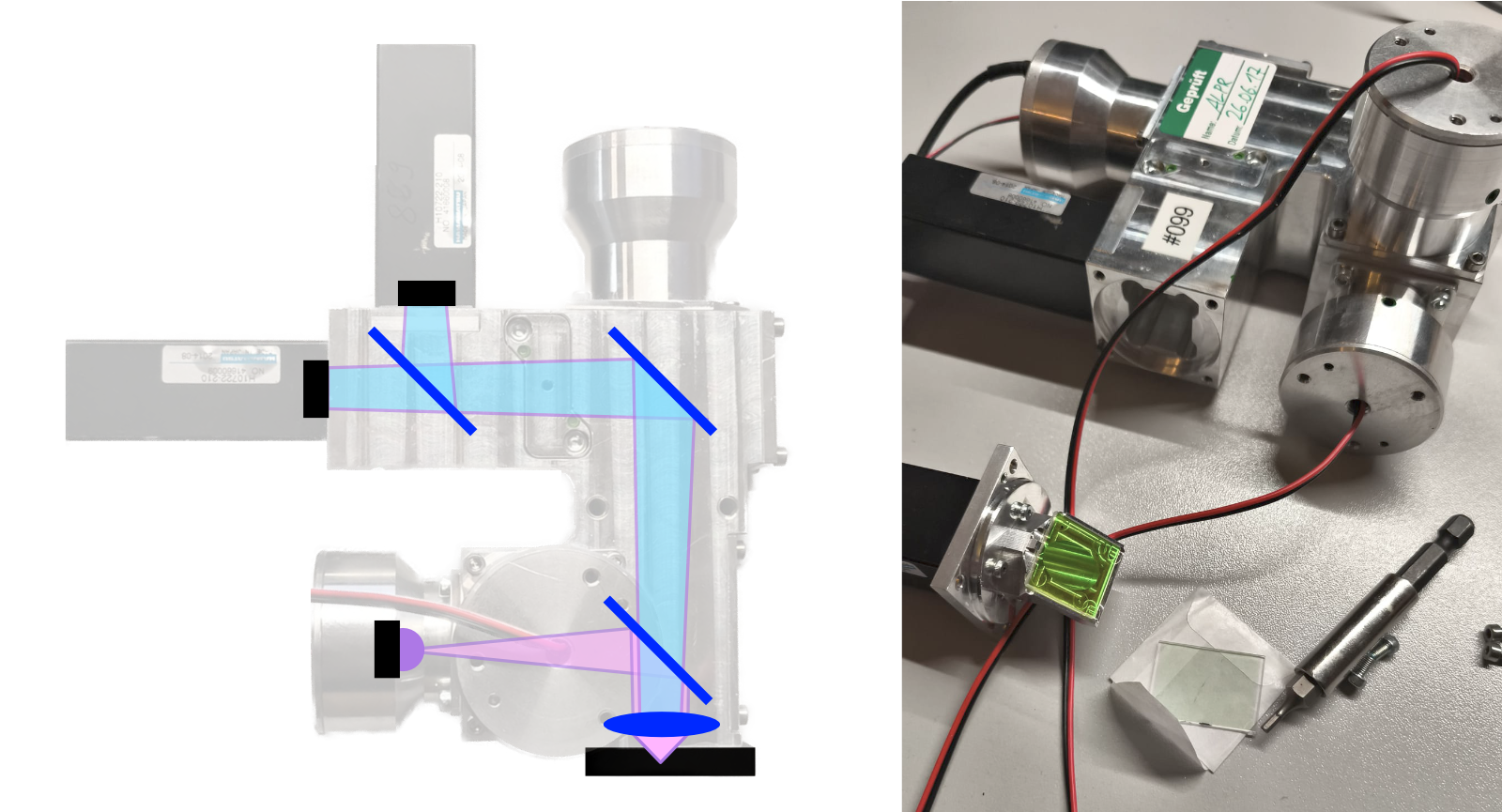
Photomultiplier tubes (PMTs) are components that detect very weak light and convert it into electrical signals. However, this device does not use a light source that reliably generates single photons one by one; instead, it utilizes light from LEDs and fluorescence that has been sufficiently weakened. Therefore, there is a possibility that multiple photons may arrive at roughly the same time, and simply replacing the PMT reaction with 0s and 1s may result in bias or short-term correlations remaining.
The two PMTs are components from
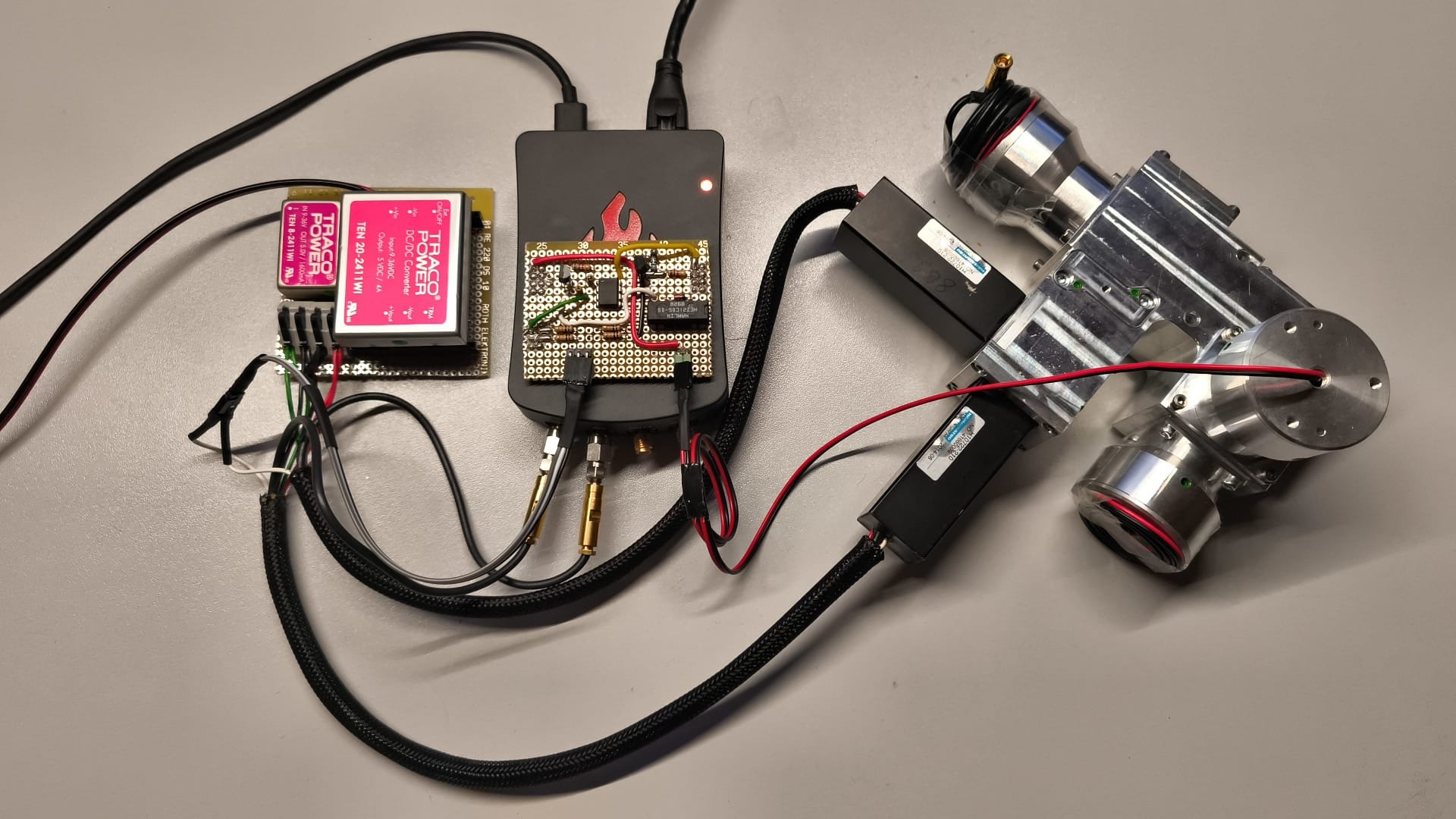
The random number generator in A Quantum Magic 8-Ball is named 'Universe Splitter.' According to Mr. N, this is a conscious expression of the many-worlds interpretation, which states that the universe branches depending on the results of quantum measurements, and of course, it does not mean that it is a device that actually branches the universe.
The electrical signals output by each PMT are input to a board called Red Pitaya, which is equipped with an ADC and an FPGA. The FPGA interprets a rising voltage above a certain threshold as a photon detection and records a bit if only one PMT responds within a predetermined short time. Events where both PMTs respond almost simultaneously are rejected to rule out possibilities such as multiple photons arriving at the same time. Furthermore, immediately after a detection is received, both inputs are ignored for a certain period of time to prevent fluctuations in subsequent PMT pulses or circuit signals from mixing into the next random number.
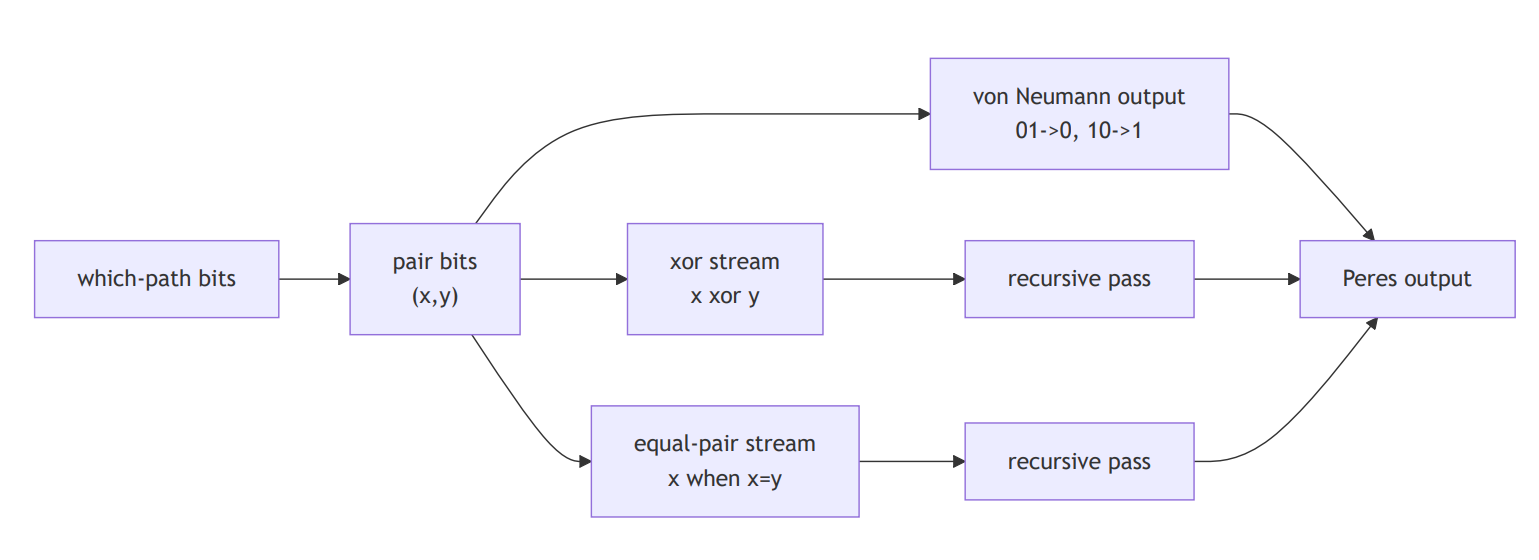
If one of the PMTs has high sensitivity, or if the beam splitter's splitting ratio is not exactly 50/50, a bias will occur in the raw 0s and 1s. Mr. N suppressed the bias by using the Peres method, which recursively utilizes the information that would otherwise be discarded by the von Neumann method, which removes bias by handling bits in pairs. Subsequently, the 1024 bits that have passed through the Peres method are compressed to 896 bits using the Toeplitz extractor to further suppress any remaining bias or correlation. This process is not to keep the random numbers secret, but to make the output closer to uniform random numbers, taking into account the imperfections inherent in the physical device.
The generated random number sequences were validated using the NIST Statistical Test Suite. Statistical tests were performed on 600 million bits with a conservative setting that compresses more tightly, and on 1 billion bits with a setting that loosens compression to increase output. Mr. N stated that no systematic problems were found in the latter case either.
However, passing these tests does not fully prove that the random numbers are quantum-derived or secure for cryptographic purposes. The final output speed is approximately 2.28 kbit per second, which is fast enough to select one answer for a fortune-telling game.
The random numbers output from the FPGA are read by software called '
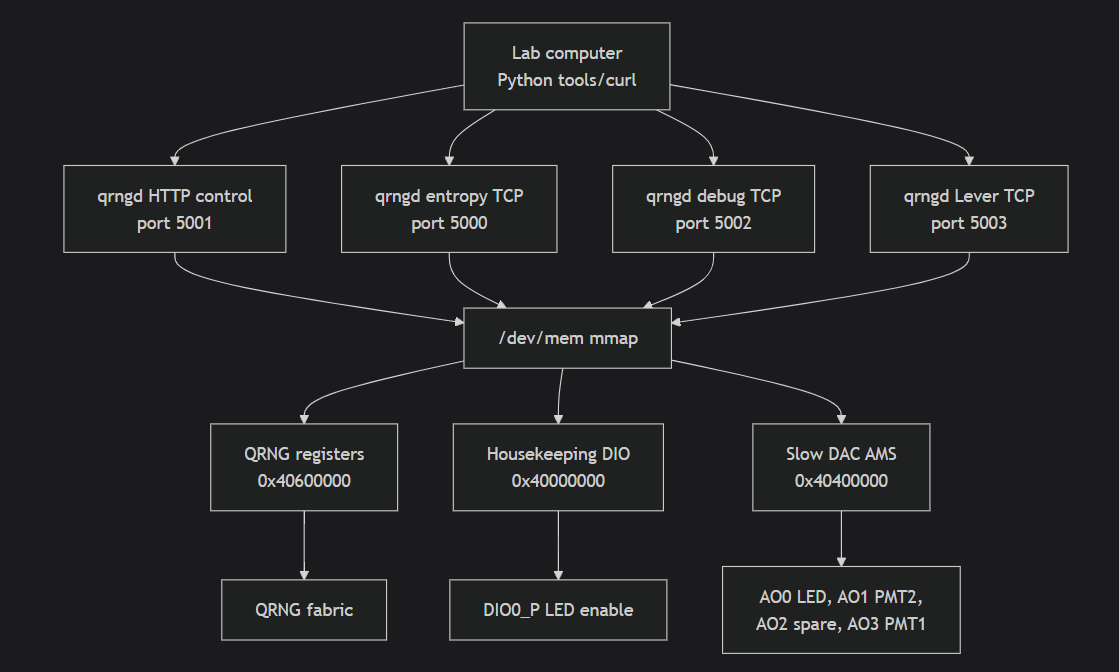
Furthermore, Mr. N stated that 'the 20 possible answers provided for a regular icosahedron die are insufficient to handle complex questions,' and that he intends to develop a system that communicates results in natural language in the future.
Related Posts:






in Video, Hardware, Software, Review, Web Application, Posted by log1i_yk