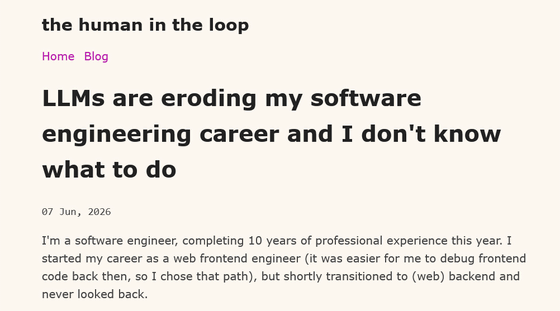
A post titled 'AI is encroaching on my career as a software engineer and I don't know what to do' has garnered a huge response.

While the remarkable advancements in AI technology are making various tasks more convenient, there are also concerns that it will take away human jobs. One
LLMs are eroding my software engineering career and I don't know what to do | the human in the loop
https://human-in-the-loop.bearblog.dev/llms-are-eroding-my-software-engineering-career-and-i-dont-know-what-to-do/
Replies to comments on my 'LLMs are eroding my career' post | the human in the loop
https://human-in-the-loop.bearblog.dev/replies-to-comments-on-my-llms-are-eroding-my-career-post/
The blog post was written by a software engineer who will have 10 years of practical experience in 2026. The author started his career as a web front-end engineer, quickly switched to back-end development, and worked there for a while before moving into software development in fields such as finance, bookkeeping, and payment processing. He says that he learned a lot about how to create effective programs for those fields and that he felt he should focus his career on becoming an expert in those fields in order to differentiate himself from other engineers.
The author joined a financial company in 2025. The company actively utilizes AI, and from their first day, they were given ChatGPT and Claude Enterprise accounts and encouraged to use them for research, investigation, and even coding. However, they were also cautioned that they must personally review and take responsibility for all code deployed to the production environment.
The author highly valued their own knowledge and believed that an LLM could not replace it, so they created design documents before coding, minimizing the use of AI. Then their supervisor contacted them and said, 'Your code delivery pace is good, but you're taking too long to deliver the design documents. Are you using AI? You should be using more AI.' So they actually started using AI tools and found that it greatly helped speed up their writing and decision-making processes.
The author states, 'I began to realize that the expertise I had accumulated over many years—regarding payment system design principles, implementation trade-offs, and designs to prevent double billing—could be recalled through prompt input to the AI. Although the AI model still needed some adjustments, it was able to properly organize the most difficult parts that I had only just acquired in my mind through years of practical experience. That was my first real shock.'
The next area the author considered to be a human advantage that AI cannot replicate was debugging ability. Analyzing faults in distributed systems and investigating race
In the blog post, the author argues, 'Of course, there's still a reason for me to be employed, as people are needed to review code and pilot robots. But now I'm just another replaceable engineer. I don't have any expertise that other senior engineers piloting LLMs don't possess. My expertise in finance and payments, my debugging intuition honed through hours of sweat and tears, and my knowledge of distributed systems are now things that can be pulled out at the prompt. We've been taught that generalists and specialists will always have their own roles. But now the market is pushing everyone to become a generalist. That in itself isn't a bad thing, but from the perspective of supply and demand economics, if everyone becomes a generalist, the demand will disappear, and the price of generalists will fall. And it's clear that the demand is running dry.'

Nevertheless, the author believes that maintaining software architecture and code quality remains a human responsibility. AI agents are prone to code duplication and circular dependencies, requiring human design judgment. However, the author expresses concern that the value of pursuing high-quality design has declined to the point where it's sometimes felt that 'code is becoming something that AI, not humans, reads,' and that it's becoming something of a 'hobby.'
The author concludes by saying, 'I think I will continue working in the same job for the time being. However, I don't know what to think about in the long term. And I know this is not just my problem. Our company has now resumed hiring for several positions, and specialized knowledge is no longer a major differentiating factor. Of course, this is good for talented engineers who have not had the opportunity to delve deeply into a specialized field, as it means more job opportunities, but it is also sad that other talented engineers who have dedicated their lives to accumulating specialized knowledge now have to compete on the same playing field.'
This blog post became a big topic of discussion in developer communities on social media and message boards. On the social news site Hacker News, there were comments agreeing with the author's idea, such as 'Writing code manually will be seen as a fun challenge, and AI will be seen as something like a calculator.' There were also comments agreeing with the part of the blog post that says, 'I've spent 10 years or more getting better at something that's becoming increasingly less valuable,' and pointing out that it's a common occurrence for engineers to be forced to adapt to AI technology, just in a different field, saying, 'This is the reality, and it's always been that way in this industry. And it takes about 10 years to realize it. I'm scheduled to retire in a few years, and most of what I 've learned over nearly 40 years is no longer relevant, or at best, no longer fits the way software is developed today. And that's something that's always been the case.'
On the other hand, some comments emphasize the importance of specialized knowledge, such as, 'Like the author, I use an LLM in the financial sector, but AI agents make mistakes regularly, so they need to be corrected by engineers with expertise.' Others counter, 'The areas the blog author thinks will be the first to be disrupted by AI are the areas I feel are currently the most unscathed. LLMs often lack sufficient understanding of the specifics of tax systems and accounting procedures, and there are always many subtle problems to be found.' There were also comments suggesting that people who have worked as engineers rode the wave when websites and apps were popular, and that now that AI is developing and becoming established, it's important to ride that wave rather than resist it and worry about it.
The blog post garnered significant attention, prompting the author to post another article in response to comments. Regarding the comment that 'I also work in finance and handle LLMs, but I'm never responsible for financial products; I leave the decision-making to experts,' the author clarified that he wasn't claiming AI understands everything. While the legal department still handles complex aspects, he shared his experience, stating that much of the practical knowledge he had acquired over years regarding settlement processing and accounting systems can now be retrieved simply by giving appropriate instructions to a high-performance LLM. He also agreed with the comment about the importance of 'riding the wave,' acknowledging that he himself is becoming an 'AI-native engineer,' reviewing and correcting AI-generated code. However, he expressed concern that this is merely the current optimal solution and that even this role may become unnecessary in the future. Furthermore, some criticized the blog post for being anonymous, claiming it fueled anxiety and suspicion in the AI industry. However, the author recounted his real-world experience, warning that 'appropriate measures should be taken to address the AI's capabilities, which seem almost science fiction-like.'
Related Posts:






in AI, Posted by log1e_dh