At the prestigious University of California, Berkeley, the increasing use of AI and a noticeable decline in mathematical ability have led to a surge in students failing.

Failing grades soar as professors see greater AI usage, dwindling math skills in UC Berkeley computer science classes | Academics | dailycal.org
https://www.dailycal.org/news/campus/academics/failing-grades-soar-as-professors-see-greater-ai-usage-dwindling-math-skills-in-uc-berkeley/article_16fad0bf-02cb-4b8c-8d88-888ffd9f8608.html
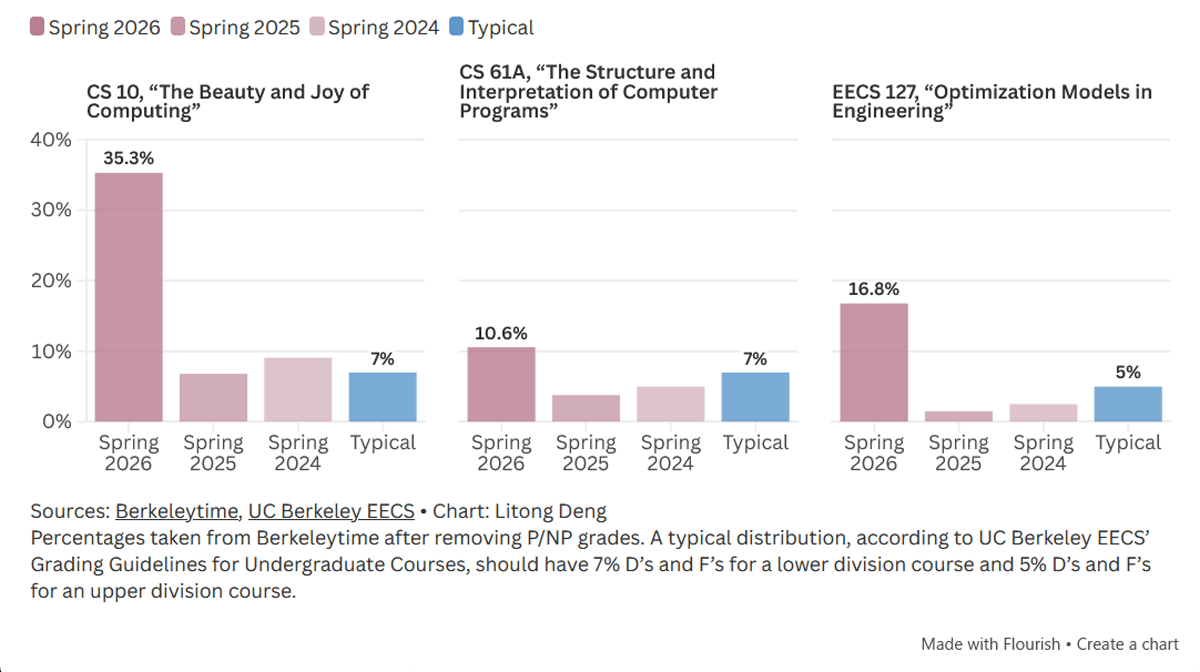
According to Berkeleytime , the University of California, Berkeley's online course search and planning platform, in the spring semester of 2026, 35.3% of students in the computer science course 'CS10: The Beauty and Joy of Computing' and 10.6% of students in 'CS61A: The Structure and Interpretation of Computer Programs' received an F grade (failure).
In the spring semesters of 2025 and 2024, the percentage of students receiving an F grade never exceeded 10% in either class. Furthermore, the grading guidelines for the Department of Electrical Engineering and Computer Science at the University of California, Berkeley, state that only 7% of students taking lower-level courses, including CS10 and CS61A, should receive a D or F grade. The guidelines suggest that the typical GPA for lower-level courses is in the range of 2.8 to 3.3, and the average GPA for CS10 and CS61A in the spring semester of 2026 was 2.3.
Professor Dan Garcia of the University of California, Berkeley, who taught CS10 and CS61A, believes the main reason for these unusually high failing rates is a 'significant increase in academic misconduct' due to students using AI models such as ChatGPT, Claude, and Gemini. According to Garcia, in the spring semester of CS10 in 2026, it was discovered that approximately 30 students had cheated on take-home exams.
Garcia stated, 'Among the students who failed, some were found to have cheated, were investigated, and referred to the student behavior center. However, in other cases, students relied too heavily on large-scale language models and were unprepared for the exam.'
Furthermore, Garcia's lectures employ absolute grading rather than relative grading, meaning that credits are awarded regardless of the number of students who exceed a certain standard. Garcia opposes limiting the number of students who receive an A grade according to a predetermined percentage, and argues that teachers should disclose the grading criteria in advance and guide students so that all students can achieve an A grade.

Garcia cited the increased use of AI as the reason for the surge in failing students, but also pointed out that a decline in students' basic mathematical skills is a problem. Associate Professor
The failing rate for EECS27 in the Spring 2026 semester, taught by Mr. Ranade, was 16.8%, far exceeding the 5% rate that the guidelines define as a typical D-F grade for advanced courses. The graph below shows the failing rates for CS10, CS61A, and EECS27 from left to right, and it is clear that the failing rate in Spring 2026 has increased sharply compared to Spring 2025, Spring 2024, and the typical failing rate.
EECS27 assumed that students had already taken courses in subjects such as linear algebra and vector calculus. However, when Ranade spoke to students during office hours , he learned that many students were struggling with linear algebra. One student even mentioned that in their university linear algebra classes, they were allowed to freely use the internet and AI.
On May 25, 2026, faculty members at the University of California published an open letter to the university administration and others regarding the education system. The letter, signed by more than 1,000 faculty members including Garcia and Ranade, calls for the re-establishment of the requirement for applicants to STEM majors to submit mathematics scores from the SAT and ACT, which are nationally standardized academic achievement tests, starting with the 2027 entrance examinations.
Ranade emphasized that professors in the age of AI will need to teach more, adding that students should acquire the critical and analytical thinking skills necessary to become leaders in a highly competitive world. 'We need to make sure our students are well-prepared to become outstanding citizens and leaders who can contribute to society in the future. They are Berkeley students, after all,' Ranade said.
Garcia said, 'I love the phrase my colleagues often use: 'Confusion is the sweat of learning.' I think it's a really great phrase. I think many students don't put in the sweat.'
Related Posts: