What are the challenges and difficulties of being a 'professional reader,' a rare profession that involves evaluating novels with a view to film adaptation?
Many avid readers have probably wondered, 'Is there any way I could make a living just by reading books?' Julian Levy, a New York-based writer, describes the work and struggles of Clark Speicher, a professional reader—a truly unusual profession.
Literary Hub » The Man Who Reads Books For a Living (One Every Two Days)
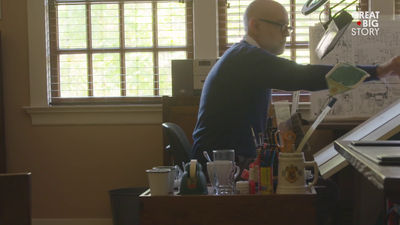
Speicher, who is in his mid-40s at the time of writing, reads novels that are sent to him with the intention of being made into films, and compiles reports evaluating them, such as 'what was good about this work' and 'whether this work would be successful as a film.'
Speicher receives manuscripts from people like novel agents, film company executives, and producers, and sometimes even first drafts full of typos and grammatical errors before publication. Speicher says, 'I'm probably one of the first people to read famous new books. That's exciting.'
After reading the submitted novels, Mr. Speicher writes out key elements such as main scenes, settings, conflicts, and characters, as well as a detailed synopsis, and also includes important lines and outstanding passages in his report. After that, Mr. Speicher takes a step back and evaluates 'what the work would be like if it were made into a film.'
When considering a film adaptation of a novel, the evaluation process involves assessing aspects such as 'which elements are inherently cinematic,' 'what can be visualized,' and 'which parts can be used as material for a film or drama.' In addition, factors such as the expected budget, target audience, potential star actors, past success of similar film adaptations, and basic feasibility are also included in the evaluation criteria.
What Speicher emphasizes is whether the book's basic idea can be expressed in a single sentence, and he says that if this point cannot be cleared, it is difficult to adapt it well into a film. Furthermore, Speicher argues that it is not always best to make a film that is faithful to the original work, and that sometimes it is necessary to cut out details from the original work and adapt it for the film in order to highlight the appealing elements of the work, and that this is what makes a film successful.
Then, Mr. Speicher makes a decision, such as whether the project should be shelved or whether it should be continued, and sends a report summarizing his findings to the client. Mr. Speicher's report serves as reference material for the film's producers and production staff, and is used as the basis for discussions about making the film. Mr. Speicher said, 'Not all executives can read every book. Everyone is busy and doesn't have time to read everything.'

Speicher, who was born and raised in Delaware, USA, originally wanted to become an entertainment journalist or film critic. 'I never imagined that reading books and turning them into movies would become my job. I didn't even know that such a job existed,' he says.
In 2000, while a student majoring in English literature, Speicher visited a local film festival for the university newspaper, where she met a film company executive and received an internship offer. Speicher jumped at the opportunity and moved to New York in 2002, where she began working as a production assistant at a major independent studio, reading and organizing piles of scripts.
However, because Speicher was an extremely fast reader, his job eventually became reading books that had the potential to be made into films rather than screenplays. Apparently, many of the books Speicher was made to read at the time were 'terrible horror novels,' but his reading speed, his knowledge of film, and his meticulous, uncompromising personality suited him well, and he eventually became the 'chief reader' for a major producer.
At a social gathering, Speicher was told by someone in the producer's development department, 'You are actually one of the most powerful people in Hollywood. That's because this producer's opinion is given the most weight, and you are one of the people who can offer him their opinion.'
In fact, when his production partner was enthusiastically pitching a book as a potential source material to a big-name producer, the producer would ask, 'What did you think of Clarke?' Apparently, if Speicher didn't like a book, the producer usually didn't like it either, and sometimes the project would just fall through. Speicher says, 'Even though I was the kind of person who struggled to pay my credit card bills, I secretly had a lot of power, and I didn't even realize it.'
As of the time of writing, this influential producer has fallen from power, and Mr. Speicher is working as a freelancer. According to Mr. Speicher, many production companies and film studios employ 'professional readers' who do similar work, but these professional readers rarely meet or interact with each other.
When you hear that 'a report on a book he reads becomes reference material for a film adaptation,' you might think that Mr. Speicher lives in a glamorous world. However, in reality, Mr. Speicher is a gig worker who makes a living by taking on a large amount of work, and he lives in a small apartment in the industrial area of Brooklyn , New York.
Levy met Speicher when Levy was working as a bartender, and Speicher was a customer at the bar, and they became friends. When Levy learned about Speicher's job, he initially thought, 'I'm so jealous that he can read books and write about books all day,' but his feelings changed as he learned more about the realities of the job.
When Speicher first met Levy, he was working for the aforementioned big-name producer, and apparently he would work from 8 pm to 11 pm almost every night, sometimes even until 1 am. On one occasion, a book of over 1000 pages would be delivered to him at 8 pm, and he had to finish reading it before work started the next morning.
Apparently, only big-name producers have offered him work like this, and at the time of writing, Speicher is able to work with plenty of time to spare, sometimes taking two days to read a single book. Even so, to make ends meet, he has to read six books a week, or about 300 books a year, and as a freelancer, he has no benefits or job security. His name never appears in the film credits, but he says he still feels proud when a novel he approved of being made into a movie is actually made.
Levy notes that Speicher has built a healthy relationship with a fortunate partner in recent years and seems happier than ever before. One day, Speicher's partner gifted him tickets to the 2025 film ' One Battle After Another, ' and he took the day off work to go see the movie with her.
In fact, Speicher had read Thomas Pynchon's novel ' Vineland, ' the basis for 'One Battle After Another,' for work and decided that 'I don't think this would work as a movie.' Nevertheless, Speicher listed 'One Battle After Another' as one of his favorite movies of 2025 and posted a photo on social media of himself sitting next to his partner in a movie theater lobby.
Related Posts: