California Governor signs executive order to prepare for job losses due to AI

California Governor Gavin Newsom has signed an executive order directing state agencies to develop policies to support workers, small businesses, and communities in preparation for the impact of AI on employment. The aim is to quickly identify the changes AI will bring to the labor market and to put in place mechanisms to respond to unemployment and job changes.
Newsom signs first-of-its-kind executive order to prepare workers and businesses for potential AI disruption | Governor of California
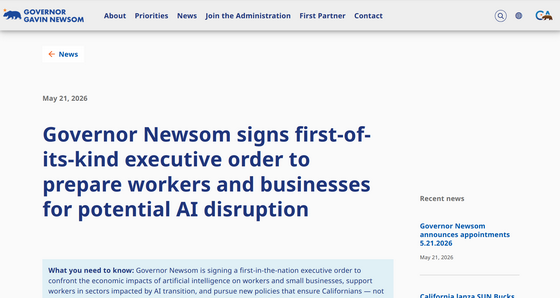
California governor addresses AI-related job losses
https://thehill.com/policy/technology/5889582-california-ai-job-losses/
Newsom executive order directs California to prepare for AI job disruption - CBS San Francisco
https://www.cbsnews.com/sanfrancisco/news/gavin-newsom-california-ai-job-disruption-executive-order/
This executive order calls for state agencies, labor experts, economists, universities, and industry stakeholders to collaborate in collecting data and developing policy recommendations to identify industries and workers potentially affected by the proliferation of AI. The order also considers compensation measures, including unemployment benefits, job placement assistance, vocational training, temporary employment support, and severance pay and stock options.
California plans to develop new reports to understand the impact of AI on the labor market, as well as dashboards to visualize the impact by industry. Furthermore, it will incorporate the impact of companies' hiring, salaries, and technology adoption on employment decisions into the state's monthly employment report, creating a system to detect potential layoffs and employment changes early.

Of particular interest is the review of California's Worker Adjustment and Retraining Notice (WARN) Act. This law is designed to provide advance notice of large-scale layoffs and business closures, but the new order requires that recommendations for amendments and updates be compiled within 180 days to make it function more effectively as an early warning system in the age of AI.
Governor Newsom stated that California 'wasn't just going to stand by and watch the future unfold,' emphasizing that instead of passively responding to AI-driven changes, the state needs to restructure the way we work, govern, and prepare for the future itself. The governor's office sees the order as part of a policy effort to 'extend the benefits of AI-generated wealth not only to big technology companies but also to the citizens of the state.'
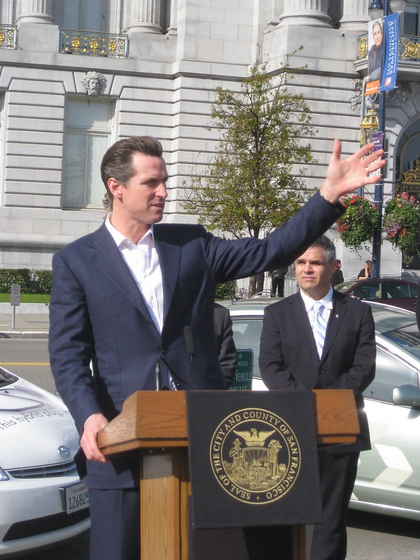
by Gavin Newsom
California is home to some of the world's leading AI companies, with 33 of the world's top 50 privately held AI companies based in the state, according to the state government. Against this backdrop of industrial concentration, the state has also taken the lead in implementing regulations and policies in areas such as AI safety, transparency, privacy protection, and consumer protection.
On the other hand, there are differing views on how much AI will actually take away jobs. The Hill, an overseas news media outlet, reports that 'while disruption to the labor market due to AI is widely expected, there is still limited economic data showing a large-scale impact, and there is a mix of pessimism and optimism among industry executives.'
The key point of this directive is not simply to regulate AI, but also to explore mechanisms that allow workers to share in the benefits of increased productivity. California is trying to address both job insecurity and economic growth in the age of AI through measures such as expanding employee-owned businesses, utilizing labor negotiations, providing AI training in higher education, and supporting small and medium-sized businesses in adopting AI.
Related Posts:








in AI, Posted by log1i_yk