Google and SpaceX are in discussions about a 'space data center'—will AI computing infrastructure move beyond Earth?

The Wall Street Journal has reported that Google and SpaceX are in talks to build a 'space data center' that will take AI computing processing outside of Earth. The discussions concern the use of SpaceX's launch capabilities in Google's space data center concept. As of the time of writing, there has been no formal contract announcement, and the report is based on information from sources close to the matter.
SpaceX and Google Are in Talks to Launch Data Centers in Orbit - WSJ
https://www.wsj.com/tech/spacex-google-in-talks-to-explore-data-centers-in-orbit-7b7799e2
Report: Google and SpaceX in talks to put data centers into orbit | TechCrunch
https://techcrunch.com/2026/05/12/report-google-and-spacex-in-talks-to-put-data-centers-into-orbit/
A space data center is a concept that involves mounting servers and specialized chips necessary for training and inference of AI models onto artificial satellites and operating them in low Earth orbit. Proponents argue that while ground-based data centers require large amounts of electricity, cooling water, and construction land, space allows for the long-term use of solar power and avoids opposition regarding land use on Earth. However, there are numerous challenges that differ from those on Earth, such as the manufacturing and launch costs of artificial satellites, radiation countermeasures, heat dissipation, and communication stability.
Google's central plan is 'Project Suncatcher.' In November 2025, Google announced a research concept to equip a constellation of solar-powered satellites with TPUs and connect them with optical communication links. TPUs are specialized chips that Google is developing for AI processing, and optical communication links are a system that uses lasers and other technologies to exchange data between satellites at high speed. According to Google, in the right orbit, the power generation efficiency of solar panels could be up to eight times that of Earth, and in the future, space may become a promising place to expand the AI computing infrastructure.
Google proposes 'Project Suncatcher,' a plan to launch satellites equipped with AI chips into space - GIGAZINE
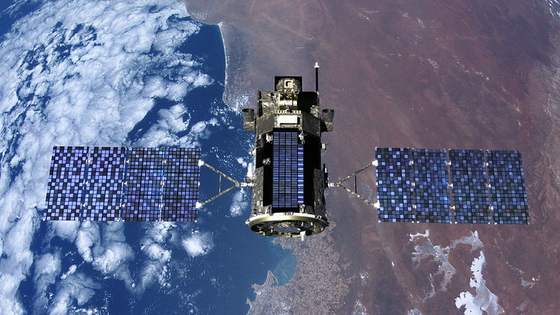
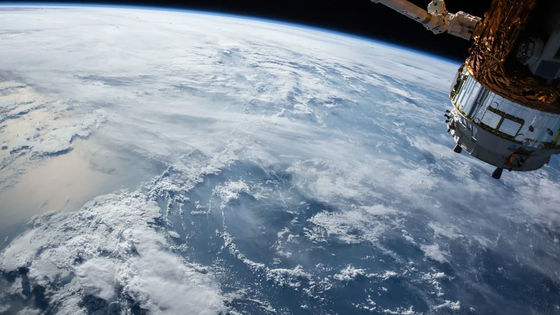
by NASA Goddard Space Flight Center
As an initial demonstration of Project Suncatcher, Google is collaborating with satellite imagery company Planet Labs to launch two test satellites by early 2027. The test satellites will verify how Google's machine learning models and TPUs operate in space and whether distributed AI processing is possible using optical communication links between satellites. In other words, rather than immediately building a massive space data center, the focus is on first confirming whether an AI computing infrastructure can run in space.
For SpaceX, the space data center project represents an expansion of its satellite operation capabilities, honed through rocket launches and Starlink, into the AI infrastructure market. According to TechCrunch, SpaceX has told investors that in the coming years, space will be the cheapest place to deploy AI computing infrastructure. Furthermore, SpaceX subsidiary xAI has signed a contract to provide computing resources from its 'Colossus 1' data center to AI company Anthropic, and the possibility of future collaboration on on-orbit data centers is also being discussed.
Anthropic announces partnership with SpaceX, raises restrictions on the use of Claude Code and APIs - GIGAZINE

However, it remains unclear whether space data centers will truly be cheaper than ground data centers. Google itself has indicated that if launch costs fall to less than $200 per kilogram by the mid-2030s, the launch and operating costs of space data centers will become roughly comparable to the electricity costs of ground data centers. Conversely, this also means that if launch costs do not fall sufficiently, the economic viability of space data centers will be difficult to achieve.
From a technical standpoint, Google explains that 'it is necessary to keep satellites flying at close range, within a few hundred meters to a few kilometers.' This is because AI processing requires the exchange of large amounts of data with low latency, and replicating performance in space that is close to server-to-server communication within a ground data center requires both satellite formation flight and ultra-high-speed communication. Furthermore, since electronic equipment is affected by radiation in low Earth orbit, Google says it has irradiated Trillium-generation TPUs with proton beams to test whether they can withstand space use.
Google is reportedly in talks not only with SpaceX but also with other rocket launch companies. For Google, the talks with SpaceX are one option for advancing Project Suncatcher, while for SpaceX, it is seen as a potential major project to extend its AI computing infrastructure into space. Google invested $900 million (approximately 142 billion yen) in SpaceX in 2015, so the relationship between the two companies has been ongoing for some time.
Related Posts:



in Hardware, Posted by log1d_ts