The reason the heart is less prone to cancer might be because it keeps beating steadily.

Cancer originating from the heart itself is extremely rare. This has been attributed to several factors, including the fact that adult heart cells divide very little, making DNA replication errors less likely, and that the heart is located deep within the chest, making it less susceptible to direct exposure to carcinogens. However, a study published on April 24, 2026, has newly suggested the possibility that the physical forces generated by the continuous beating of the heart may be preventing cancer cells from growing within the heart.
Mechanical load inhibits cancer growth in mouse and human hearts | Science
https://www.science.org/doi/10.1126/science.ads9412
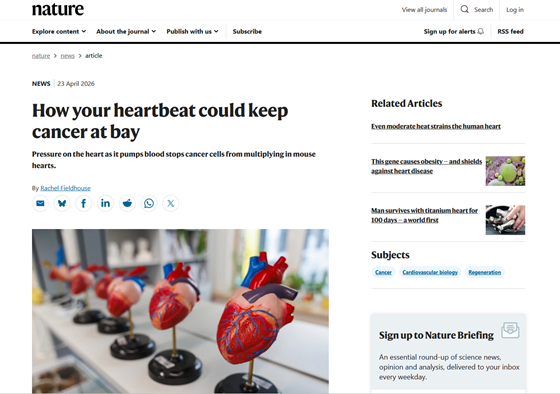
How your heartbeat could keep cancer at bay
https://www.nature.com/articles/d41586-026-01296-z
Heartbeat’s Mechanical Force Found to Suppress Tumor Growth – ICGEB
https://www.icgeb.org/heartbeats-mechanical-force-found-to-suppress-tumour-growth/
It is known that cancer rarely originates in the heart, and even when cancer that originates in another organ metastasizes to the heart, the lesions in the heart tend to be smaller than those in other organs. However, the detailed reasons why cancerous tumors do not easily grow in the heart were not understood.
Therefore, a research team from the International Center for Genetic Engineering and Biotechnology (ICGEB) , the University of Trieste in Italy, and the Monzino Heart Center , a specialized cardiovascular research hospital in Milan, focused on the fact that 'the heart is constantly beating.' Every time the heart pumps blood, it contracts and expands, and each time it is subjected to physical forces such as pressure and deformation. The research team hypothesized that these forces might make it difficult for cancer cells in the heart tissue to grow, and proceeded with their research.
The research team first used genetically modified mice to investigate whether tumors would develop in the heart when cancer-causing genetic changes were introduced. The results showed that even with strong cancer-promoting changes, tumors were less likely to develop in the heart, indicating that the heart has high resistance to cancer.

Furthermore, the research team created an experimental model in which a donor heart was transplanted into the neck of another mouse to reduce only the physical forces acting on the heart. Blood still flows through this transplanted heart, but because it does not have the role of pumping blood throughout the body like a normal heart, the stress from pressure and deformation associated with beating is reduced.
In this state, human cancer cells were directly injected into the myocardium of mice and transplanted into the neck of another mouse, reducing the physical load on the heart. The growth of cancer cells was then compared between the heart that was in its original position and beating normally. The results showed that tumor cells proliferated more easily in the heart with reduced physical load, while the proliferation of various cancer cells was consistently suppressed in the normally beating heart.
Furthermore, the research team reported that when they conducted similar experiments with artificial heart tissue created in the laboratory, which allows for adjustment of the physical load on the heart tissue, tumor growth slowed down when the heart tissue was beating and receiving physical load, but cancer cells proliferated again when the physical stimulation decreased.
Regarding these results, Serena Zaquinha of ICGEB, who led the research team, said, 'This finding suggests that the heart's beating may not only serve to pump blood, but also have a natural function in suppressing tumor growth.' Zaquinha also explained that the reason the heart is a difficult place for cancer cells to proliferate may be related not only to immunity and metabolism, but also to the fact that the heart is constantly beating.

The study also shows that the physical force from the heartbeat is not simply crushing cancer cells. According to the research team, this force is transmitted inside the cancer cells and alters how genes function. The central role in this process is played by Nesprin-2, a protein that is part of the LINC complex , a structure that connects the outside of the cell to the nucleus, and transmits physical stimuli received from the outside of the cell to the nucleus .
According to the research team, physical changes such as pressure and deformation occurring within the heart are transmitted to the nucleus of cancer cells via Nesprin-2. This then alters the state of chromatin and the way methyl groups, which are chemical markers attached to histones , are attached. The research team believes that these changes make it more difficult for genes involved in tumor cell proliferation to function.
The research team actually weakened the activity of Nesprin-2 in cancer cells, and found that the cancer cells were able to grow more easily even in a normally beating heart, forming tumors. In other words, the physical force from the heartbeat may be transmitted to the nucleus of cancer cells via Nesprin-2, making it more difficult for cancer cells to grow.
To investigate whether these experimental results could be observed in human cardiac metastases, the research team also analyzed human cardiac metastasis samples. By comparing 'lesions that had metastasized to the heart' with 'lesions that had developed in other organs' within the same patient's body, they found that patterns similar to those observed in experimental models such as mice were also confirmed in the human samples.
However, this study did not demonstrate that 'increasing heart rate can prevent cancer,' nor did it present a method that can be immediately used as a new treatment. The ICGEB explained that 'while this may potentially lead to treatments that use physical stimulation to suppress the growth of cancer cells in the future, it is still unknown whether it can be used as an actual treatment.'
Related Posts:






in Science, Posted by log1b_ok