In the United States, the world's most powerful economy, national happiness levels are at a record low. What are the reasons behind this?

Sam Peltzman, an economist at the University of Chicago, published a paper stating that 'the happiness level of Americans has been declining sharply since 2020.' Following the paper, Derek Thompson, a writer for The
The Happiness Crash of 2020 by Sam Peltzman :: SSRN
https://papers.ssrn.com/sol3/papers.cfm?abstract_id=6465460
If America's So Rich, How'd It Get So Sad?
https://www.derekthompson.org/p/if-americas-so-rich-howd-it-get-so
Peltzman analyzed data from the General Social Survey and revealed that self-reported happiness levels among Americans suddenly and sharply declined in 2020 and did not recover until 2024. The following shows the difference between those who answered 'happy' and those who answered 'not very happy' in the survey. Up until 2018, the percentage of people who answered 'happy' was about 20% higher, but in 2020, the percentage of those who answered 'not very happy' surpassed the percentage of those who answered 'happy,' and the difference has remained at around 5% since then.
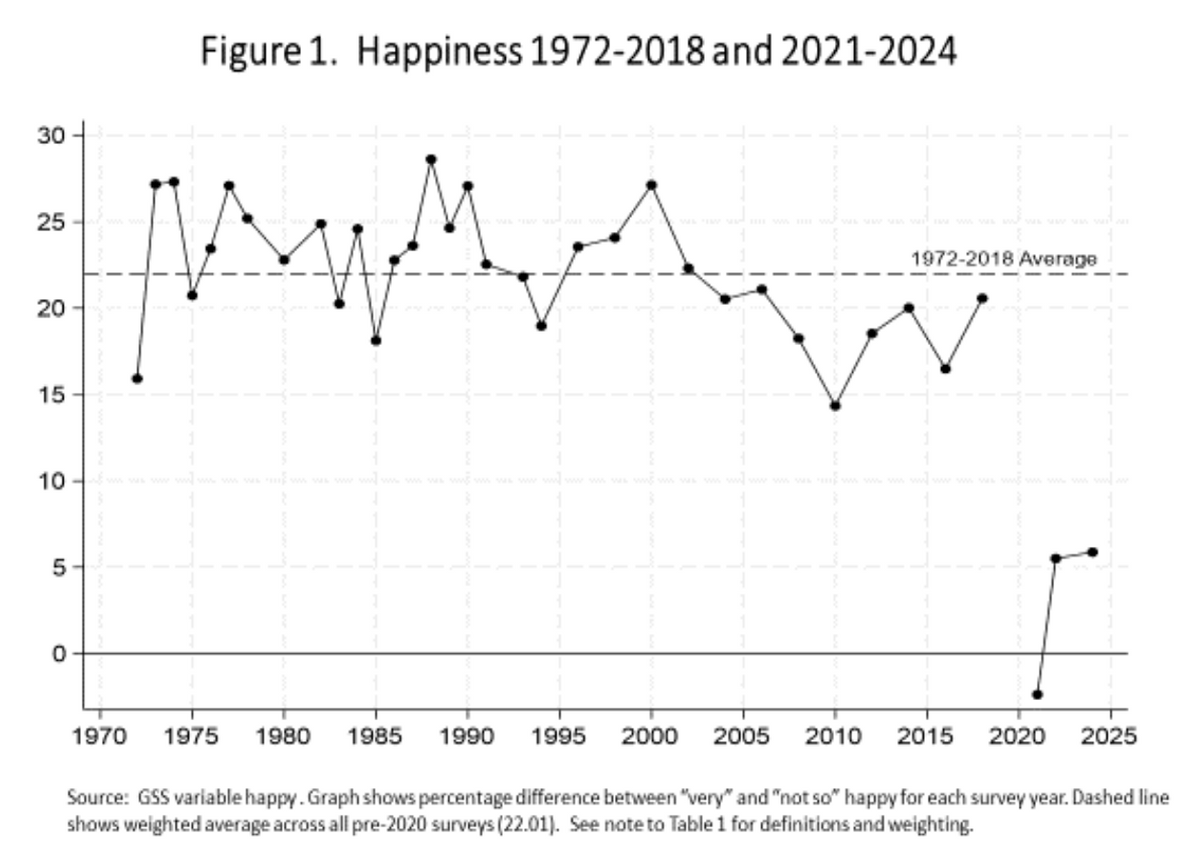
In addition to Peltzman's research, various studies indicate a decline in American well-being, such as the Federal Reserve's Worker Satisfaction Index, which was released in 2026 and hit its lowest level since the survey began in 2014, and the University of Michigan Economic Survey's Consumer Confidence Index, which hit a new record low.
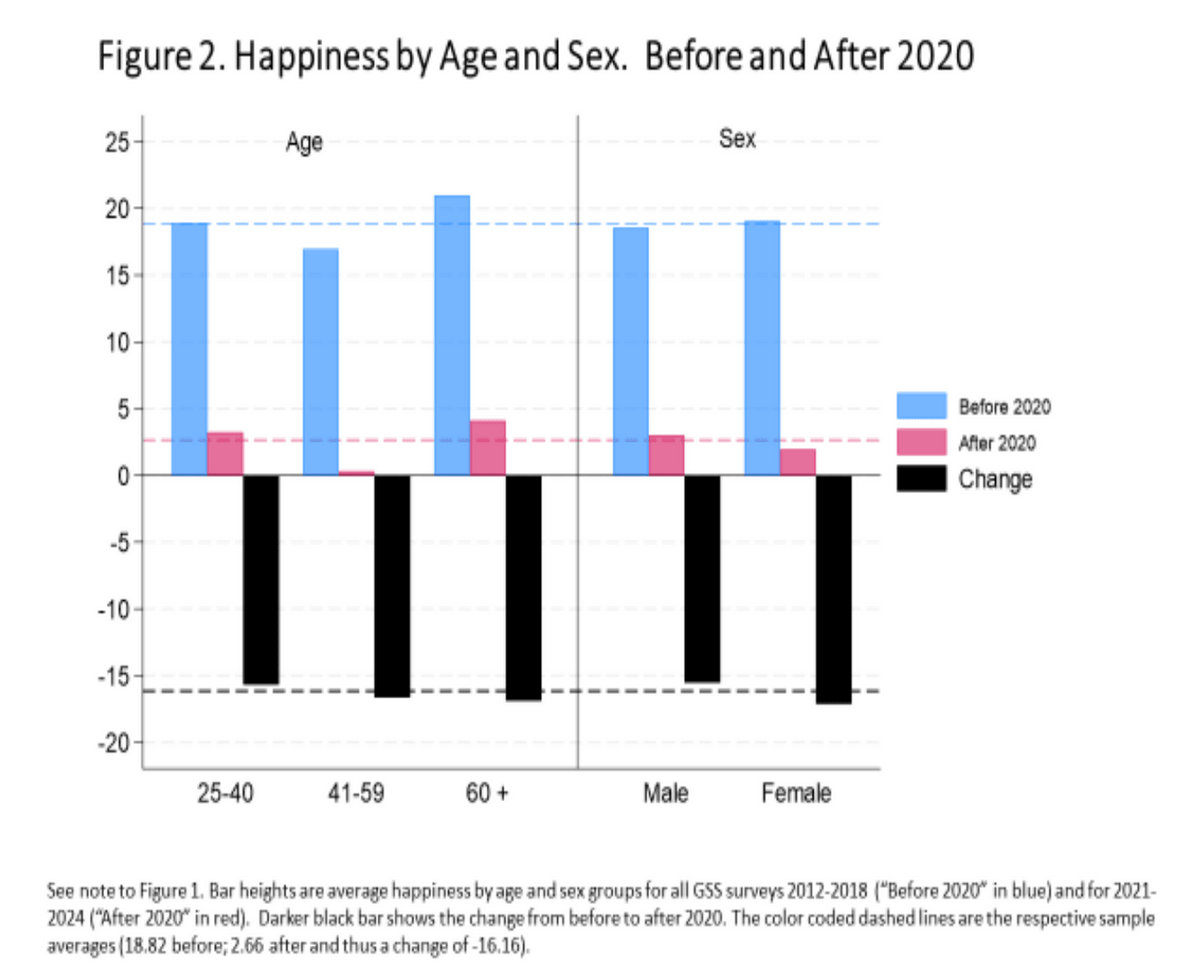
In his paper, Peltzman examines the differences in happiness levels when the population is divided into various categories. The figure below shows the differences when divided by age and gender, and it can be seen that happiness levels have decreased by about 15 points since 2020 in every category.
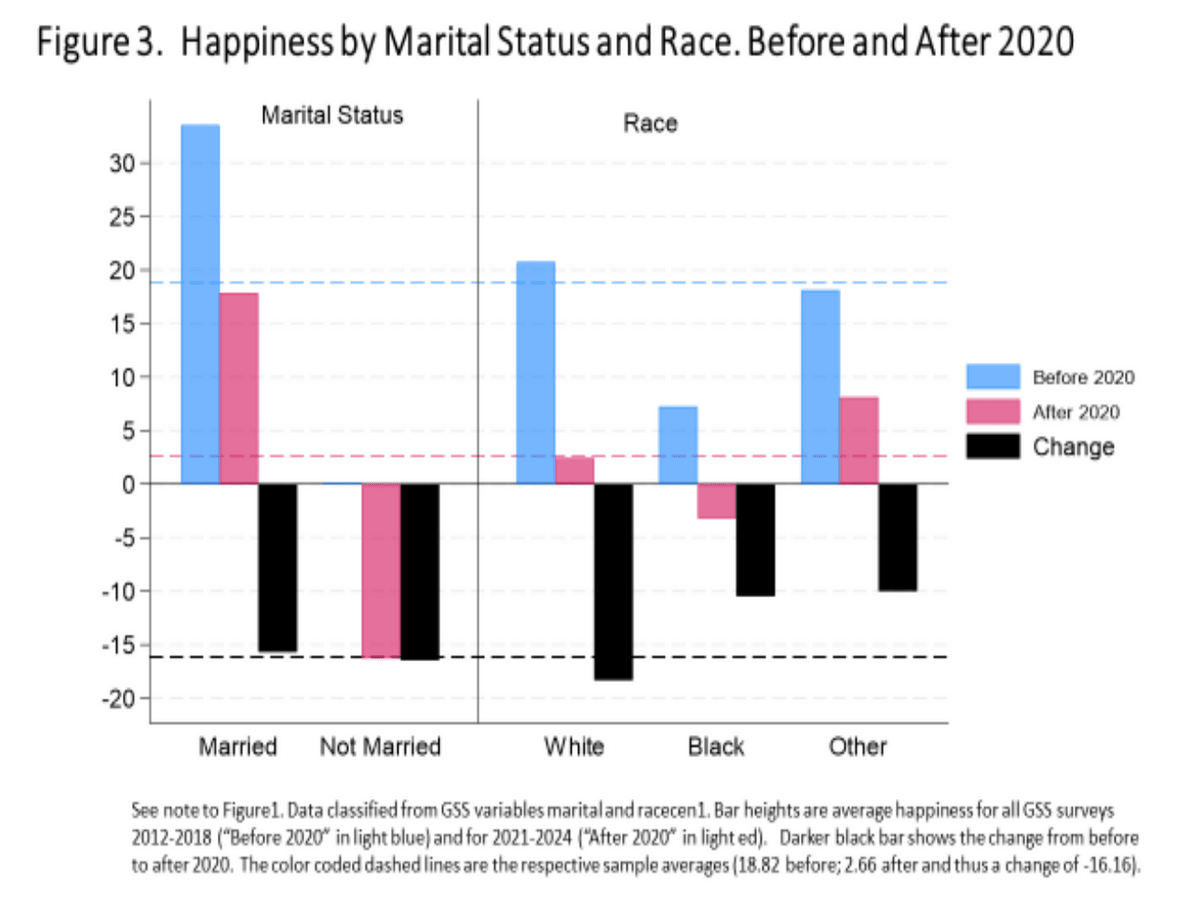
Furthermore, happiness levels showed a similar decline regardless of marital status. While the decline was particularly large among white people, Black people and others also experienced a decrease of more than 10 points.
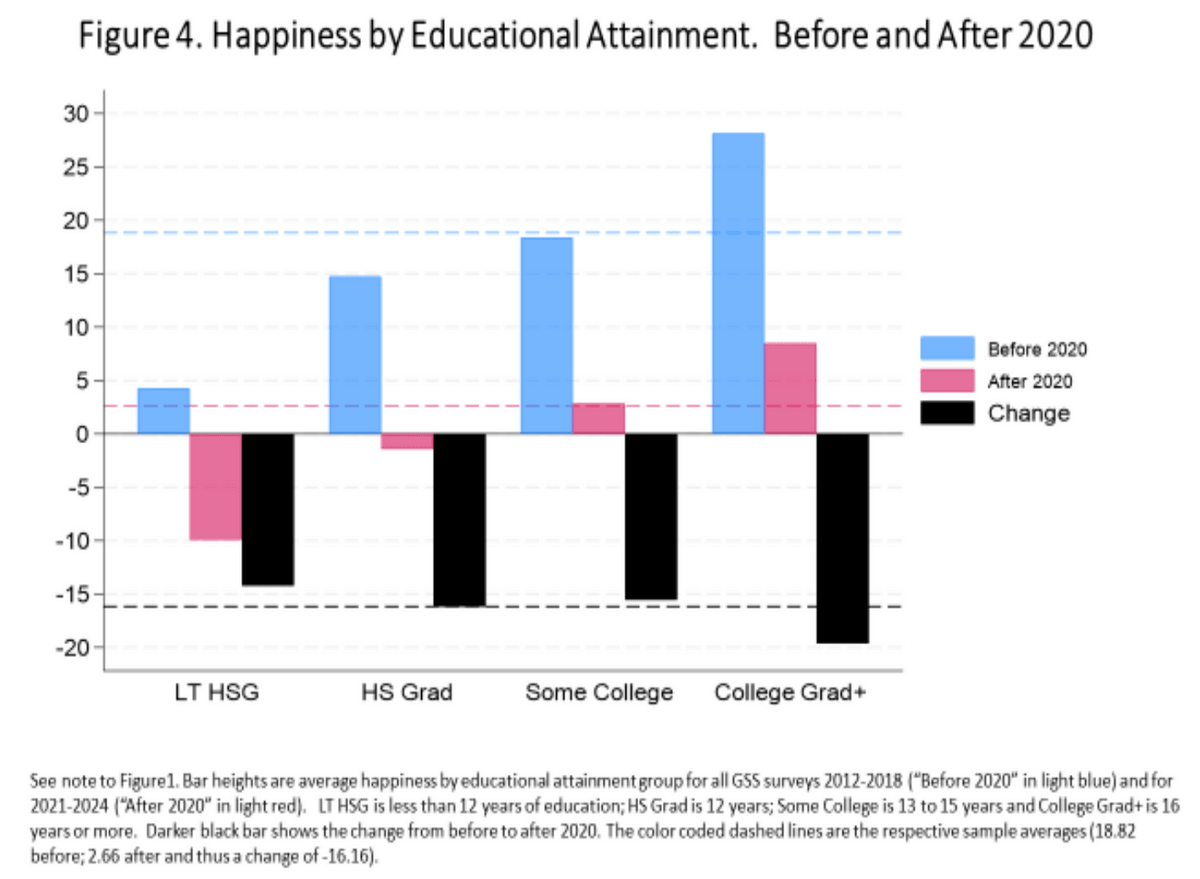
While there may be some differences, educational background is irrelevant.
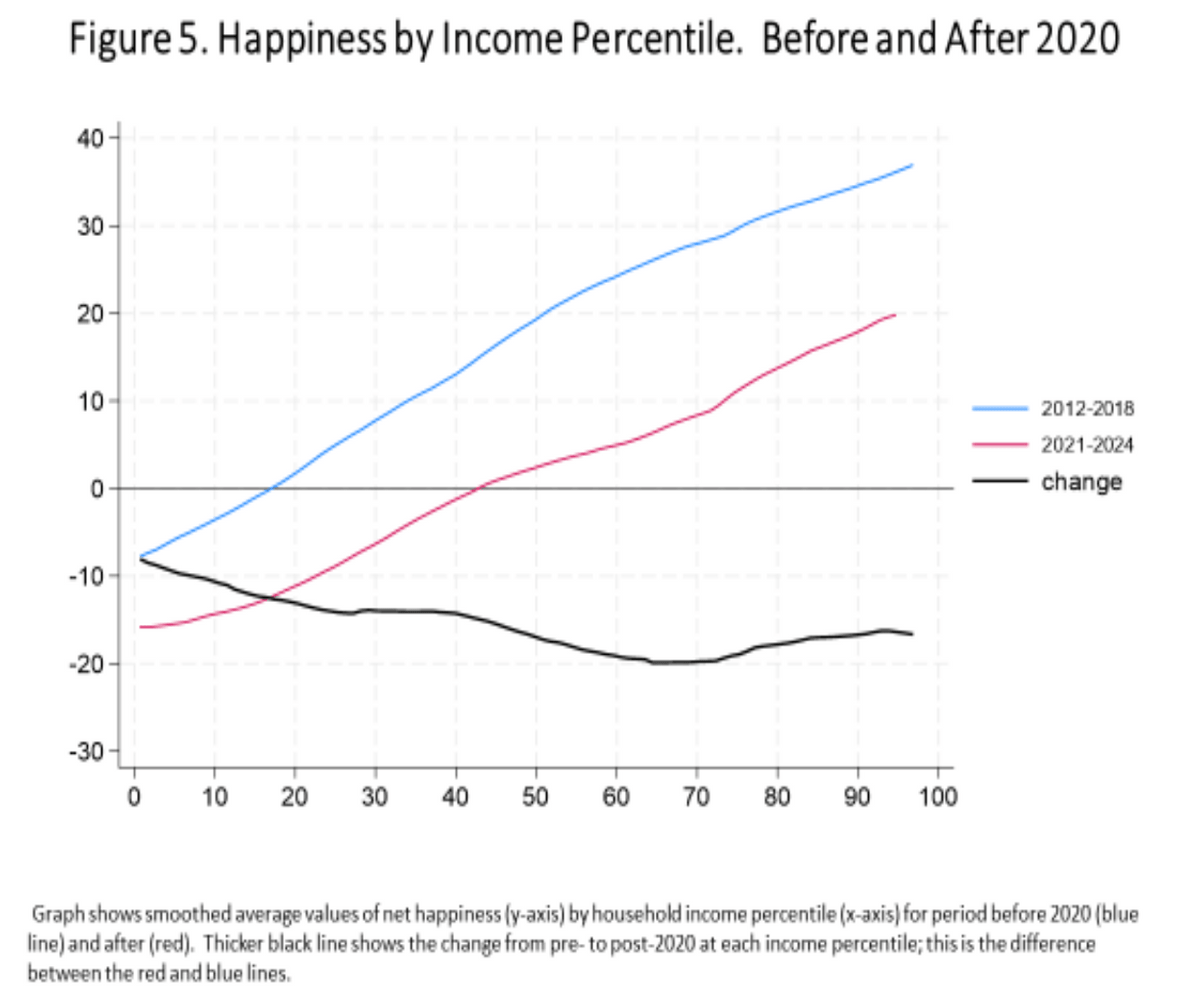
While the decline in happiness is greater with higher income, even the lowest-income group experiences a decrease of approximately 10 points in happiness.
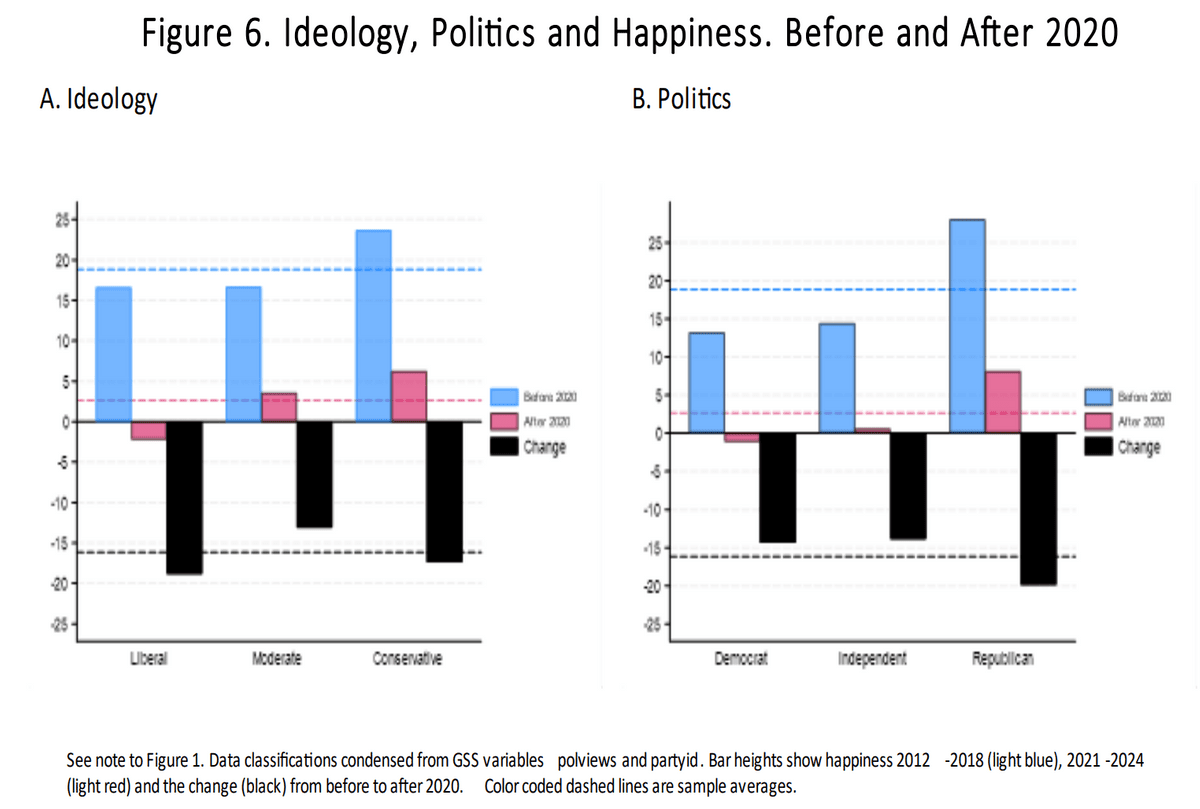
Even when categorized by ideology or political stance, all groups showed a similar decline in happiness levels.
Thompson cites three factors as to why this 'uniform decline in happiness across all households' occurred despite favorable economic conditions such as low unemployment and rising wages.
◆1: Sustained inflation
From 2007 to 2020, the Consumer Price Index (CPI) rose by 25% over 13 years, but from 2020 to 2025, it rose by another 25% over the same five-year period. When people suddenly experience inflation three times higher than usual after having previously experienced low inflation rates, it can feel like everything they want to buy is constantly out of their reach.
Furthermore, the strong economic conditions and abundant employment have led to rising wages in previously low-paying jobs, while the rapid increase in prices for services such as childcare and elder care, which traditionally relied on low-wage workers to maintain their prices, has reportedly increased dissatisfaction, particularly among middle- and high-income households.
◆2: Distrust of others and accelerating loneliness
Surveys conducted in the 1970s and 1980s showed that the majority of people trusted others when asked, 'Do you think most people would try to take advantage of you if given the chance, or would treat you fairly?' While trust in others remained relatively high in subsequent surveys, it has reportedly plummeted since 2020. Furthermore, trust in organizations such as governments and corporations has also declined rapidly.
Since the outbreak of the coronavirus pandemic, many people have been spending more time alone than ever before, and their interactions with others are mediated by on-screen algorithms. Jay van Babel, a psychologist at New York University, points out that 'online conversations tend to value negative opinions and hostility towards outsiders, thus turning people into adversaries.'

◆3: A series of crises
Following a once-in-a-century pandemic, not only has hyperinflation continued, but wars have broken out one after another in Ukraine, Gaza, Lebanon, Iran, and the Persian Gulf. Furthermore, within the United States, political conflicts are deepening over whether Donald Trump is a 'symbol of the coming of fascism' or a 'savior who has appeared to rescue traditional values from the demonic calamity of the left.'
The news has become extremely serious, and according to a news sentiment analysis conducted by the Brookings Institution in 2024, news from 2018 to 2020 was reported in a more negative tone than the actual indicators suggest, and from 2021 onwards, it has been reported in an even more negative tone relative to the indicators.
The pessimism in news reporting reflects an era of successive crises, while simultaneously giving people the impression that they are 'always on the brink of crisis.' 'Even after the COVID-19 pandemic subsided, people still have a lingering sense that the world is in the midst of a state of emergency,' Thompson analyzed.
Related Posts:






in Note, Posted by log1d_ts