YouTube expands the use of its similarity detection technology to prevent celebrities from having their image rights misused in deepfakes and other means.
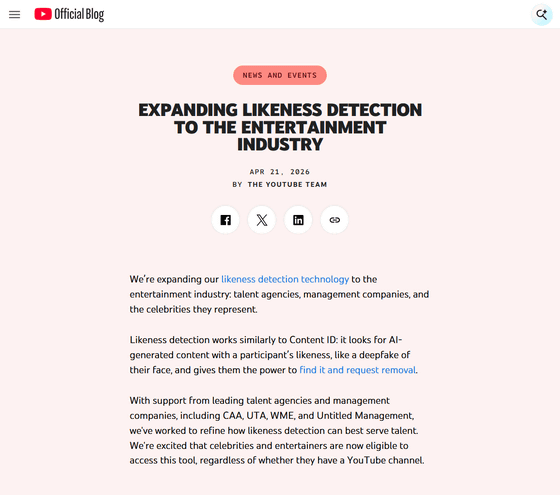
YouTube has announced it will expand its similarity detection technology to the entertainment industry.
Expanding likeness detection to the entertainment industry
https://blog.youtube/news-and-events/youtube-likeness-detection-ai-protection/
YouTube Opens Up AI Deepfake Detection Tool to All of Hollywood
https://www.hollywoodreporter.com/business/digital/youtube-ai-deepfake-detection-tool-1236569593/
Celebrities will be able to find and request removal of AI deepfakes on YouTube | The Verge
https://www.theverge.com/ai-artificial-intelligence/915872/celebrities-will-be-able-to-find-and-request-removal-of-ai-deepfakes-on-youtube
YouTube expands AI deepfake detection to Hollywood's biggest stars
https://www.androidpolice.com/youtube-expands-likeness-detection-to-entertainment-industry/
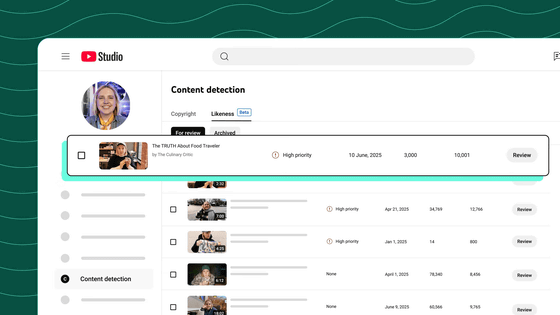
Similarity detection works in a similar way to Content ID . Users have the right to search for AI-generated content that resembles them, such as deepfakes of their own faces, and to request its removal if found.
YouTube has reportedly been working with major talent agencies and others to improve its similarity detection technology to make it optimal for its talent. Now, YouTube has announced that celebrities and entertainers can use this similarity detection technology, regardless of whether they have a YouTube channel or not.
A YouTube executive told The Hollywood Reporter that the similarity detection technology will be available to anyone at high risk of having their image misused. 'Actors, athletes, creators, musicians, and others—whether they have a YouTube channel or not—can register to identify and request the removal of deepfakes on the platform.'
YouTube CEO Mary Ellen Coe said, 'We've been working on this issue since we first started considering AI tools and their impact on the platform. Frankly, we still don't even know what the potential impacts might be. That's why we're working closely with talent agencies and third-party management companies to be proactive before something bad happens to celebrities.'
YouTube has been testing its similarity detection technology since 2024. Initially, it was offered to popular creators on YouTube, but in early 2026, its use was expanded to include some politicians and government officials. Now, its use has been expanded to the entire entertainment industry.
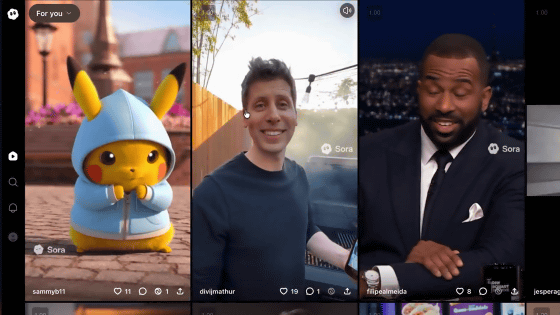
Furthermore, deepfakes have caused significant problems in the entertainment industry multiple times in less than a year. The first instance was at the end of September 2025 when OpenAI released Sora 2, which was criticized for its ability to generate anime and manga characters that are supposed to be protected by copyright.
CEO Sam Altman promises to improve the situation where character videos are being created excessively using the video generation AI 'Sora 2,' specifically mentioning Japanese content and suggesting revenue sharing for rights holders - GIGAZINE
The second instance occurred in February 2026 when ByteDance released its video generation AI, Seedance 2.0. Seedance 2.0 drew fierce criticism from Hollywood for its ability to easily generate copyright-infringing videos, such as 'a video of Tom Cruise and Brad Pitt fighting.'
ByteDance has reportedly postponed the global launch of its video generation AI 'Seedance 2.0' due to copyright issues - GIGAZINE
While the similarity detection technology is available to anyone who is a celebrity, YouTube does not guarantee that a video will be removed just because a removal request has been made. CEO Koh explained, 'There are many cases where parody and satire are permitted to remain on the platform under our community guidelines.' However, videos containing 'realistic and serious defamation,' and more importantly, videos containing 'content replacement,' will be removed upon request.
CEO Koh explained, 'If someone is duplicating content in a way that literally replaces it, threatening the livelihood of a celebrity, actor, or creator, then it will be removed.' However, The Hollywood Reporter pointed out that there are still some ambiguities regarding what will be removed, stating, 'For example, it's somewhat unclear whether this applies to fan-made movie trailers.'
One prominent YouTube creator told The Hollywood Reporter that 'most of the content generated by AI is harmless, and is rather positive and favorable.'
Related Posts:


in AI, Web Service, Posted by logu_ii