A new cause of high blood pressure has been identified, potentially leading to new treatments.

Hypertension is one of the leading causes of heart disease and stroke, but much about its pathogenesis remains unclear. However, new research has suggested that specific brain regions may be involved in some cases of hypertension, and has even discovered the possibility of a new treatment method utilizing this mechanism.
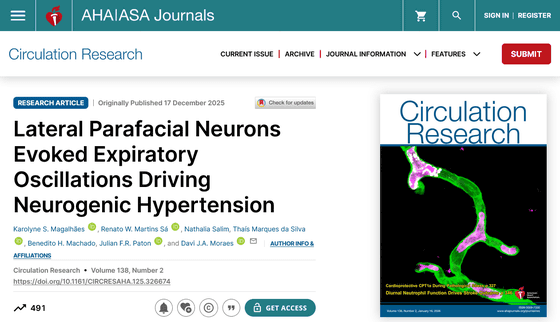
Lateral Parafacial Neurons Evoked Expiratory Oscillations Driving Neurogenic Hypertension | Circulation Research
Scientists May Have Found a New Cause of High Blood Pressure, And a Way to Treat It : ScienceAlert
https://www.sciencealert.com/scientists-may-have-found-a-new-cause-of-high-blood-pressure-and-a-way-to-treat-it
A research team from the University of São Paulo in Brazil and the University of Auckland in New Zealand has concluded that excessive activity of the sympathetic nervous system is a contributing factor to hypertension. In particular, they suggest that a brain region called the 'lateral parafacial area (pFL),' which is involved in respiratory control related to the forceful, intentional exhalation that occurs during exercise, coughing, and laughter, may explain why blood pressure remains uncontrolled even when taking antihypertensive medication.
Therefore, researchers used gene optics techniques in experiments with rats to switch pFL neurons on and off, and monitored respiration-related neural activity, sympathetic nervous system activity, blood pressure, and other parameters.
The experiment confirmed that activating pFL neurons in rats also activated other brain circuits, ultimately leading to increased blood pressure. The researchers then meticulously mapped brainstem and nerve activity, identifying other neurons that pFLs communicate with and comparing their measurements to those of control rats without hypertension. This led them to conclude that 'pFL neurons in hypertensive rats not only assist respiration but also constrict blood vessels.'
According to the researchers, a combination of respiratory control and vascular signaling may, in some cases, cause hypertension. In other words, when pFL, which is involved in respiration, is activated, blood vessels constrict, and as a result, blood pressure rises. This study demonstrated a link between the respiratory system and hypertension, and is thought to explain, to some extent, the conventional understanding that 'people with sleep apnea syndrome are also at high risk of hypertension.'
Julian Paton, a physiologist at the University of Auckland and co-author of the paper, explained, 'We found that certain brain regions are activated when hypertension is present. When our team inhibited the activation of this region, blood pressure dropped to normal levels. Our goal is to identify the region that can control pFL and improve hypertension without using drugs that penetrate the brain.' This also suggests the possibility of a new therapeutic pathway utilizing pFL neurons.

It should be noted that this study used only animal models, so even though there is a reasonable possibility that the same neural circuits are involved in humans, it is unclear whether the research findings are applicable to humans.
Another challenge is the development of drugs that target specific pFL neurons without interfering with other nerve cells. Instead of directly controlling brain regions with drugs, targeting carotid bodies—clusters of tiny, sensor-like cells in the neck—is expected to be a more limited and safer treatment for hypertension.
Related Posts:







in Free Member, Science, Posted by log1e_dh