What is the scientific method for consistently making delicious espresso every time?
While everyone has their own definition of what makes a good coffee, baristas around the world are constantly experimenting and refining their recipes. A paper on modeling 'liquid permeability,' a crucial factor in
A model for the permeability of coffee pucks validated using X-ray computed micro-tomography | Royal Society Open Science | The Royal Society
https://royalsocietypublishing.org/rsos/article/13/4/252031/481206/A-model-for-the-permeability-of-coffee-pucks
A new equation may help baristas produce the perfect espresso shot every time
https://phys.org/news/2026-04-equation-baristas-espresso-shot.html
Espresso is characterized by being made using a dedicated espresso machine. Finely ground coffee is packed into a filter, and hot water under pressure is passed through it to extract the coffee's components. In this process, the speed at which the liquid passes through the coffee grounds within a certain time (permeability) determines the contact time between the hot water and the coffee grounds, which in turn affects the extraction of soluble components such as caffeine.
Baristas aim for the right liquid permeability by adjusting factors such as the grind size (particle size) of the coffee beans and the amount of beans packed into the filter to create a delicious espresso. However, until now, there has been no general-purpose model that predicts how permeability changes depending on the particle size and amount of coffee beans.
In this study, a research team from the University of Munich in Germany and other institutions modeled the permeability of espresso by examining the powder at a microscopic level. Generally, it is believed that the finer the grind, the narrower the pores between the particles through which the liquid flows, resulting in slower liquid flow, while the coarser the grind, the larger the pores, resulting in faster liquid flow.
The experiment used roasted Rwandan and Colombian coffee beans, ground into 11 different particle sizes from extra-fine to coarse, and packed into small plastic tubes. Subsequently, a 3D digital map of the internal structure of the coffee grounds was created using X-ray micro-CT, and digital flow rate tests were performed to identify areas where the liquid flowed and areas where it stagnated.
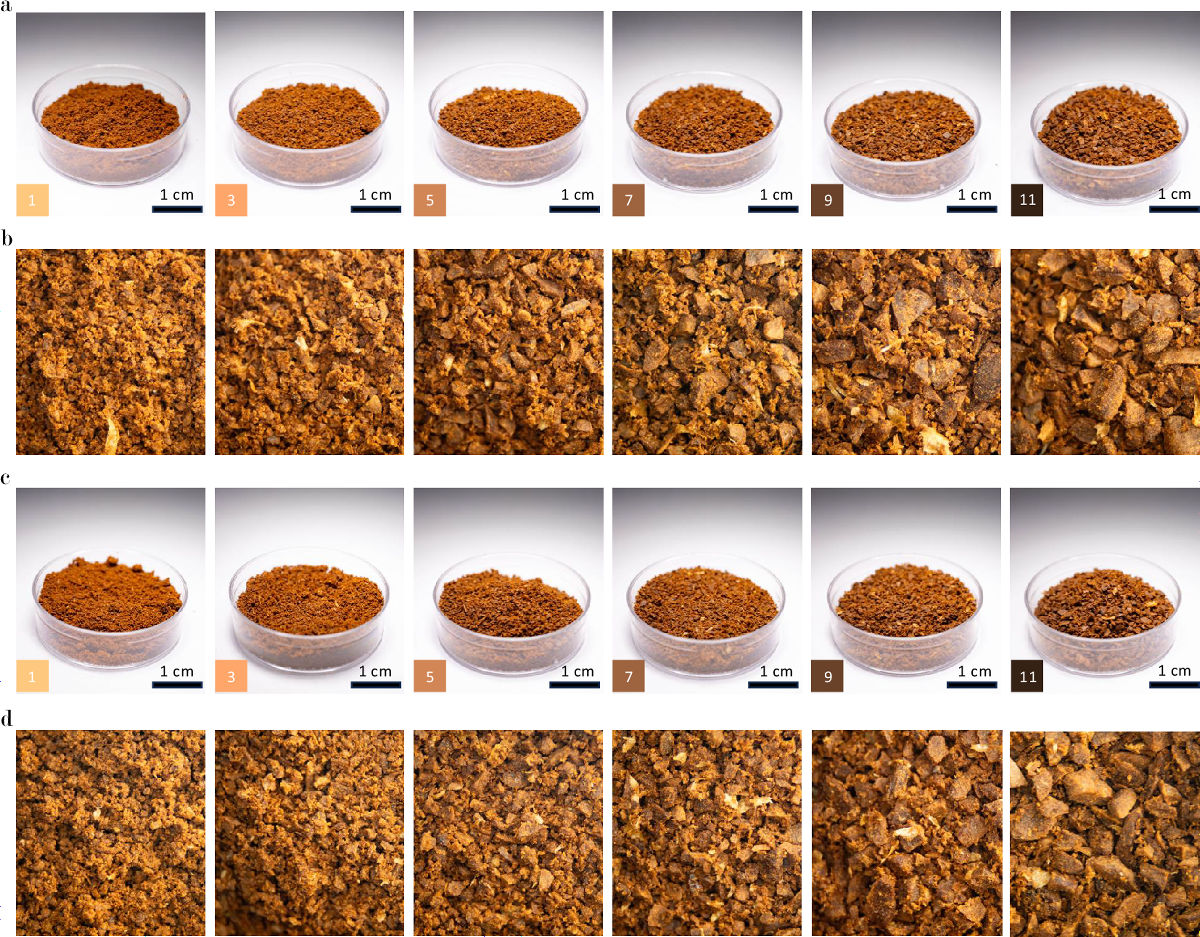
The images below show ground coffee beans from Rwanda (a and b) and Colombia (c and d). Images a and c were taken from a distance, while images b and d were taken at close range, showing the individual coffee particles. The grind becomes coarser from left to right; the leftmost image shows almost entirely powdered coffee, while the rightmost image shows many larger particles remaining.
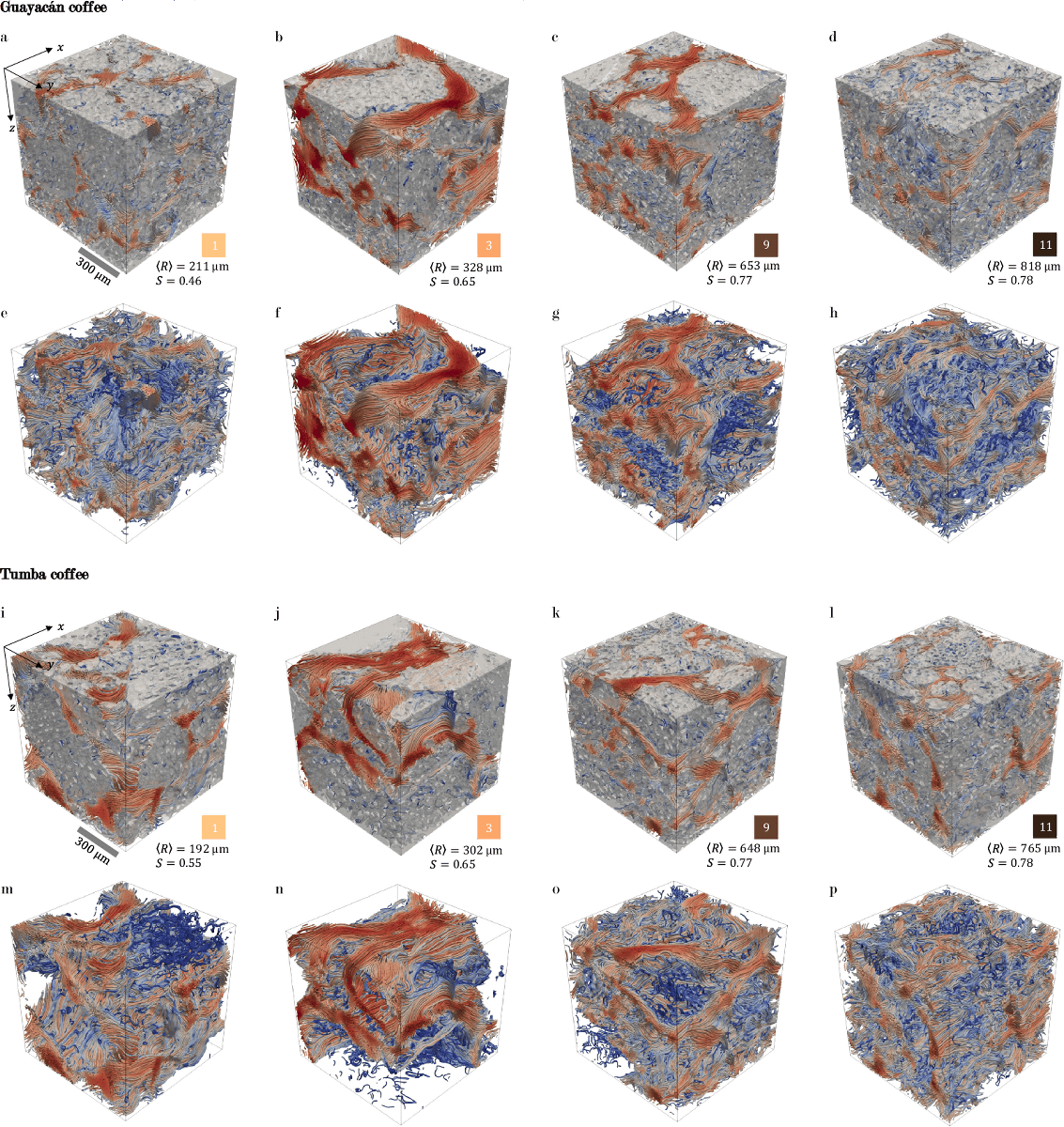
Below is a 3D digital map of coffee grounds created. a-h represents coffee from Colombia, and i-p represents coffee from Rwanda. The slower the speed of the liquid passing through each ground, the more it is shown in red, and the faster it is shown in blue. a-d and i-l retain 50% of the solid portion, while e-h and m-p have had the solid portion removed. The particle size of the coffee grounds increases from left to right.
The experiment revealed an equation indicating that the permeability of liquid through coffee grounds primarily depends on the amount of interconnected pores, the surface area of the grounds, the average particle size, and how tightly the beans are packed. Overall, the finer the grind, the lower the permeability, but ultimately, it is determined by multiple factors included in the equation.
Grinding coffee beans too finely reduces their permeability, while using too much grounds makes it difficult to control the flavor, potentially leading to inconsistencies. The research team explains that grinding the beans a little coarser and using a smaller amount results in a more consistent quality espresso.
However, the changes caused by the beans becoming wet remain unclear, and the research team states in their paper that 'our model indicates that intensive investigation is needed into particle expansion and its possibilities.'
Phys.org, a science media outlet that reported on the study, stated, 'While this research is unlikely to change how baristas brew coffee overnight, it could help us more accurately predict how the grind size of the beans and how they are packed into the filter affect the coffee flow.'
Related Posts: