Maintaining a regular bedtime reduces the risk of cardiovascular disease.

A study by the University of Oulu in Finland found that people who maintain a regular bedtime have half the risk of cardiovascular disease compared to those who do not.
Sleep timing irregularity in midlife: association with incident major adverse cardiac events and cardiovascular disease mortality over a 10-year follow-up | BMC Cardiovascular Disorders | Springer Nature Link
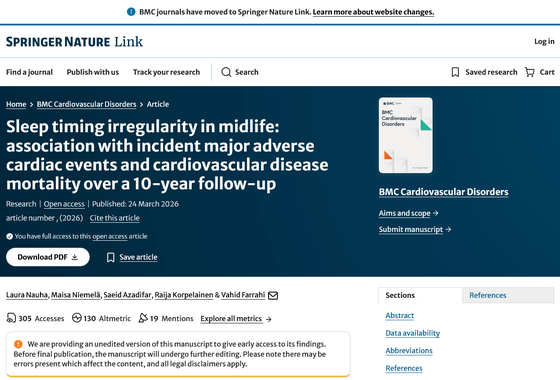
Irregular bedtime linked to higher risk of cardiac events | University of Oulu
One Sleep Habit Could Boost Your Heart Health, Study Suggests : ScienceAlert
https://www.sciencealert.com/sticking-to-the-same-bedtime-each-night-could-help-lower-heart-health-risk
Laura Nauha and colleagues at the University of Oulu conducted a 10-year follow-up study on participants in a health survey conducted from 2013 to 2014. All participants were born in Finland in 1966, totaling 3,231 people, 39.5% of whom were male.
Sleep timing was measured using wearable devices, and based on the 7-day standard deviation of three values—bedtime, wake-up time, and midpoint of sleep (exactly halfway between bedtime and wake-up)—student sleep patterns were classified into three groups: 'regular,' 'fairly regular,' and 'irregular.'
The study revealed that 128 participants, or 4% of the total, experienced a serious cardiovascular event during the study period. When compared to sleep patterns, those with irregular sleep patterns had a higher risk of developing the condition than those with regular sleep patterns. This association was only observed in participants whose sleep duration was shorter than the median sleep duration for their group.
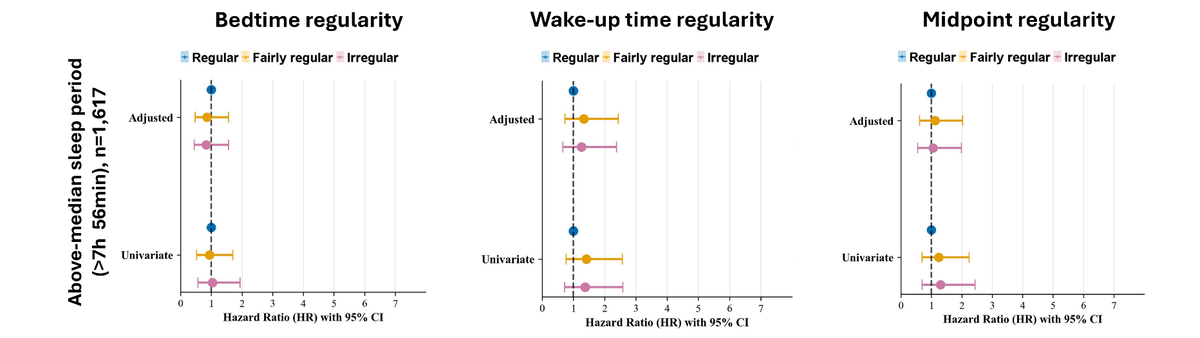
The following graphs show the risk of developing cardiovascular disease for subjects with 'regular' (blue), 'fairly regular' (yellow), and 'irregular' (purple) sleep patterns, broken down by deviations in sleep duration (left), wake-up time (center), and midpoint of sleep (right). No association was observed for the 1617 subjects whose sleep duration was longer than 7 hours and 56 minutes.
However, among the 1,614 participants whose sleep duration was 7 hours and 56 minutes or less, the risk was shown to be higher for those with 'fairly regular' and 'irregular' sleep patterns compared to those with 'regular' sleep patterns. In particular, those with 'irregular' sleep patterns had more than twice the risk of developing the condition compared to those with 'regular' sleep patterns.
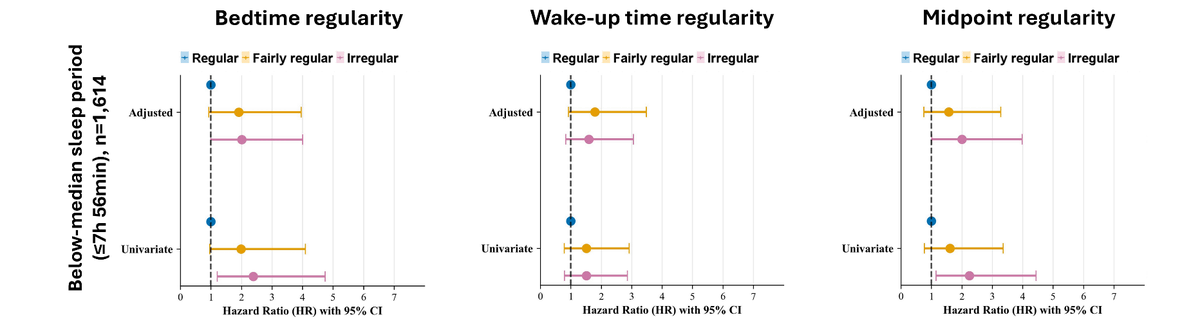
Regarding these results, Nauha stated, 'The regularity of bedtime and the degree to which daily rhythms fluctuate may be important for heart health,' adding that maintaining a regular sleep pattern is one of the factors that can be controlled among the habits that shape heart health.
While some studies have shown that people who sleep for 9 hours or more have a 14% higher risk of death compared to those who sleep for 7-8 hours, this doesn't necessarily mean that 'sleeping for a long time is unhealthy.' Rather, it suggests that 'increased sleep duration may be due to health problems.'

Related Posts:








in Science, Posted by logc_nt