Utsunomiya University in Japan has announced that it has become the first university in the world to demonstrate that a 'ceramide deficiency' in the skin can be a cause of atopic dermatitis.

A research team at Utsunomiya University in Japan has announced that they have for the first time in the world demonstrated that a deficiency of ceramide , a type of stratum corneum lipid, may be a cause of atopic dermatitis. This research is expected to advance research into the treatment and prevention of atopic dermatitis.
Acid ceramidase overactivity drives ceramide loss, leading to atopic dry skin and Th2‐skewed immune polarization - Takada - The Journal of Pathology - Wiley Online Library
https://pathsocjournals.onlinelibrary.wiley.com/doi/10.1002/path.70050
[Press Release] World's First Demonstration that Skin 'Ceramide Deficiency' is a Direct Cause of Atopic Dermatitis | Topics | Utsunomiya University
https://www.utsunomiya-u.ac.jp/topics/research/013613.php
It was previously known that patients with atopic dermatitis have reduced levels of ceramides in their skin, but it was unclear whether 'reduced ceramide levels cause atopic dermatitis' or 'atopic dermatitis causes a decrease in ceramide levels in the skin.'
Ceramides are a type of lipid that plays a role in retaining moisture on the skin's surface and preventing external stimuli and the intrusion of foreign substances. This study showed in mice that a deficiency of ceramides on the skin's surface alone can lead to a condition similar to atopic dermatitis, characterized by dryness and increased sensitivity to irritation.
The research team created mice in which an enzyme called acidic ceramidase was made more active in the upper layers of the epidermis, thereby incorporating a mechanism to reduce ceramide on the skin's surface. They compared these mice with normal mice and investigated how much moisture escaped from the skin, how much moisture was retained, changes in the appearance and tissue of the skin, the amount of lipids on the skin's surface, and even the likelihood of allergic reactions. The mice were mainly analyzed from 3 weeks of age onward, and experiments involving repeated application of mite antigens were also conducted.
As a result, unlike normal mice (top), ceramide-deficient mice (bottom) had dry skin from a very early age, and by 3 weeks of age, even at a stage where no clear inflammation was visible, they continued to have dry skin accompanied by fine desquamation. Furthermore, it was confirmed that the amount of water escaping from the skin increased, and indicators of moisture retention decreased, indicating that both the skin's barrier function and water retention function were impaired. On the other hand, there was no significant difference in the thickness of the epidermis itself at 3 weeks of age, indicating that the functional abnormality occurred first.
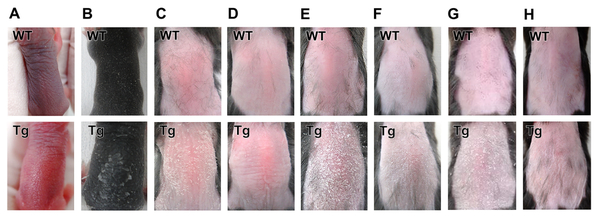
A closer examination of the cause revealed that mice with increased activity of acidic ceramidase, which breaks down ceramides, actually had a significantly reduced amount of ceramide on the skin surface. This suggests that the decrease in ceramide on the skin surface made the skin unable to retain moisture and more susceptible to external stimuli. Furthermore, changes were observed in the extension of nerves thought to be related to itching, indicating that a condition similar to atopic dermatitis was being created before noticeable inflammation appeared.
Furthermore, the research team repeatedly applied mite antigens to the weakened skin of ceramide-deficient mice. They found that redness and swelling, which were hardly observed in normal mice (top), became noticeably apparent in ceramide-deficient mice (bottom). In particular, the skin of the ears thickened, IgE levels, which are involved in allergic reactions, increased, and clusters of eosinophils, commonly seen in allergic inflammation, were also observed.
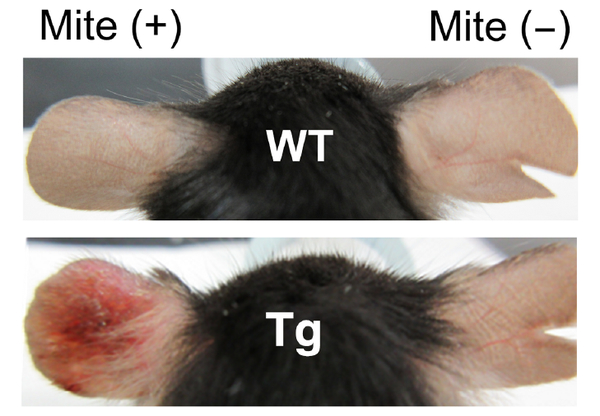
Furthermore, an increase in inflammation-related molecules, which tend to increase in atopic dermatitis, was found in the skin, suggesting that skin weakened by ceramide deficiency becomes more hypersensitive to allergens.
The research team believes that these results suggest that a deficiency of ceramides on the skin surface not only causes dryness, but also weakens the skin's defenses, creating a foundation for itching and allergic inflammation. In that sense, they consider this mouse model to be useful for investigating the mechanisms of atopic dermatitis.
However, the research team also explained that the mechanism by which ceramide levels decreased in these mice is not exactly the same as the mechanism assumed to occur in human atopic dermatitis. Nevertheless, they argued that the significance of this study lies in its ability to isolate and demonstrate what effects the decrease in ceramide itself has on the skin.
Related Posts:







in Science, Posted by log1i_yk