A study revealed that the 'AI-generated summaries' displayed in Google search results contain tens of millions of false statements every hour.
When you perform a Google search, an AI-generated answer appears at the top of the search results page under the heading 'AI Summary.' The New York Times investigated the accuracy of this 'AI Summary' and reported its findings.
How Accurate Are Google's AI Overviews? - The New York Times
Testing suggests Google's AI Overviews tell millions of lies per hour - Ars Technica
https://arstechnica.com/google/2026/04/analysis-finds-google-ai-overviews-is-wrong-10-percent-of-the-time/
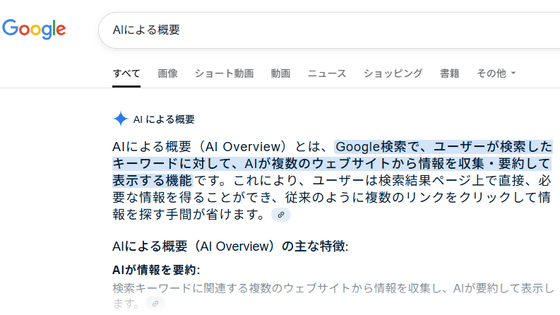
In May 2024, Google implemented the 'AI Summary' feature, which includes AI-generated answers on Google Search results pages. This feature was rolled out to Japan in August of the same year, and to over 100 countries and regions in October.
Google's AI-powered 'AI Summary,' which provides an easy-to-understand overview of search results, finally supports Japanese - GIGAZINE

Instead of having to open each page in the search results and summarize the information yourself, the AI summarizes the information for you, making it highly convenient. Links to the information sources are also displayed, so if you need more detailed information, you can go and do further research yourself.
However, even if a source is displayed, the information shown in the 'AI summary' is not necessarily accurate, and there have been cases where people have searched for their own name and found a summary stating that they were dead.
A report from GIGAZINE states that when someone searches for their own name on Google, the 'AI summary' returns 'a person who died 10 years ago' - GIGAZINE

The New York Times collaborated with Oumi, a startup that develops AI models, to investigate how accurate Google Search's 'AI-generated summary' is. Oumi used SimpleQA, a common test for evaluating the accuracy of generative models released by OpenAI in 2024, to verify the accuracy of the 'AI-generated summary.'
The investigation revealed that when Gemini 2.5 was used to generate the 'AI-generated summary,' the accuracy rate was 85%. Although the accuracy rate increased when the internal model was updated to Gemini 3, it was still only 91%. In other words, a simple calculation shows that for every 10 searches, an incorrect 'AI-generated summary' would be displayed.
The New York Times noted that Google searches exceed 5 trillion times a year, stating, 'If the accuracy rate is 90%, that means tens of millions of false summaries are displayed every hour.'

Google, in response to a New York Times investigation, stated that 'SimpleQA contains misinformation and does not reflect what people are actually searching for on Google.'
In terms of the accuracy of AI output, even newer models released in 2026, such as the 'Gemini 3.1 Pro Preview' and 'Claude Opus 4.6,' often only achieve 50% to 75% , so 90% is undoubtedly a very high figure. While it's good that 'AI summaries' improve their accuracy by using web search tools, the New York Times warns that 'AI summaries' can also be intentionally manipulated, such as by 'creating websites that claim to be experts and having the AI present them as experts.'
The news site Ars Technica, which covered this issue, stated, 'Many people have probably seen AI outputting incorrect information. In fact, Google has issued a warning to verify the accuracy of its content.'
Related Posts:





in AI, Posted by log1d_ts